



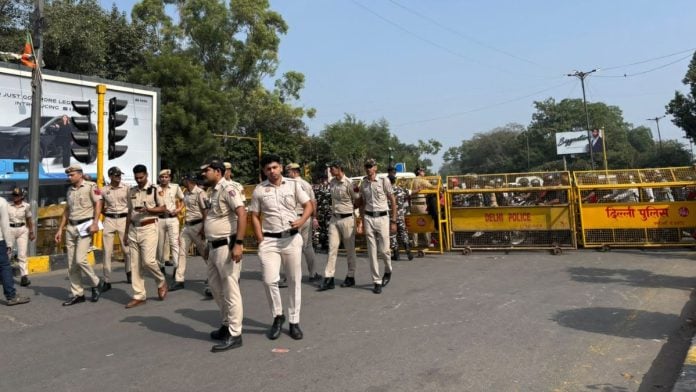
New Delhi: The Supreme Court Sunday ordered the restoration of all services related to metros, trains, internet and movement of people in the national capital in accordance with law. Detentions, except legal, have also been barred with respect to peaceful and unarmed people beyond the area where Section 163 of Bharatiya Nagarik Suraksha Sanhita (which deals with emergency powers to maintain public order) is imposed.
A special bench of justices J. Bagchi and V. Mohana, after hearing a group of senior advocates flagging restrictions on movement and illegal detentions for over two hours, passed the order for restoration of rights in accordance with law. The bench also issued notice on a plea filed alleging contempt of the top court’s Friday order—all contemnors were directed to file their responses.
On Friday, a bench of Chief Justice of India (CJI) Surya Kant and justices J. Bagchi and V. Mohana had advised the central government and Delhi Police to not to follow “use a hammer to kill a fly” principle, noting that there cannot be complete prohibition of traffic movement, or stoppage of trains and closure of metro stations in anticipation of a potential law and order problem.
Importantly, Solicitor General Tushar Mehta, appearing for the central government, told the court that all metro, train and internet services are back to normal as per the law and order situation.
Also Read: ‘Will create our own Jantar Mantar’: Mini protests spring up at detention centres & on Delhi roads
Next hearing Tuesday
The bench was hearing two petitions today—one is the contempt petition, filed over the closure of multiple Metro stations and the cancellation of trains ahead of a planned protest Saturday against CEC Gyanesh Kumar; and a habeas corpus petition filed by senior advocate Menaka Guruswamy against the detention of political leaders.
Among many others, senior advocates Kapil Sibal, Shadan Farasat, N. Hariharan, and Gopal Sankarnarayan mentioned that the SC’s Friday order had been “willfully and deliberately not followed”. During the arguments, Menaka Guruswamy drew parallels between the law and order situation of the city with the Emergency.
The court’s order Sunday is an interim order, with the next hearing scheduled Tuesday.
Pronouncing the order, Justice Bagchi took note of the urgent applications on the violation of the SC’s earlier order and alleging illegal detentions in large numbers in Delhi on 10 October.
“Everyone brought to our notice there was flagrant violation of our directions passed on Friday; metro railway was not functional; New Delhi and Nizamuddin railway station remained closed, no traffic advisory was issued, and a large number of people were subjected to undue harassment. It was also contended that the internet was shut down and the city held a curfew-like situation,” he noted.
In the habeas corpus petition, advocate Guruswamy also noted that the detentions were not restricted to political personalities but involved widespread illegal detention of 7,000 people.
The court also recorded Mehta’s submissions. “Mehta orally denies and disputes such contentions and contends that the Delhi Metro was functioning normally. Only 45 out of 303 stations were closed,” the court noted.
Accordingly, the court ordered:
- Metro and rail facilities shall function normally until and unless regulations are required to be imposed keeping in mind disturbance to the public under.
- Free movement of people in the city shall be permitted subject to traffic regulations; requirement of imposition of barricades shall be reviewed keeping in mind public order.
- Internet facilities shall remain undisturbed.
- Smooth movement of people in the city shall be permitted in accordance with law.
- There shall not be detention, except legal, save and except by procedure established by law with respect to peaceful and unarmed people beyond the area where BNSS 163 is imposed.
Who said what on Emergency & Delhi protests
The two-hour-long hearing started with a group of senior advocates apprising the court of the situation in Delhi—from illegal detentions, internet shutdowns, violence on lawyers and even willful disobedience of the top Court’s Friday order.
Importantly, Solicitor General Tushar Mehta, appearing for the central government, told the court that all metro, train and internet services have been back to normal.
From the start, senior advocate and former Attorney General for India KK Venugopal mentioned that he is seeking issuance of contempt on SC’s Friday order.
He told the bench that his former junior was picked up by the police, taken in a bus and dropped 11 kms away – not being able to access the court. “Multiple violations. No badge. She was picked up and dropped away,” he said.
Then senior advocate Kapil Sibal thanked the bench for hearing the matter on a Sunday. Justice Bagchi responded by saying “we are always at the service of the nation”.
Senior advocate Shadan Farasat told the court, “I was also brutalised yesterday, along with a large number of lawyers”.
The question, however, is larger than just lawyers’ issue, he said. “Yesterday, the situation in the city was such that nobody was allowed to stand, yesterday we were one step away from a police state, people should be allowed to peacefully protest.”
Then, senior advocate Gopal Sankarnarayan highlighted how practising lawyers have “lost their right” to even move around in the city. He also mentioned how senior advocates Dinesh Dwivedi and Shadan Farasat were detained in a bus, far away from Jantar Mantar and the videos on record show there was no proportionality as people standing in a crowd have been picked up without any reason.
“I just have to highlight the important points because I must tell Your Lordships, this is something which actually has brought a lot of emotions among a lot of us because we have found how close it has come to our doorstep,” Sankarnarayan said.
Supreme Court Advocates-on-Record Association President Devvrat also sought relief regarding AORs, members and former members.
Senior advocate Sanjay Hegde stated “This Court operates through Advocates-on-Record. Access to justice is also access to lawyers. If lawyers are prevented from doing their duties, it is this court’s dignity which is directly impacted. Today, the Solicitor General is here. He is the leader of the Bar. He has to ensure that every lawyer in this city can access his clients, provide justice right at the police station”.
Senior advocate Menaka Guruswamy addressed the court relating to her petition. She said, “It’s not just that the State is in contempt of Your Lordships’ earlier order, whereby the metro stations have not been opened. It is not just as if the State has not disconnected the internet. It is not just that by disrupting the metro service, you take away my ability to move, transport, etc. It is not just that 7,000 people are reported to have been detained, with the State not providing anyone any official numbers…. What has happened is that young people have taken to lawful protests, which the Constitution recognises, to peacefully assemble and protest because they feel that the election system is not fair”.
“The Constitution says in Article 358 that Article 19 rights can be restricted only in the case when an Emergency is imposed. So is the State saying to us that they have brought in an unimposed Emergency?”, she added.
This is an updated version of the report
Edited by Sunanda Ranjan
Also Read: Detained CJP legal head alleges wrongful confinement, moves court amid protests against CEC