



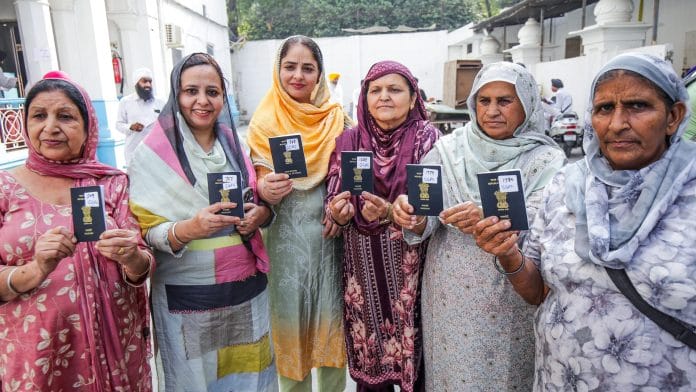
New Delhi: The Ministry of External Affairs’ clarification this week that the passport is not a conclusive proof of citizenship has led to a flurry of debates and confusion over what constitutes proof of identity and citizenship.
The ministry said Wednesday that an Indian passport, despite being issued by the Government of India after extensive scrutiny, is fundamentally a travel document rather than conclusive proof of citizenship.
The clarification came amid questions about whether passport holders excluded from electoral rolls during the ongoing Special Intensive Revision (SIR) of voter lists in several states could rely on their passports to establish their citizenship.
For decades, the passport has been viewed as the Republic’s most authoritative identity document. It is accepted by governments across the world, and is issued only after police verification and multiple layers of official scrutiny. For many citizens, the suggestion that it is not definitive proof of citizenship seemed paradoxical.
However, the government’s position is correct legally. The difference remains in how Indian law views citizenship versus documentation for foreign travel.
Passports are issued under the Passports Act of 1967 in India. Citizenship is governed by the Citizenship Act of 1955. A passport does not confer citizenship, nor does it legally settle disputes over citizenship if that status is challenged before a court. Instead, judges examine the provisions of the Citizenship Act alongside documentary evidence, such as birth records, parentage, domicile and other official documents.
“A passport does not create citizenship. Nor is it the legal instrument that finally determines citizenship if that status is challenged before a court. Like many democracies, India distinguishes between citizenship law and passport law. In rare cases involving fraud, disputed parentage or illegal acquisition, citizenship may have to be established through the provisions of the Citizenship Act and supporting evidence. That is why a passport is not regarded in law as conclusive proof in every conceivable circumstance,” former foreign secretary Nirupama Menon Rao wrote on X.
Issued only after the Government of India determines that an applicant is entitled to it, the passport remains the strongest official evidence of Indian nationality that most citizens will ever possess. But only in ordinary circumstances.
Citizen or not?
Foreign immigration authorities do not independently investigate whether every Indian passport holder is truly a citizen. They accept the document trusting that the Indian government has verified the holder’s nationality before issuing it. Internationally, an Indian passport continues to function as the country’s formal guarantee that the bearer travels under Indian nationality.
While a passport establishes that an individual is travelling under the protection and nationality of a particular state, citizenship is a legal status acquired through birth, descent, registration or naturalisation under domestic law.
If there are cases involving fake documents, disputed parentage, fake applications or mismatched records, the courts determine whether one is a citizen of the country not based on whether you have a passport, but by examining your records under the Citizenship Act.
Legally, Section 6 of Passports Act gives the government the authority to refuse passports to non-citizens, proving that only Indian citizens can hold Indian passports. But Section 20 of the Act also allows it to issue travel documents to non-Indians, in case of exceptional circumstances in public interest.
“Notwithstanding anything contained in the foregoing provisions relating to issue of a passport or travel document, the Central Government may issue, or cause to be issued, a passport or travel document to a person who is not a citizen of India if that Government is of the opinion that it is necessary so to do in the public interest,” Section 20 of the Passports Act reads.
In 2023, the Madras High Court directed the Union Government to consider issuing an Indian passport under Section 20 of the Passports Act, 1967 to a legally stateless woman born in India to Sri Lankan refugee parents.
The court held that the Centre has the power to issue passports or travel documents in the “public interest,” even to non-citizens, noting that the petitioner’s parents had fled persecution in Sri Lanka and had been living in a refugee camp in Tamil Nadu.
Since the law allows for rare exceptions even for non-Indians, a passport does not establish citizenship.
Why the public concern?
The ministry’s statement does not diminish the value of an Indian passport. It merely restates a longstanding legal distinction between a document issued under passport law and citizenship determined under citizenship law. For most Indians, the distinction will never matter.
The problem essentially remains that, unlike many countries, India does not have a universal citizenship certificate. Citizenship is established through multiple official documents like birth certificates, school records and voter IDs, among others. Amid the Citizenship (Amendment) Act of 2019, the National Register of Citizens and now the SIR exercise, public anxiety around citizenship documents have risen.
India’s civil registration system evolved unevenly over decades. Millions of older Indians were born when birth registration was incomplete, while inconsistencies in names, dates of birth and family records remain common across official documents.
The National Register of Citizens exercise in Assam demonstrated how gaps in documentation can leave even long-settled residents struggling to establish citizenship, Rao argued in her post as well.
Against that backdrop, any suggestion that a passport is not definitive proof of citizenship inevitably generates public concern, even if the underlying legal principle has existed for decades.
“The lesson, therefore, is not that passports have somehow lost their value. It is that India needs stronger and more comprehensive civil registration, universal birth registration and reliable archival records so that citizenship can never become hostage to missing or inconsistent paperwork,” Rao said.
(Edited by Niyati Kothiyal)
if passport is not proof of citizenship then why are Indians required to surrender their Indian Passport if they aquire citizenship of some other country.