





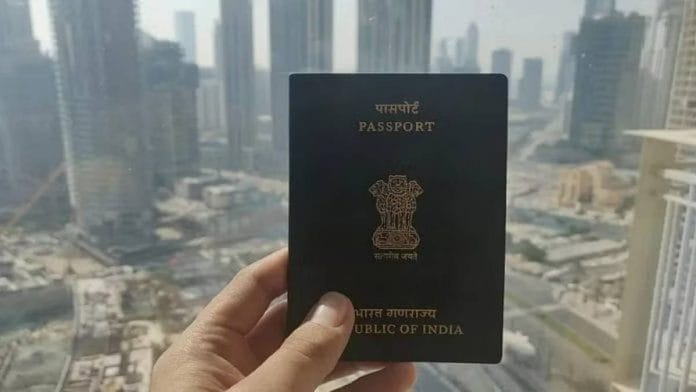


New Delhi: A passport has never been considered proof of citizenship, Thursday’s clarification by the government of India said, adding that no such decision was taken either recently or in the last 12 years, referring to Section 20 of the Passports Act 1967, which provides for the issuance of passports to non-citizens.
In the same line, it also pointed to judgments of the Bombay High Court from 2013 that had made it clear that possession of a passport does not establish citizenship.
The controversy over passports not being conclusive proof of citizenship emerged after the Ministry of External Affairs (MEA) on Wednesday clarified that passports are not legal standalone proof of citizenship but only an official document issued to facilitate international travel and verify identity.
ThePrint explains the 2013 Bombay High Court judgment at the heart of the debate.
Delivered by Justice K.U. Chandiwal in July 2013, the judgment upheld the conviction of one Anwar Hussain Abdul Kadar Shaikh among others for violating the Foreigners Act 1946 and the Passport (Entry into India) Rules, 1950, sentencing them to six months of simple imprisonment and a fine for illegally entering or remaining in India. Essentially, the court upheld the trial court order sentencing the four men charged with being illegal immigrants even after they produced passports (later terminated), Aadhaar cards and birth certificates for proving they were Indian citizens.
The men contended they were Indian nationals by birth; their counsel presented several documents to support this, including a birth certificate for Anwar Hussain, Aadhaar cards for the group, and passports for two of the applicants.
Two of the applicants claimed to have passports showing their nationality as Indian to support their argument that they were Indian nationals by birth. The defence requested the case be sent back to a trial court for reconsideration based on this evidence.
The court, however, found these documents legally insufficient. Regarding the passports, Justice K.U. Chandiwal noted that the documents cited were “already terminated passports”. As a result, the court ruled that “no legal basis can be achieved for its reliance” as valid proof of citizenship.
It was also noted that these passports were not originally placed before the Metropolitan Magistrate while evidence was being recorded in the initial trial, thus determining that a terminated passport does not constitute valid legal evidence to establish a claim of Indian nationality.
Delhi HC judgment
This MEA statement has added to the already existing confusion by the diverging court rulings. In 2018, the Delhi High Court ruled that a passport is a “document evidencing a citizen’s nationality and cannot be ignored on mere suspicions”, while allowing the petitioner to be given passport services without being questioned about her nationality.
This specific ruling stems from the landmark Prabhleen Kaur v. Union Of India & Anr where the court said that under Section 6(2) of the Passports Act 1967, passport authorities cannot refuse services or question nationality based on unbacked administrative doubts alone, especially when an applicant has lived, studied, and previously held passport documentation in the country.
(Edited by Nardeep Singh Dahiya)
Also Read: Identity vs citizenship: What makes you a citizen & which documents are not conclusive legal proof