





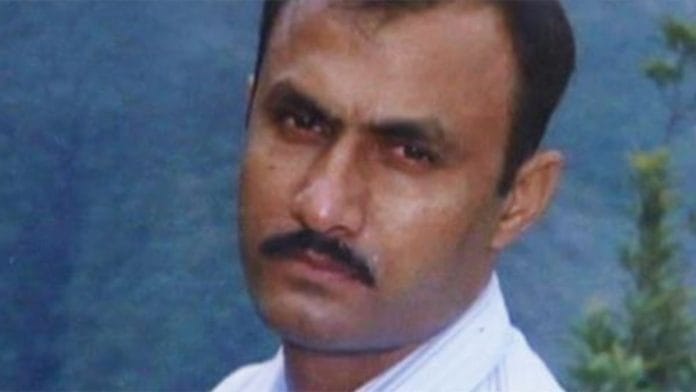


New Delhi: Declaring that the “very foundation” of the CBI’s case is demolished and the theory of a criminal conspiracy has not been proved, the Bombay High Court has upheld the acquittal of all 22 accused including 21 policemen in the Sohrabuddin Shaikh alleged fake encounter case of 2005.
Chief Justice Shree Chandrashekhar and Justice Gautam A. Ankhad, in their 50-page judgement Thursday, emphasised that a judgment of acquittal “strengthens the presumption of innocence of the accused” and requires a “higher threshold” of manifest illegality or perversity to be overturned—criteria the prosecution failed to meet. Therefore the HC found no ground to interfere with the trial court judgement.
The family of the deceased had challenged the acquittal of the 21 policemen (from Gujarat and Rajasthan) by a Mumbai trial court in 2018.
Gangster Sohrabuddin Shaikh, his wife Kausar Bi and associate Tulsiram Prajapati had been killed in 2005 and 2006 in an alleged fake encounter by the Rajasthan and Gujarat police.
The Bombay High Court on Thursday upheld a 2018 special CBI court verdict that acquitted 22 accused, including 21 police personnel.
The infamous case has been dogged by political and legal controversies, with then Gujarat Home Minister Amit Shah named as one of the accused initially and then discharged from the case on 30 December 2014, soon after the death of the presiding special CBI judge from Mumbai, Brijgopal Harkishan Loya on 1 December 2014.
Along with Amit Shah, the special court in 2014 had also discharged 16 other accused in the case, including BJP member and ex-Rajasthan home minister Gulab Chand Kataria and senior IPS officers.
Appealing against the trial court order, Shaikh’s family argued before the HC that “there are witnesses who tendered evidence on several important aspects of the prosecution case but the trial judge did not consider their testimony in the right perspective”, and that the trial court judgment was based on “unwarranted assumptions and manifest erroneous appreciation of evidence”.
High court’s ‘two views theory’
In upholding the acquittal, the high court said it cannot interfere with a trial court’s decision simply because “another view is possible”. The court applied the “two-views theory”—elaborated by the SC in Mallappa & Ors v. State of Karnataka (2024)—stating that when the evidence can lead to two equally plausible conclusions, “following the one in favour of innocence of the accused is the safest course of action”.
The high court found that the trial court had “thoroughly appreciated the evidence” and that its conclusions were not perverse. The Bench noted that the chain of circumstantial evidence was broken at several points, and the prosecution had failed to establish a motive or even the basic presence of the accused at the crime scenes.
The CBI had said the killings were the result of a “politician-police nexus”. The prosecution alleged that politicians were interested in eliminating Sohrabuddin because he was extorting money from the “marble lobby of Rajasthan”. Furthermore, the trial revealed deep-seated village political rivalry and gang wars dating back to 1996.
However, the high court observed that the prosecution’s theory often “aligned with a particular narrative with strong political overtones” and attempted to foist liability on specific political figures without sufficient evidence. The court specifically noted that there was “no material much less anything to whisper even about proving even prima facie element of extortion from (the) marble lobby”.
Ultimately, the court concluded that the interest of public justice did not require interference, as the prosecution’s case was based on hearsay and “parrot-like” statements from unreliable witnesses with criminal antecedents.
The court via the same order also disposed of an interim application filed by Harsh Mander, a resident of Mumbai’s Goregaon (East) in 2026. He sought to challenge the trial court’s discharge of Amit Shah in December 2014. Noting that the Supreme Court had already dismissed an appeal against the 2014 trial court order in 2016 and that there was no material connecting Mander to the crime registration, the Bombay HC said it had “no hesitation to observe” that the application was filed with “an oblique motive and at the instance of some political adversary” of Amit Shah.
The alleged fake encounter
The case dates back to November 2005, when the prosecution alleged that Sohrabuddin Shaikh, his wife Kausar Bi, and their associate Tulsiram Prajapati were abducted by a police team from Gujarat and Rajasthan. According to the prosecution, the trio was traveling in a luxury bus from Hyderabad to Sangli on the night of 22 November 2005, for Kausar Bi’s medical treatment and Eid celebrations. They were allegedly intercepted near Zahirabad, taken to farmhouses in Ahmedabad, and subsequently killed.
Sohrabuddin was shot dead on 26 November 2005, in an incident projected by the police as an encounter near Vishala Circle. Kausar Bi’s body was never found, though the prosecution claimed she was killed and her remains disposed of in the Narmada river. Over a year later, on 28 December 2006, Tulsiram Prajapati was also killed in what the police claimed was an encounter following his attempt to escape from custody near Himmatnagar.
The investigation, initially handled by Gujarat’s Anti-Terrorism Squad and CID (Crime), was later transferred to the CBI on Supreme Court’s direction in January 2010. It was the CBI that eventually registered the crimes and filed charge sheets. After repeated requests made by the family, the case was transferred from Gujarat to Mumbai.
Why the trial court acquitted the cops
The Special Sessions Court acquitted the accused in December 2018 primarily due to a staggering lack of evidence and credible witnesses. Out of 210 witnesses examined, 92 turned hostile, including key passengers and drivers of the luxury bus, completely denying any abduction from the bus—the foundation of the prosecution’s case.
The trial judge found that there was “no iota of evidence” to prove a politician-police nexus or that the seized firearms were actually used in the encounter. Forensic gaps were also critical; cartridges seized from the accused did not match the service pistols.
Furthermore, medical evidence contradicted the prosecution’s claim that an injury suffered by one of the police officers (also accused) was self-inflicted to stage the encounter, instead suggesting it was a genuine injury sustained during a confrontation. Finally, the trial court held that the accused—most of whom were public servants—could not be prosecuted without previous sanction from the state government under Section 197 of the CrPC, as they were acting in the discharge of their official duties.
(Edited by Viny Mishra)
Also read: CBI court acquits all 22 accused in Sohrabuddin & Prajapati ‘fake encounters’