



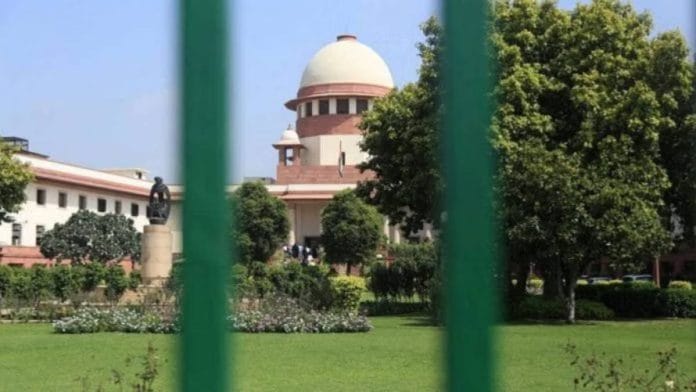
New Delhi: A seven-judge bench of the Supreme Court of India has unanimously disposed of a reference to define the extent of legislators’ privileges vis-à-vis citizens’ fundamental right to free speech, calling it “infructuous”.
The core question that the bench was supposed to deliberate upon was the definition of the breach or limits of legislative privileges—the interpretation of provisions related to scope of legislative privileges of MPs and MLAs, and its effect on the fundamental right of freedom to speech and expression.
The question of law has been left open for an appropriate case in the future.
The case stems from a 2003 Tamil Nadu Assembly resolution that had ordered five senior editors of national daily The Hindu to 15 days in jail for alleged “breach of privilege” over an editorial criticising then Chief Minister J. Jayalalithaa’s “authoritarian ways” and her government’s functioning. A massive raid at the newspaper’s Chennai office had followed, but the five editors moved the Supreme Court, which stayed the arrests because it felt a larger constitutional question needed deliberation first—one that remains unanswered more than two decades later. Now the wait grows even longer.
The bench—comprising Chief Justice of India Surya Kant and Justices Aravind Kumar, P.K. Mishra, Joymalya Bagchi, Vipul Pancholi, Sree Chandrashekhar and V. Mohana—was constituted in August, and was expected to hear the reference starting Tuesday, till 15 October.
However, on Monday, the court indicated that the matter may be disposed of as an academic issue, after senior advocate Raju Ramachandran, appearing for Tamil Nadu, told CJI’s bench that the 2003 resolution had actually been revoked in 2004, adding that this information was included in their filed affidavits but never appeared in the order related to the reference.
The court noted that the 2004 revocation had not shown up in its reference order. The advocates also pointed out that this fact was mentioned in their affidavits, but had not been pressed by counsels until now.
Also Read: Meet the three new Supreme Court judges, and the cases that defined their careers
What the reference was meant to decide
Legislative privileges are special powers and immunities that members of Parliament and state legislative assemblies have that allow them to function without obstruction. They can be exercised against non-members as well. They can be exercised against non-members as well. The question before the Supreme Court was the extent of these powers in context of the rights guaranteed to citizens outside the House.
Under Article 194(3) of the Constitution, a state legislature can pass its own laws to decide its powers, privileges and immunities. If it has not passed such a law, those powers are the same as the ones that existed right before Section 26 of the Constitution (44th Amendment) Act, 1978, took effect.
Originally, Article 194(3) stated that until a state legislature defined its privileges by law, its powers and privileges would be the same as those of the House of Commons of the British Parliament at the time the Indian Constitution took effect (26 January, 1950). Section 26 replaced that reference. Instead of referencing the British House of Commons as it stood in 1950, it tied the baseline powers to the powers, privileges and immunities that state legislature possessed immediately before it came into force.
Ahead of the hearings that were expected to take place this month, many prominent figures—including journalists and creators—had also applied to intervene in the main matter and raise arguments.
The intervenors had largely argued that if the 2024 landmark Sita Soren verdict by the Supreme Court proved that legislative privileges are functional, bounded, and subject to rule of law, then a state assembly cannot turn around and use those same privileges as an “absolute shield” to punish outside critics, journalists, or comedians who exercise their right to free speech under Article 19(1)(a).
(Edited by Mannat Chugh)