



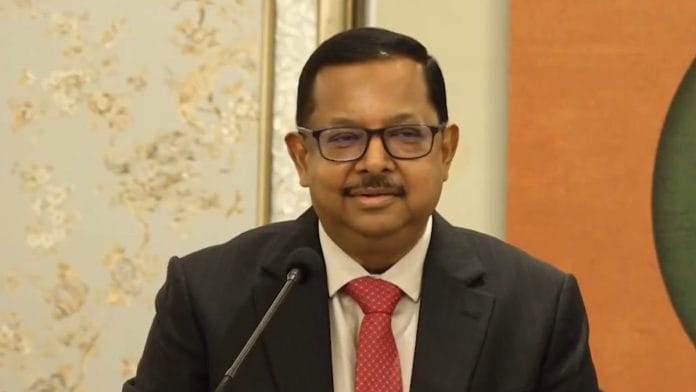
New Delhi: Any process that results in disenfranchisement of millions of Indians, “making them citizens without voting rights”, is “intrinsically arbitrary” and “no amount of whataboutery can justify it”, Supreme Court Justice Ujjal Bhuyan said Sunday.
Without directly referring to the Special Intensive Revision (SIR) exercise conducted by the Election Commission of India (ECI), the judge said, “Any process which leads to wholesale disenfranchisement of the citizens, making them citizens without voting rights, in my view, would be outrightly violative of Articles 326 and 14 of the Constitution”, he said. The remarks come amid concerns over alleged mass voter deletions after the SIR exercise.
Article 326 deals with universal adult franchise, which gives voting rights to all citizens above 18. Under this, a person can be denied voter registration or the right to vote only on specific grounds of non-residence, unsound mind, and criminal record. Article 14 guarantees the right to equality.
“Article 326 cannot be tinkered with at all. No authority can do it and no court can endorse/condone it. No one is above the Constitution,” Justice Bhuyan said, speaking at an event at NALSAR University of Law campus in Hyderabad. The Indian Constitution does not prescribe for two classes of citizens—one with voting rights, and one without them—he added.
In his address, Justice Bhuyan spoke about the “long and difficult road our country has travelled to give each one of its citizens howsoever humble, howsoever illiterate, howsoever poor, an equal vote”.
“If any process results in disenfranchising millions and millions of Indian citizens making them second class citizens in their own country in the sense of being citizens without voting rights, such a process is intrinsically arbitrary. No amount of whataboutery can justify it. It strikes at the very heart of the Constitution, and I would go to the extent of saying that it is a negation of the constitutional order which we have adopted under the Constitution of India,” he remarked.
“Therefore, in my view, the right of an Indian citizen to cast his vote is central to the basic structure doctrine itself. In fact, the right of franchise is the very essence of citizenship. It is the only way an ordinary citizen of India can participate in the governance of the country.”
Justice Bhuyan further highlighted that India’s right to vote is a result of a long freedom struggle with colonial rule. It is a manifestation and long fought struggle, he said, adding that the right to vote is not merely a statutory right, but a constitutional one flowing from Article 326, which guarantees elections to the Lok Sabha and State Legislative Assemblies on the basis of adult suffrage.
He also traced how the right to vote and universal adult franchise took shape in India during the British Rule, referring to the Swaraj Resolution, Lucknow Pact 1916, and the Montagu-Chelmsford Reforms or Government of India Act 1919.
He also mentioned Supreme Court precedents of People’s Union for Civil Liberties vs Union of India, the Anoop Baranwal judgement (2023), and the Lal Babu Hussein judgement (1995), where the apex court laid down guidelines for disenfranchised voters.
Under Article 326, a person who has attained the age of 18 years is entitled to vote in the Lok Sabha and Assembly elections, subject to disqualifications permitted under the Constitution, including non-residence, unsoundness of mind, crime or corrupt or illegal practices. “Any law infringing these parameters will be void,” he said, adding that it is equally necessary to ensure that administrative exercises do not irrationally or unreasonably curtail the right to vote.
The right to vote, he said, cannot be detached from the identity of a citizen. “It will be like taking out the soul from the body,” he said. “I ask myself, what is the worth of a citizen, without her voting rights”.
‘Proud of NALSAR students’
Before wrapping up his speech, Justice Bhuyan left a word of appreciation for the students of NALSAR, where he was a chancellor earlier.
“I think legitimately, I can be proud of the NALSAR students,” he said. “You have shown to the country and the world what a university student, that too a student of law, should be like. You are brilliant. You are bold and you are brave.”
The institution was recently at the centre of a controversy, after a group of students had opposed the invitation to Chief Justice of India Surya Kant for their convocation ceremony. Amid the row, Bar Council of India President and BJP Rajya Sabha MP Manan Kumar Mishra had directed State Bar Councils to not enrol any of the outgoing NALSAR students, and that an inquiry would be undertaken. However, after strong backlash, the directive was withdrawn, and Mishra had to issue an apology.
On Sunday, Justice Bhuyan went on to praise NALSAR’s faculty, saying, “You have performed your duties admirably; you have done what a university teacher is expected to do. It was during my tenure as the Chancellor that Professor (Srikrishna Deva) Rao was appointed as the Vice Chancellor. I must say that he has led the university admirably. He has not let the teachers and the students down.”