



New Delhi: For the past few weeks, Davinder Kaur has been running from one government office to another after discovering that her daughter’s name has been struck off the electoral list during the ongoing Special Intensive Revision (SIR).
“I have given all the proof there was for my daughter, but now I have been told there is no confirmation if my daughter’s name will appear in the list that will be shared in November. Why are common people being made to go through such hassles? The CEC needs to answer,” she said to ThePrint.
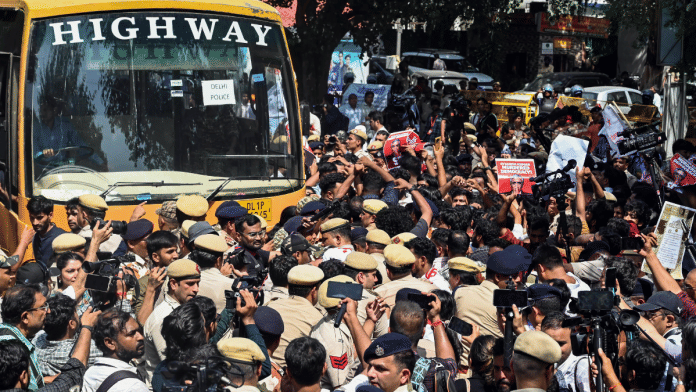
On Friday, people whose names have been deleted or struck off the electoral list joined a protest at Jantar Mantar demanding the resignation of Chief Election Commissioner (CEC) Gyanesh Kumar.
The Delhi Police detained hundreds of protesters from Jantar Mantar and several nearby locations. The protesters alleged irregularities in the SIR and raised concerns over the mass deletion of voters’ names.
‘Gave proof, stood in long lines’
Davinder Kaur, a housewife in her 50s and a resident of Vishwas Nagar, never expected her family to face such troubles over a vote.
“My name was correct in the SIR list, but my daughter’s name was removed,” Kaur said. Her daughter is 26 years old and not a first-time voter. She has voted in previous elections without any issues.
Yet, without a clear reason, her name was deleted from the official records.
To get her daughter’s name added, Kaur collected all documents required by the authorities. “I submitted her identity cards, marksheet, Aadhar, PAN cards, Voter IDs and my own identification documents as proof of residence,” she told ThePrint.
“I went again and gave all the proof,” Kaur said. “I don’t know why the name was cut in the first place because I had filled out the right forms earlier. But even now, after resubmitting everything, I have no idea if the forms will be accepted.”
The process to fix ‘errors’ has been exhausting for common people. Like Kaur, many at Jantar Mantar said they had to travel to multiple offices, only to be sent from one place to another. Officials directed Kaur to specific SIR booths located in different areas, forcing her to travel across the city many times.
Once she reached the booths, the struggle was far from over. “I had to stand in long lines, push through crowds, and suffer,” she said. “After standing in line for one and a half hours, my turn finally comes.”
Despite the time and energy spent, officials have offered her no guarantees. They informed her that she would have to wait until November to know whether her daughter’s form was processed and if her name would be included in the final electoral list.
Kaur had submitted all necessary paperwork before the deadline on 24 August. Yet, she is left in complete uncertainty for months.
“I have seen such difficult days during this government’s time,” Kaur added. “Why must ordinary people push through crowds and stand in lines for hours just to get an answer? We follow all the rules, but we are still left waiting with no certainty about our basic right to vote.”
‘How can the poor provide such proof?’
Like Davinder, Sajida, too, is a housewife in Badli Vidhan Sabha seat in Samaypur Badli. She stood under the sun, one of a crowd, asking questions.
She demanded why the authorities have sought her decades-old documents under the ongoing electoral revision. Her frustration grew after the officers asked for her father’s records too.
“They told me my father’s name was incorrect in the list,” Sajida said. “My father voted for many years without any issues, and his details were always accurate. He passed away at the age of 70, without facing such a problem.”
When officials demanded additional proof, Sajida said, “I told them I only have these basic documents. If you want to delete the vote, go ahead.”
Sajida said that 20 to 30-year-old records are not accessible to poor families who lack proper storage, land ownership, or formal paperwork documenting their existence.
“Poor people don’t own land. They often don’t have documents of their existence from decades ago,” Sajida said about the documents demanded in the SIR exercise. “Where are they supposed to get 20 or 30-year-old documents now? How can the poor provide such proof?”
(Edited by Viny Mishra)
Also read Delhi SIR: Names of most prominent voters who received notices cleared after verification
Blown out of proportions. Are all those whose names got deleted genuine voters?
CEC should be jailed for or should compensate for the mental torture inflicted on each genuine voter deletion. There is no accountability or sense of responsibility in this government. Burden of proof of deletion should have been on EC officials. If it’s done with malicious intent of winning the elections for a single party, he should be tried under NSA or UAPA.