





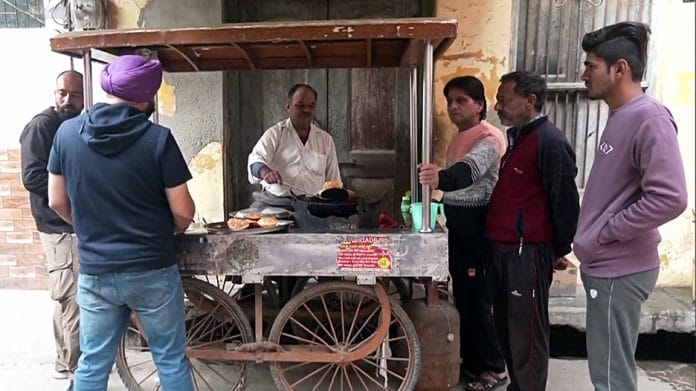


Gurugram: The Supreme Court has quashed a July 2020 notification that had let Chandigarh’s street food vendors to operate under the category of “Essential Service Providers”, ruling that the Covid-era relaxation had “outlived its object, purpose and utility”.
A bench of Justices Sanjay Karol and Nongmeikapam Kotiswar Singh passed the order on 1 July while hearing the ongoing dispute over street vending in Chandigarh, arising out of a plea by Malkit Singh, president of Manimajra Vyapar Mandal, and the Residential Welfare Association.
The 2020 notification, issued by the Municipal Corporation, Chandigarh (MCC) under the Street Vendors (Protection of Livelihood and Regulation of Street Vending) Bye-Laws, 2018, had widened the definition of “Essential Service Provider”, a category that enjoys wider latitude to vend, to include tandoor, chhole bhature, kulche chhole, parantha and fruit and vegetable sellers, besides florists outside temples and gurdwaras. It had also extended their permitted vending hours to 10 pm.
Amicus curiae Anant Vijay Palli, senior counsel appointed by the court, argued that the notification was a pandemic-specific relaxation that had no reason to continue and was diluting the very concept of an essential service provider.
After hearing all sides, including Chandigarh administration officials present in court, the bench recorded that “deliberations with all concerned… led us to a formation of consensus with the learned amicus curiae on this specific issue,” and struck down the notification, restoring the original, narrower 2018 definition.
Background: From a 48-hour deadline to a full compliance roadmap
The case has its roots in a complaint by Chandigarh shopkeepers and residents against hawkers occupying pathways near the Manimajra bus stand, a civil hospital, a school and a police post.
The Punjab and Haryana High Court had dismissed that plea in May 2025, calling it “prima facie motivated” and making adverse “elite class” remarks against the petitioners.
The Supreme Court set aside that order in December 2025 and gave Chandigarh authorities 48 hours to clear the encroachments.
Since then, the matter has stayed before the same bench, with the MCC filing periodic affidavits and the amicus filing responses. Thursday’s order is the latest in that sequence and follows an earlier detailed order of 9 April 2026 in which the court had already flagged that any relocation of vendors must be handled with “adequate sense of fairness and responsibility,” since it disrupts both vendors’ livelihoods and residents’ access to them.
What MCC told the court
In its affidavit, the MCC Commissioner gave the court a full account of the enforcement drive so far. Chandigarh has 10,939 registered street vendors — 3563 Essential Service Providers, 1139 mobile vendors and 6237 Non-Essential Service Providers. Roughly 5400 challans have been issued in anti-encroachment drives, of which about 1150 pertain to Manimajra alone.
On amenities, the MCC said basic facilities like drinking water, toilets and paver blocks were mostly available at vending zones adjoining markets, and that 18 mobile toilet vans were being deployed elsewhere, with 10 more being procured.
The affidavit also disclosed that 6881 vending licences had been cancelled for non-payment of dues, of which 5,535 vendors neither appealed nor cleared their outstanding fee — vendors the MCC said appeared to have “migrated to somewhere.” Of 1346 appeals filed against cancellation, 1177 vendors were allowed to pay their dues within three months. 169 appeals remained pending. Separately, 443 applications were pending before the Grievance Redressal and Dispute Resolution Cell (GRDRC).
Amicus pushed back on ‘challan-only’ approach
Responding to the MCC’s affidavit, amicus curiae Palli argued that challans alone do not solve the problem, since they neither remove encroachments permanently nor rehabilitate vendors, amounting to little more than a revenue exercise. He also flagged that mass cancellation of licences, with over 5500 vendors neither appealing nor paying up, would likely push them back onto the streets, this time illegally.
The amicus urged the court to direct MCC to file a “result-oriented” report — not just a tally of drives and challans, but proof of which sites had stayed encroachment-free for at least 30 days, and how many displaced vendors were verified to be actually operating from designated zones, backed by photographic evidence. He also pressed for a dedicated post-drive enforcement team, a four-week deadline to clear all pending GRDRC applications, a narrower definition of “Essential Service Provider”, ward-wise public data on vending sites, and for the same enforcement drive to be extended to Mohali and Panchkula as part of the “Tricity.”
The MCC, in response, said encroachment removal was a routine exercise under the Punjab Municipal Corporation Act, 1976. Defending licence cancellation as a “measure of last resort” preceded by 30 days’ public notice, it said nodal officers appointed on 7 May had been tasked with daily inspection of vending zones and amenities. It also said 330 of 409 appeals fixed for the period had already been decided, with most of the remaining 79 filed only in February 2026.
What the court has now ordered
Weighing both sides, the bench issued a fresh set of directions to Chandigarh authorities, to be complied with “in letter and spirit.” Vendors already identified for relocation must be shifted to the designated vending zones without delay, and those zones must be made fully functional, with everyday monitoring by city officials and multilingual signage to guide the public to them. Basic amenities at every vending zone must be put in place immediately, wherever they are not already available, and properly maintained thereafter. The MCC has also been told to advertise the vending zones and their timings at regular intervals in print and electronic media.
The ongoing exercise of issuing smart ID cards to vendors, which will also carry the geo-coordinates of each vendor’s allotted site, must be completed swiftly, with the details shared with local police stations and the district administration.
CCTV cameras must be installed at all vending zones within six months, with adequate arrangements for storing the footage, to ensure the safety of both vendors and buyers. The court has also asked the authorities to consider setting up a helpline for vendors and buyers, to build public confidence in how the vending zones are regulated.
Finally, all applications and appeals currently pending before the authorities must be decided within 60 days, and any fresh ones within 30 days, after giving the concerned parties a hearing.
The Chandigarh authorities have been asked to file a compliance affidavit by 22 July, and will next hear the matter on 24 July.
(Edited by Niyati Kothiyal)
Also read: Haryana rolls out red carpet for Delhi traders with 5,000-acre commercial township plan—‘Namo City’