





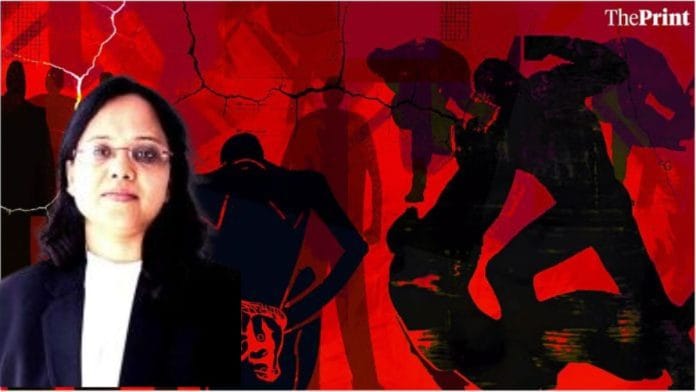


New Delhi: The Supreme Court Advocates on Record Association (SCAORA) Wednesday issued a statement condemning threats and “targeted social media campaign” against Additional District and Sessions Judge in Narmadapuram district in Madhya Pradesh Tabassum Khan, for convicting 14 men of lynching a Muslim man.
The judge had, on 12 June, sentenced 14 to life imprisonment in two separate judgments in a mob lynching case. Since then, she has been threatened and abused on social media; the police have registered an FIR.
The case pertained to a mob lynching one Nazeer Ahmed and injuring two others in August 2022, on suspicion of cow smuggling.
The 14 men convicted in the case are Deepak alias Baba Kevat, Ajay alias Ajju Rathore, Prakhar Kaushal, Pawan Bathav, Amar alias Bhola Bathav, Kanhaiya Bathav, Ballu alias Anuj Raghuvanshi, Raju alias Rajendra Kaushal, Akash alias Pintola Bathav, Gaurav Yadav, Akash Sarathe, Chetan Maratha, Devendra alias Chhoru Kori, and Sandeep alias Raja Kaushal.
In the judgment, the judge noted that the offence of mob lynching had been proved against the accused, and that the accused assaulted the victims “brutally”, resulting in a person’s death. While considering the law on death penalty, the court noted that considering all aggravating and mitigating circumstances, it did not appear that there was no possibility of reformation for the accused.
However, following the judgment in the mob lynching case, several videos uploaded on social media have targeted the judge for the verdict. Congress leader Pawan Khera had come to the judge’s defence, writing on X, “All the convicts are indeed Hindu men. But they were not convicted because of their religion; they were convicted because the investigation found them guilty of rioting, attempted murder and murder.”
The statement issued by SCAORA has asserted that “judicial orders are to be challenged before appellate courts, not through intimidation, vilification or threats against judges”. The lawyers’ body expressed solidarity with the judge and also expressed “the hope that all necessary steps will be taken to ensure her safety and to uphold the independence and dignity of every judicial officer”.
Following the threats, the Seoni Malwa police registered an FIR against unidentified persons, as per reports.
What happened during the trial and what did the judge say in her judgment? ThePrint explains.
The complaint
In his complaint, one of the injured persons, Sheikh Lala, had told the police that he had been called by someone called Setty to load a truck.
When he reached Nandarwada, Setty got his truck loaded with animals, including cows, and asked him to transport these to Amravati in Maharashtra.
However, it was alleged that on 3 August 2022, at around 12.30 am, several men stopped the truck driven by Sheikh Lala, along with Nazeer Ahmed and Sheikh Mushtaq. The men then attacked the trio with lathis and sticks, leading to Ahmed’s death and serious injuries to the other two.
The judge convicted the accused under Sections 148 (rioting, armed with deadly weapon), 307 (attempt to murder)/149 (every member of unlawful assembly guilty of offence committed in prosecution of common object), 302 (murder)/149 of the Indian Penal Code, handing life imprisonment to all of them.
“Based on the statements of the complainants and medical evidence, it is proven that the mob used force and violence against the complainants and the deceased. The above evidence also clearly demonstrates that the assault was carried out with sticks, rods, etc., which have been seized,” the court observed.
It noted that it was not necessary to prove the individual actions of each member of an unlawful assembly, noting, “Thus, although the above evidence does not establish the specific actions of each accused, it is clear that the accused, armed with sticks, rods, etc., were gathered in numbers exceeding five, and used force and violence. From the above circumstances, it is proved that the accused persons formed an unlawful assembly and caused riot by using force and violence, and in furtherance of the common object of unlawful assembly, caused the murder of deceased Nazir Ahmed by beating him with sticks.”
Victims turned hostile
The victims in this case, Sheikh Lala and Sheikh Mushtaq turned hostile during the trial.
They told the court that they were unable to see and identify people who assaulted them. However, the prosecution had submitted that the injured were made to identify the accused and they had identified them. This was supported by statements of the inspector who organised the identification proceedings, and the executive magistrate, in whose presence the injured had identified the accused in 2022.
The court noted, “It is noteworthy that although the complainants have not supported the identification proceedings, which makes it probable that they have made statements in the court under influence, it is noteworthy that the above identification proceedings have been conducted by Tehsildar Lalit Soni in the discharge of his official duty, from which it can be presumed that the said official work has been performed regularly under Section 119 (c) of the Indian Evidence Act, 2023.”
The judge also noted that sticks, rods, and blood-stained clothing had been found in the houses of the accused after the lynching.
“The accused offered no defence during the cross-examination of Investigating Officer Jitendra Yadav that the clothing did not belong to them. No contradiction was presented on record that could lead to the conclusion that the accused had a long-standing grudge against the police, leading to their being falsely implicated. Therefore, there is no reason to distrust the seizure proceedings conducted by Investigating Officer Jitendra Singh Yadav,” the court asserted.
The motive
While the accused had submitted that the motive of the crime had not been proved, the court observed that “where the case of the prosecution is proved by circumstantial evidence, the accused cannot be given the benefit of the doubt on the basis that the motive of the crime is not disclosed by the prosecution”.
The accused had also argued that even though the complainants in the lynching case had claimed that they were driving the truck under the direction of Setty and another man called Raja, neither of them nor the registered owner of the truck had been questioned. Additionally, they said that no investigation had been conducted into the species of the animals in the truck, nor where the animals were taken or to whom they were handed over.
They had also pointed out that while the complaint had mentioned that the trio had animals in the truck, Sheikh Lala and Sheikh Mushtaq had told the court that they were carrying vegetables in the truck.
However, the court rejected this argument, observing, “It is noteworthy that if the animals were being transported in the truck without a licence, there was a basis for separate action against the truck owner and other related individuals. However, merely because appropriate legal action was not taken against them separately, it cannot be concluded that the accused were not involved in the incident. It is also noteworthy that the present case involves assault, murder, and attempted murder, and the accused’s involvement is established based on the above evidence analysis.”
The court also noted that while it was unclear how many dependents or legal representatives the deceased man, Ahmed, had, it directed that compensation must be paid to his wife, children and parents. A copy of the judgment was directed to be sent to the Legal Services Authority, Narmadapuram.
(Edited by Viny Mishra)
Also read: Allahabad HC upholds NSA detention of 3 men for ‘cattle slaughter on first day of Navratri’