





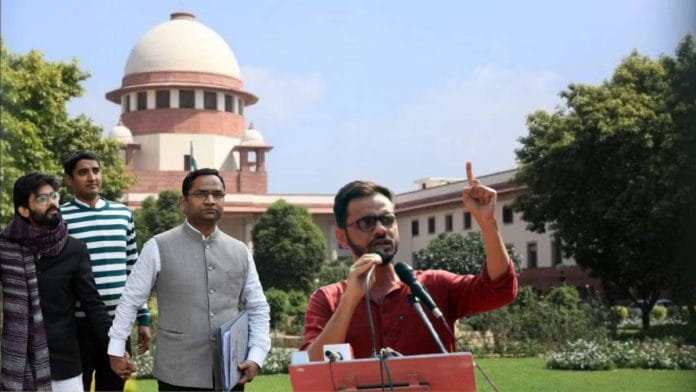


New Delhi: A two-judge Supreme Court bench Monday voiced its reservation over a coordinate bench’s refusal to grant bail to Umar Khalid and Sharjeel Imam, who are facing charges under anti-terror law Unlawful Activities (Prevention) Act (UAPA) in the Delhi riots case.
A bench of justices B.V. Nagarathna and Ujjal Bhuyan noted the January order was a departure from the settled bail jurisprudence in UAPA cases that reinforced personal liberty as supreme and upheld bail is a rule and jail an exception even in terror-related cases, particularly those where trials were pending for an indefinite period.
The bench quoted the 2021 KA Najeed judgement in which a three-judge bench had ruled the right to speedy trial under Article 21 would apply to those accused in Unlawful Activities (Prevention) Act cases as well.
This meant that a UAPA accused could be released on bail if there was an inordinate and inexplicable delay in the trial.
The UAPA contains stringent provisions for bail since there is a presumption of guilt against the accused and the onus lies upon the defence to convince the judge that there is prima facie no offence made out against them, unlike otherwise in cases registered under the Bharatiya Nyay Sanhita.
The two-judges bench that refused to release Khalid and Imam in January this year, putting the two on a “qualitatively different footing” had exempted them from the benefits of principles enshrined in the KA Najeeb judgement.
A bench led by Justice Aravind Kumar had, however, granted bail to five others.
It carved out the exception for Khalid and Imam by citing “hierarchy of participation” and identifying the duo as the main planners behind the 2020 riots.
They were behind “planning, mobilisation and strategic direction” of the riots, the SC bench had said, making it tighter for them to get bail.
It had, however, given them liberties to file fresh bail applications after the examination of protected witnesses or after one year from the day of its judgement.
According to justices Nagarathna and Bhuyan, the 2021 Najeeb judgement had precedential value and judicial discipline required smaller benches to follow and not dilute it.
In case of a disagreement, the two-judges bench could have referred the question of law, on which dispute is raised, to the Chief Justice of India who could have set-up a larger bench to reconcile the difference of opinions.
The bench’s observation came while it granted bail to a Kupwara resident, Syed Iftikhar Andrabi, who has been in jail awaiting trial since June 2020 in connection with a narco-terrorism case registered by the National Investigation Agency (NIA).
“We have serious reservations about judgment in Gulfisha Fatima. The judgment in Gulfisha Fatima would have us believe that Najeeb (a case law which says accused cannot be indefinitely jailed) is only a narrow and exceptional departure from Section 43D(5), justified in extreme factual situations.
“It is this hollowing out of the import of the observations in Najeeb that we are concerned with. The broad reading of Najeeb suggests that the mere passage of time, if it arises from all surrounding circumstances, mechanically entitles an accused to release,” observed the bench.
It reiterated that bail should be the rule even in UAPA cases and that the right to speedy trial cannot be defeated merely because an accused has been booked under this stringent anti-terror law.
“The statutory embargo of Section 43D(5) UAPA (which sets up a highly stringent bail regime) must remain a circumscribed restriction that operates subject to the guarantee of Articles 21 and 22 of the Constitution.
“Therefore, we have no manner of doubt in stating that even under the UAPA, bail is the rule and jail is the exception. Of course, in an appropriate case, bail can be denied having regard to the facts of that particular case,” the court held.
In that spirit, added the court “we make it clear that Najeeb is binding law and entitled to the protection of judicial discipline. It cannot be diluted, circumvented, or disregarded by trial courts, High Courts, or even by benches of lower strength of this Court.”
SC underlines ‘judicial discipline’
The bench shared its concerns over a trend where smaller benches were not following the larger bench decisions.
“More particularly, the issue concerns the propriety of smaller benches progressively hollowing out the constitutional force of a larger bench decision without ever expressly disagreeing with it,” the court said, reminding the smaller benches that they are bound by decisions of larger benches.
“A decision made by a bench of lesser strength is bound by the law declared by a bench of greater strength. Judicial discipline mandates that such binding precedent must either be followed in full, or in case of doubt, be referred to a larger bench. A smaller Bench cannot dilute, circumvent, or disregard the ratio of a larger Bench … If a smaller Bench cannot agree with a larger Bench, it can only refer the case to the Chief Justice of India for allocation to a larger Bench,” added the court.
“Judicial discipline and certainty demand that benches of smaller strength are mindful of the decisions rendered by larger benches and are bound to follow the same,” the Court added.
At the same time, the bench strongly rebutted the observations in the Gulfisha Fatima’s case that delays in UAPA trial may not entitle an accused to bail and recalled that SC has in several cases categorically held that Article 21 applies, irrespective of the nature of the offence.
With regard to the specific case before it, the bench disagreed with the Jammu and High Court’s decision to justify the continued incarceration of the accused.
It cited law emerging following two significant judgements on the law point—Najeeb and Sheikh Javed Iqbal (caselaws)—to state that the existence of prima facie case against a UAPA accused cannot be cited to indefinitely keep an undertrial accused in jail.
It rejected the prosecution’s argument that quoted a previous SC judgement – delivered much before the Najeeb verdict – which justified indefinite incarceration of the accused under UAPA, in terms of section 43D(5) of the anti-terror law.
“A plain reading of Najeeb will show that it was trying to prevent precisely this possibility from arising, when it cautioned that Section 43D(5) must not become the sole metric for denial of bail, causing wholesale breach of the constitutional right to speedy trial,” the Court said.
SC also took note of the low conviction rate in UAPA cases, specifically in Jammu and Kashmir where it has been always below one percent.
“We have quoted statistics from the National Crime Records Bureau. For the five years from 2019 to 2023, the all-India figures show that the rate of conviction minimum is 1.5% and the maximum is 4%, whereas in the case of Jammu and Kashmir, the rate of conviction in 2019 was zero, and the maximum was in 2022 at 0.89%,” observed the bench.
“Therefore, for the all-India figures, we have 2% to 6% convictions, meaning thereby that there is a 94% to 98% possibility of acquittal in such cases in the country. So far as the Union Territory of Jammu and Kashmir is concerned, the annual rate of conviction is always less than 1%. It means that at the end of the trial, there is a 99% possibility of acquittal in such cases,” the court observed.
(Edited by Ajeet Tiwari)
Also Read: How SC relied on prosecution theory of ‘vertical chain of command’ to deny bail to Umar, Sharjeel