





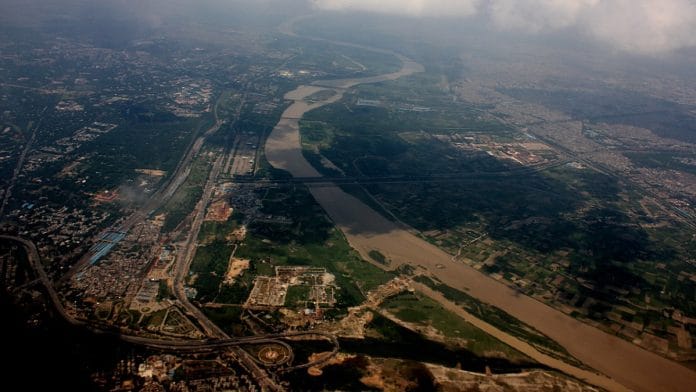

New Delhi: The Supreme Court has set aside the National Green Tribunal’s environmental compensation order against the Art of Living Foundation, holding that the NGT imposed liability without clear proof of fresh damage caused by the event organised on the Yamuna floodplains that took place in 2016.
Justice S.C. Sharma and N.K. Singh Saturday held that the NGT failed to establish a clear, evidence‑based link between the event organised by Art of Living Foundation and any measurable damage to the Yamuna floodplains. Its order took note of inconsistent expert reports, unverified satellite imagery and rejection of the no-fault liability principle. For these reasons, the court held that the compensation could not stand.
However, it made clear that rehabilitation of the floodplains must continue under the Delhi Development Authority (DDA), which remains responsible for restoring the site irrespective of the appellant’s liability.
The dispute arose from the World Culture Festival (WCF) organised by Art of Living Foundation (Vyakti Vikas Kendra India) on 25 hectares of the Yamuna floodplains in Delhi in March 2016. In February that year, environmental activist Manoj Misra moved the NGT, arguing that large-scale preparations would cause serious harm to the ecological balance and health of the Yamuna river and its adjoining floodplains and wetlands.
The NGT took cognisance of these concerns and appointed an expert committee to inspect the site. Based on the committee’s report, the tribunal passed an interim order just two days before the event, allowing it to proceed but directing the organisers to deposit Rs 5 crore as environmental compensation.
After the event, the second report prepared by the expert committee in July 2016, based on visual inspection and Google imagery, concluded that the floodplains were “severely damaged” but did not quantify restoration costs.
Later, a third report submitted in November 2016 proposed a Rs 42-crore rehabilitation plan spanning 10 years, while admitting that complete restoration was impossible.
The NGT relied on these findings and held the organisers liable under the principle of “no-fault liability”.
It directed that the Rs 5 crore already deposited be used for restoration, and if costs exceeded that amount, the DDA could recover the balance from the organisers.
The organisers appealed to the Supreme Court, arguing that the site was already degraded before the event, that the expert reports were inconsistent and unscientific, and that the NGT had wrongly equated “restoration” with “rehabilitation”.
Also Read: NGT orders DDA and Delhi flood department to end Yamuna floodplain deadlock
‘Tribunal erred in equating rehabilitation and restoration’
The top court was to decide whether the appellant, by organising the World Culture Festival on the Yamuna floodplains, had in fact caused damage to the floodplains of the river and consequently, whether it was legally responsible for the restoration of that area or for its broader rehabilitation.
It ruled that the NGT relied too heavily on the expert committee’s claim that large-scale preparations were happening at the site and jumped to the conclusion that the appellant had severely damaged the floodplains. The court also pointed out that the photographs used in the expert committee’s report were unclear. The report did not specify source and reliability and mainly relied on a single Google Earth satellite image from 2015 to describe the condition of the floodplains before the event.
“In a judicial proceeding, it was expected of the Tribunal to have tested the report and solitary satellite image with other contemporaneous evidence on record before giving a stamp of judicial approval to the opinion of the committee. More so, because the committee’s report appears to be palpably contrasting with other material, including its own reports filed earlier,” read the order issued by the two-judge bench.
Further, the court noted that the expert committee first claimed the appellant had damaged the floodplains, but later admitted it could not suggest any proper restoration because the original ecological condition of the site was unknown. Despite this, it went ahead and recommended rehabilitation projects and even gave cost estimates for them.
This, the court held, was beyond the expert committee’s mandate, which was limited to suggesting measures and outlining the cost to restore the site to its pre‑event condition.
“In our view, the Tribunal fell in error in equating the distinct concepts of rehabilitation and restoration. Going by its plain meaning in the context of environmental jurisprudence, rehabilitation refers to complete reparation of the affected area in a manner that it becomes fully functional and provides optimum ecological services,” the bench said.
Adding, “Restoration, however, refers to a process whereby the affected area is simply brought back to its original state, regardless of how optimum the original state was. Whereas the focus of rehabilitation is to achieve optimum ecological functionality; the focus of restoration is to achieve the original state, irrespective of functionality.”
The court also stated that the “task of rehabilitation of public resources falls upon the shoulders of the State and it must be undertaken by the State by upholding the spirit of public trust doctrine and the principle of intergenerational equity”.
According to it, the “responsibility of private persons gets triggered when environmental damage or degradation is attributable to them”.
The court, therefore, rejected NGT’s application of both no‑fault liability under the NGT Act and the ‘polluter pays’ principle against the appellant.
It explained that liability is confined to accidents and cannot be stretched to cover a planned cultural festival. Likewise, it ruled that the ‘polluter pays’ principle can only be invoked when actual pollution or environmental degradation is proved.
No causal link was established between the appellant’s actions and the alleged damage, the court ruled, holding that both doctrines had been wrongly applied to the appellant.
As it set aside the NGT’s order, the Supreme Court directed that the Rs 5 crore deposit be refunded to the appellant within four weeks, and affirmed that the DDA remains solely responsible for the ongoing rehabilitation and ecological management of the Yamuna floodplains.
(Edited by Amrtansh Arora)
Also Read: How Yamuna changed in 200 years—river is now 68% narrower, with 89% lower discharge