





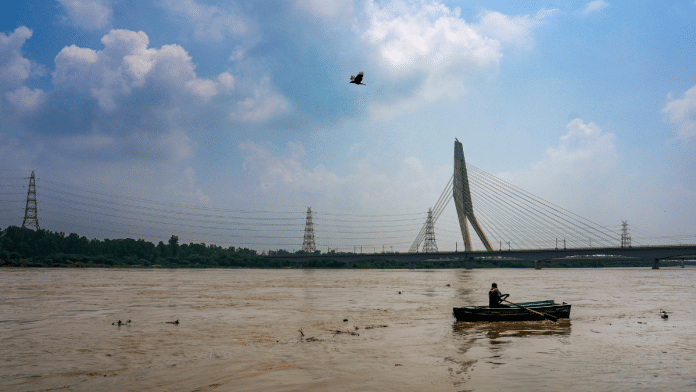

New Delhi: The Yamuna River in Delhi has narrowed by about 68 per cent, with its discharge reducing by about 89 per cent between 1799 and 2026, a new study led by researchers from Delhi University has found.
Titled ‘Two Centuries of Hydrogeomorphic Changes: Width-Discharge Dynamics of the Urbanised Yamuna River in Delhi’, the study highlighted the impact of multiple barrages built on the 50-kilometre-long reach of the Yamuna River in Delhi. Researchers used historical maps and satellite images to determine changes in river width and flow dynamics over the past 200 years.
“These changes in river width, discharge, and land-use with increasing population have reduced the natural capacity of the river to adjust to extreme events,” read the study.
The findings also highlighted that over the past century—between 1912 and 2024—man-made embankments have disconnected about 33 per cent of the Yamuna floodplains.
The study was published in the Journal of the Geological Society of India on 1 April.
Yamuna under strain
Researchers from Delhi University and the Indian Institute of Science Education and Research, Bhopal, mapped the banks of the Yamuna in 1799 in its natural form, before any barrages were built. They found that before human intervention, Yamuna’s average bankfull width—the river is full but not flooding—reduced from about 658 metres in 1799 to about 210 metres in 2024. This change in width determined how the river’s discharge fell from about 30,000 cubic metres per second in 1799 to only about 3,900 cubic metres per second in 2024.
The findings attributed a population explosion in the national capital as a primary reason behind this change. The study said that Delhi’s population rose from around 2.5 lakh in the early 19th century to about 2.15 crore in 2024. This increase over the years put an immense strain on the river.
Researchers also found that between 1912 and 2024, about 45 square kilometres of the city’s floodplains became disconnected because of embankments built to protect the city from floods. These segmented pockets were developed over the years, but continued to be flooded when the river overflowed.
These long-term changes have weakened Yamuna’s natural ability to deal with floods, the study noted.
(Edited by Prasanna Bachchhav)
Also read: India opened space to private players. ISRO brain drain is one result