






New Delhi: Pakistan has lodged a strong protest with Japan over the wording of the joint statement agreed to by New Delhi and Tokyo earlier this month which makes direct reference to cross-border terrorism emanating from Islamabad.
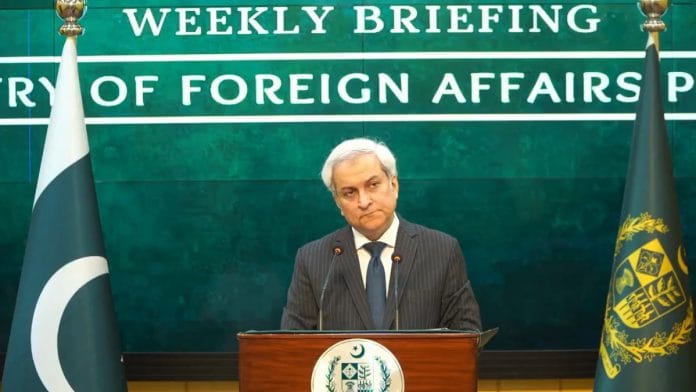
“Yes, we have expressed our concerns to Japan through diplomatic channels. In fact, a strong démarche has been made. Japan and Pakistan enjoy long-standing and cordial relations encompassing a wide array of fields and marked by a shared commitment to international peace, stability, and development. We have been conveying our concerns to Japan through diplomatic channels,” Tahir Andrabi, the spokesperson for the Pakistani foreign ministry said at a regular press briefing Thursday.
Andrabi added: “Whenever there is an engagement with India, India forces the inclusion of such references in its joint statements, not just with Japan but also with other countries. We have indicated this time as well that such language is inconsistent with the facts on the ground. The Japanese government’s endorsement of such one-sided formulations ignores the undeniable contribution and sacrifices made by Pakistan.”
Japanese Prime Minister Sanae Takaichi during her visit to India earlier this month had endorsed a joint statement strongly condemning terrorism “in all its forms and manifestations, including cross-border terrorism from Pakistan”.
The language has been some of the strongest agreed to by Japan, underlining its growing interest in deepening strategic ties with India.
The language was starkly different from the one used in the previous joint statement between India and Japan announced in August 2025, during Modi’s visit to Tokyo. At the time, the Prime Minister of Japan was Shigeru Ishiba.
“The two Prime Ministers unequivocally and strongly condemned terrorism and violent extremism in all its forms and manifestations, including cross-border terrorism,” the August 2025 statement said.
The latest statement was modified with “from Pakistan” added to the language following “cross-border terrorism”. The other major difference was the condemnation of the “terrorist incident in Delhi on 10 November 2025”.
The August 2025 statement came before the blast near the Red Fort in Delhi in November, but just four months following the Pahalgam terrorist attack, and Operation Sindoor. The change in language represents Prime Minister Takaichi’s personal interest in nurturing the India-Japan relationship.
Since coming to power in October 2025, Prime Minister Takaichi has unveiled a more proactive Japanese foreign policy, staking out potential positions on a number of prevailing issues including on the South China and East China Seas.
Takaichi’s government unveiled the updated “Free and Open Indo-Pacific” strategy in May 2026, highlighting a more robust interest in defence cooperation with like-minded partner countries.
“Japan will further advance the development of multilayered security cooperation frameworks. Japan will seamlessly utilize and coordinate the full range of policy tools at its disposal including ODA, OSA(Official Security Assistance), and defense equipment transfers and related cooperation,” the updated strategy document said.
The Japanese position on security cooperation with India has shifted in recent years. During Takaichi’s visit, the two countries agreed to co-produce the Unified Complex Radio Antenna (UNICORN) naval radio antennae, while also issuing separate joint statements on artificial intelligence and economic security.
The two countries sought to stake out a closer partnership in areas such as critical minerals, as well as energy security. Other outcomes include in sectors such as biogas and investments. Tokyo’s urgency in deepening bilateral ties with India comes as the larger geopolitical situation has shifted.
The US, which is Japan’s major military ally, has taken a different tack with its view on defence partnerships. China continues its march towards enhancing its military capabilities. With the shifting currents, New Delhi and Tokyo are looking for like-minded partners in the Indo-Pacific region.
Japanese businesses are also looking to increase their investments in India, as the Indian economy continues to maintain strong annual growth rates. Within this framework, the shifting languages on directly naming Pakistan for its cross-border terrorism assumes a certain significance.
Following the Pahalgam attacks in April 2025, India took a number of diplomatic steps against Islamabad including holding the Indus Waters Treaty in abeyance. India also launched Operation Sindoor, in May that year, targeting terrorist camps across Pakistan. The resulting 87-hour conflict between India and Pakistan has further changed the situation in the region.
(Edited by Amrtansh Arora)
Also Read: 3 choke points that could hinder India-Japan cooperation on rare earths
I just love Pakistani govt seething in anger.