





The recent India-Japan summit was different from the others. It recognised that in the 21st century, economic security begins with control over critical minerals as well as the ecosystems that transform them into strategic technologies.
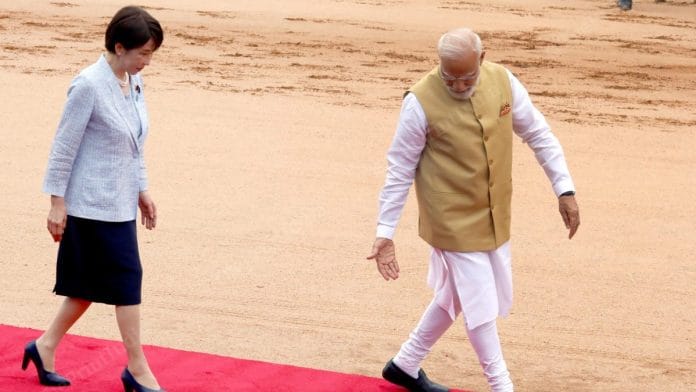
Prime Minister Narendra Modi hosted Japanese Prime Minister Sanae Takaichi in New Delhi from 1 to 3 July for the 16th India-Japan Annual Summit. It was Takaichi’s first visit to India since taking office. In the landmark meeting, the two leaders signed 16 agreements to match the “New Chapter” in their relationship. However, the part that stood out and is expected to continue to be widely discussed is the Joint Declaration on Economic Security and the accompanying cooperation on critical minerals, including rare earth elements.
The year 2027 will be marked as the India-Japan Year of Shared Horizons, and these horizons would not be complete without the discussion on critical minerals.
Vulnerable supply chains
In 2025, Beijing tightened exports on elements such as dysprosium, terbium, and yttrium, among others. It is important to note that rare earths such as neodymium, dysprosium, and terbium go into the permanent magnets used inside electric vehicle motors, wind turbines, and precision-guided defence systems. Lithium, cobalt, nickel, manganese, and graphite are the core inputs for the batteries powering EVs and grid storage. Gallium, germanium, and other critical minerals are essential to semiconductors, microchips, and LEDs. Others such as titanium, beryllium, and tantalum go into fighter jets, submarines, and satellites.
Considering the importance of new-age technology, the urgency behind the language of the summit is not abstract. India imports nearly 93 per cent of its rare earth magnets from China. After Beijing restricted the export of rare earths, the vulnerability of supply chains and China’s dominance of critical minerals became impossible to ignore. Indian industry was confronted with an uncomfortable reality, with some manufacturers only having a few weeks of inventory left.
Beijing’s strength clearly lies in extracting these minerals, but it also extends to controlling the entire value chain from refining and processing to the manufacture of high-performance permanent magnets. It is apparent to India that strategic autonomy in the 21st century will depend not only on securing access to critical minerals abroad but also on building robust domestic capabilities in mining, refining, processing, and advanced manufacturing. Without that foundation, geopolitical shocks are inevitable.
Also read: Every claim of victory gets reversed in the Middle East. Stay tuned for Iran’s
Japan’s lesson
For Japan, the disruption is not new. The year 2010 changed how Japan viewed critical minerals. After a maritime confrontation near the Senkaku Islands, shipments of rare earths from China to Japan were widely reported to have come to a halt. While Beijing denied imposing an official embargo, the disruption was enough to send shockwaves through Japanese industry.
At the time, China produced more than 90 per cent of the world’s rare earths, leaving Japan heavily dependent on a single supplier for materials essential to electronics, automobiles, and defence manufacturing. China’s share of mining since then may have marginally declined, but its dominance of the value chain, clubbed with a first-mover advantage, still gives it an edge over any other country in the world. Refining, processing, and permanent magnet production continues to be controlled by China, an expertise it has built over three decades.
The 2010 episode became a turning point for Japan. It responded by diversifying its import sources, investing in recycling technologies, and backing new mining projects overseas, particularly in Australia. However, this initiative worked only for mining, not for the part that actually matters: refining and magnet output.
This is the centrality of the argument. Diversifying ore sources means little if the processing capacity stays concentrated in one country. To this end, the India-Japan critical minerals partnership is not beginning from scratch. At its core is a Memorandum of Cooperation between the Geological Survey of India (GSI) and the Japan Organization for Metals and Energy Security (JOGMEC), which provides a framework for joint geological surveys and mineral exploration. Both agencies will collaborate directly to survey, identify, and assess upstream mineral resources, focusing heavily on critical minerals and rare earth elements. The partnership seeks to build resilient ecosystems to support next-generation industries such as electric vehicles, semiconductors, and AI, reducing reliance on single-source suppliers.
Also read: There is only one path to peace in Manipur—weapons must be surrendered
Choke points for the arrangement
The GSI-JOGMEC partnership operates alongside wider international initiatives including the Minerals Security Partnership (MSP) and efforts by the Quad Critical Mineral Initiative to create a resilient supply chain in an effort to expand both nations’ global energy mineral security. A parallel agreement on battery technologies is expected to strengthen India’s EV ecosystem. Incidentally, the relationship itself is somewhat established. Following a 2012 bilateral agreement, Toyota Tsusho’s Andhra Pradesh plant has processed monazite from rare earth oxides for Japan’s magnet industry, exporting over 1,000 tonnes in 2024.
In June 2025, IREL suspended this arrangement due to the need to conserve critical minerals for domestic use. Instead of shipping these materials to Japan, IREL negotiated around Japanese capital and processing technology being invested inside India. That pivot is the real foundation for the summit’s language that is based on Japanese technology plugging into India’s schemes.
However, India’s reserves are overwhelmingly light rare earths—cerium, lanthanum, neodymium—from coastal monazite sands. The elements that actually triggered the 2025 crisis, dysprosium and terbium, are heavy rare earths and India has almost none domestically. That is the first choke point. Japanese technology can do a lot with what India has, but it cannot manufacture ore that isn’t available. That gap is why New Delhi’s parallel attempt to source heavy rare earths from Myanmar’s Kachin state matters. The delay amid regional instability and the lack of motorable roads has not helped. The second choke point is that India still lacks industrial-scale refining technology, which is precisely what this deal is meant to transfer. This makes the arrangement somewhat circular, unless transfer is real and will expand in operations within the next few years. The third potential choke point is environmental clearances.
In the meantime, India has also moved on its own. The government approved a scheme in 2025, dedicating approximately Rs 7,280 crore to build 6,000 tonnes of annual integrated rare earth permanent magnet capacity over seven years. The initiative is aimed at the domestic market demand, which is expected to double by 2030. The chances are that Japanese technology and capital will also align with that scheme and fill the processing gap.
Both India and Japan have learned that strategic vulnerability primarily begins in industrial capacity. How one accesses the rare earth minerals is a solvable dilemma, but who controls the technology to transform them is the real question. In this scenario, the conversion of trusted partnerships and intent into real capacity would be needed much sooner than once imagined.
Rami Niranjan Desai is a Distinguished Fellow at the India Foundation, New Delhi. She tweets @ramindesai. Views are personal.
(Edited by Prasanna Bachchhav)