





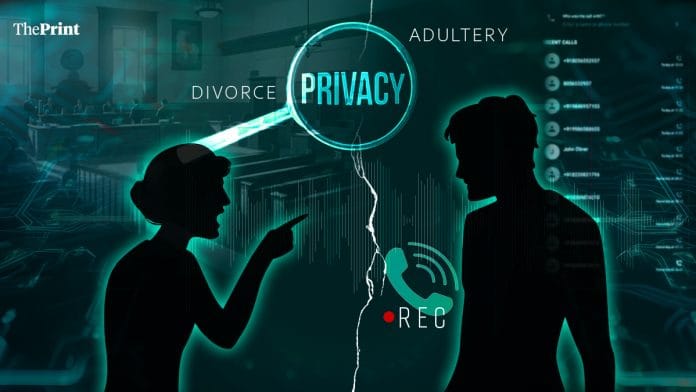

New Delhi: How much privacy can a spouse retain once their marriage lands in court?
Call records, WhatsApp chats, hotel bookings and secretly recorded conversations are increasingly at the centre of matrimonial disputes, forcing courts to decide where a spouse’s constitutional right to privacy starts and where the other spouse’s right to prove a case ends.
Past rulings by the Supreme Court and various high courts suggest there is no straitjacket formula, as the answer might depend on the specific facts of a case.
But as private data increasingly becomes evidence in matrimonial disputes, courts are seeking to balance a spouse’s right to privacy with the need to prove allegations in these cases.
The right to privacy argument stems from the Supreme Court’s 2017 Puttaswamy judgement, in which a nine-judge top court bench declared privacy an overarching fundamental right grounded primarily in Article 21 (right to life and personal liberty, as well as Articles 14 (right to equality) and 19 (right to freedom).
The court defined the right broadly to encompass bodily integrity, informational self-determination (data protection), and decisional autonomy (personal choices like sexual orientation and lifestyle).
Earlier this month, the Supreme Court passed an order that balanced privacy violation claims and disclosure in matrimonial proceedings.
Justices Manmohan and K.V. Chandran dismissed an appeal by the husband challenging the disclosure of his electronic and documentary records, arguing that providing such information to the court violated his fundamental rights.
The court noted that consensual sexual relationships outside of marriage do not enjoy absolute protection under Article 21 in matrimonial dispute cases.
The case arose when the wife filed a divorce petition in April 2022, alleging her husband was involved with another woman and had stayed with her at a hotel in Jaipur.
The family court and the Delhi High Court had allowed the preservation and production of the husband’s Call Detail Records (CDR) and hotel reservation documents in a sealed cover.
The top court dismissed his appeal.
Also Read: Shared groceries & dreams, no legal protection. Extra-marital live-ins are uncharted territory
Grey area
But the privacy issue in matrimonial disputes is still a grey area.
Over the years, different courts have ruled on the privacy issue in matrimonial disputes involving a range of issues from bodily autonomy to obtaining evidence without a spouse’s consent and the larger public interest.
In April this year, the Delhi High Court bench of Justice P.K. Kaurav held that a husband’s income tax details cannot be disclosed under the RTI Act in matrimonial disputes unless justified by a larger public interest.
In this matrimonial dispute, the wife had sought access to her husband’s income tax records from 2007-08 onwards to support her maintenance claims.
The Central Information Commission (CIC) had directed the Income Tax Department to furnish the husband’s financial details to his estranged wife.
Then, the husband challenged the order in the high court, arguing that the disclosure would violate his privacy. But the court also upheld the order, noting that ITRs are personal data and the wife could resort to other methods to obtain the information.
Another example is from October 2024, when a Madras High Court bench did not allow evidence that had been obtained without the other party’s knowledge.
“Privacy as a fundamental right includes spousal privacy and evidence obtained by invading this right is inadmissible,” the court ruled, while denying the husband’s request to admit call record details which were obtained without her consent as evidence.
Bodily autonomy
In another case in January this year, the Madhya Pradesh High Court ruled that seeking a woman’s medical examination to establish her past sexual activity in a divorce case amounted to a virginity test, which is impermissible and violates her right to privacy and dignity.
The court also held that the medical test was “not relevant for the purpose of divorce as refusal to enter into sexual intercourse in itself is not a ground of divorce”.
The court said the husband could bring forward other evidence to prove the wife’s disinclination to enter into sexual relations as alleged in the divorce petition, and a virginity test, or “two-finger test”, of the wife would neither be relevant nor conclusive for the divorce petition.
What legal experts say
Legal experts say the recurring conflict between privacy and evidence is rooted in the continued relevance of the fault theory in Indian matrimonial law.
The fault theory in Indian matrimonial law dictates that a divorce can only be granted if one spouse proves the other committed a specific matrimonial offense.
“The tension exists because we deliberately keep fault theory alive, for two reasons that pull in the same direction,” former SC Additional Solicitor General of India and senior advocate Pinky Anand told ThePrint.
“One is sanctity: marriage is still treated as a bond worth protecting, not a contract to exit on a whim. The other is welfare: proof of fault often shapes maintenance, alimony, and custody, and the party proving cruelty or adultery is usually the economically dependent one, overwhelmingly the wife,” Anand said.
According to her, evidence-gathering becomes intrusive not because intrusion is the goal, but because the law has tied private conduct to a spouse’s ability to secure financial protection.
However, senior advocate Geeta Luthra said matrimonial disputes present a different constitutional question from the one the Supreme Court was answering in the Puttaswamy judgement.
According to her, the landmark judgment principally concerned the individual’s right to privacy against state action, whereas disputes between spouses involve competing private rights.
The judgement, she says, “speaks about privacy in the private sphere, but Puttaswamy itself is essentially about privacy when the State is the actor”.
Luthra agreed that the evidentiary dilemma flows from the legal requirement to prove matrimonial misconduct.
“If the law continues to recognise grounds like adultery and cruelty, it cannot simultaneously make them impossible to establish,” she said, adding that courts must balance privacy with the need to prove allegations rather than elevating one value above the other.
Section 14 at the heart of the debate
The statutory basis for this balancing exercise is often traced to Section 14 of the Family Courts Act, 1984, which allows family courts to receive evidence that may assist in effectively adjudicating a dispute even if such material might face objections under the strict technical rules of the Evidence Act.
However, legal experts caution that this procedural flexibility does not displace constitutional protections.
“Section 14 lets a family court accept evidence that would normally be blocked by the technical rules in the Evidence Act if it helps the court reach a fair resolution. That is all it does. It clears a procedural hurdle. It does not override a fundamental right like privacy under Article 21,” Anand noted.
She said that the provision has been viewed as a women-centric procedural reform because it was intended to reduce evidentiary barriers in disputes that often arise within the private sphere of marriage.
A landmark ruling in this domain was the Supreme Court’s decision in July 2025 allowing secretly recorded conversations as evidence in family disputes and divorce proceedings.
Even though Section 122 of the Evidence Act protects communications made between spouses during marriage, a bench of justices B.V. Nagarathna and Satish Chandra Sharma held that the provision was meant for the protection of the “sanctity of marriage” and not the right to privacy of the individual/couple.
“The phone on which the conversation was recorded is no different from an eavesdropper” whose testimony would not attract the privilege, the top court had said, paving way for a landmark moment in the jurisprudence of spousal privacy in India.
This verdict was also used by the Chhattisgarh high court in February this year when it held that the right to privacy is not absolute and must yield to the right of a fair trial in matrimonial disputes.
In this case, the court went a step ahead in ruling that WhatsApp chats and call recordings, even if obtained illegally, are admissible if relevant and genuine.
However, the Telangana high court took a different view in June 2026 in a case where the husband had challenged a trial court’s refusal to accept audio recordings and financial documents as evidence to back his plea for divorce on the grounds of cruelty.
The high court held that secretly recorded telephonic conversations without the consent of the other spouse amounted to a clear breach of the right to privacy guaranteed under Article 21 of the Constitution of India, rendering such recordings inadmissible.
Hierarchy of cases
The conflicting high court rulings on secretly recorded conversations and digital evidence also reveal what Anand described as an emerging hierarchy of privacy interests.
“There is a hierarchy, and Indian courts have built it consistently even without naming it as such,” she said.
“Bodily autonomy sits at the top,” Anand added, citing past Supreme Court decisions establishing key precedents regarding gender equality, reproductive autonomy and individual privacy under Article 21 of the Indian Constitution.
She said this principle was reflected in the Madhya Pradesh High Court’s refusal to permit what was, in substance, a virginity test.
“Digital and financial privacy sit lower. CDRs, hotel bookings, and call records are now routinely ordered and produced once relevance to a pleaded ground is shown with sealed cover as the only real safeguard,” she said.
Anand added that the “unresolved loophole” lies in material that is bodily in substance but digital in form, such as intimate images, health records, or reproductive data stored on devices.
Luthra said matrimonial disputes require courts to balance two competing interests rather than treating privacy as an overriding right.
“As long as matrimonial misdemeanours have to be proved in law, the right of the allegedly wronged spouse to prove the case cannot simply be defeated by a claim of privacy,” she said.
In July 2025, the Chattisgarh High Court rejected a husband’s petition seeking the production of his wife’s call records. The case pertained to the wife initiating proceedings under the Protection of Women from Domestic Violence Act, 2005, against her mother-in-law, father-in-law and brother-in-law and a divorce plea on the grounds of cruelty as well.
“The husband cannot compel the wife to share her passwords of the cellphone or bank account, and such an act would amount to a violation of privacy and potentially, domestic violence. There should be a balance between marital privacy and the need for transparency and at the same time trust in the relationship,” the high court ruled.
“Marriage does not grant the husband automatic access to the wife’s private information, communications, and personal belongings,” it added.
Lastly, Anand also argued that the current patchwork of rulings points to the need for a clearer statutory framework on electronic evidence in matrimonial proceedings.
“Section 63 of the Bharatiya Sakshya Adhiniyam, 2023, formerly Section 65B, already governs electronic evidence generally, but it only authenticates a record once it is before the court. It says nothing about whether a spouse should have been allowed to obtain that record in the first place,” Anand explained.
According to Anand, matrimonial disputes need rules tailored to the context.
“A relevance threshold specific to the ground pleaded, a consent standard for recordings, and mandatory sealed-cover handling for financial and telecom data, so admissibility does not keep depending on which bench happens to hear the case,” she said.
(Edited by Sugita Katyal)