





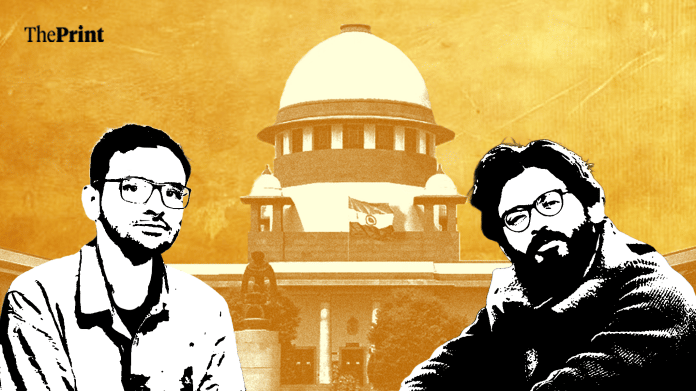


New Delhi: When a two-judge Supreme Court bench criticised an earlier court order declining bail to Sharjeel Imam and Umar Khalid under the Unlawful Activities (Prevention) Act (UAPA), the bail debate highlighted a wider issue: conflicting rulings from different court benches on the same subject.
Justices B.V. Nagarathna and Ujjal Bhuyan said on 18 May that the January decision departed from the principles laid down by a larger three-judge Supreme Court bench in the 2021 Union of India vs K.A. Najeeb case, which held that prolonged incarceration without trial is grounds for bail even under the stringent UAPA.
Stressing the importance of judicial discipline, Justice Nagarathna observed that smaller benches were bound by the decisions of larger benches and warned against conflicting positions on the same legal question by different Supreme Court benches.
Days later, a Supreme Court bench of Justices Aravind Kumar and P.B. Varale referred the matter of bail in UAPA cases involving prolonged incarceration to a larger bench, while not responding to the “serious observations” against the order that denied bail to Umar Khalid and Sharjeel Imam.
The contradiction reflected what some lawyers and judges see as a broader trend: increasingly open disagreements between coordinate benches on key constitutional questions.
“It’s obviously a function of the fact, as has been said many times before, that we don’t have one Supreme Court, but we have 17 Supreme Courts,” legal scholar Dr. Arghya Sengupta, Founder and Research Director of the Vidhi Centre for Legal Policy, told ThePrint.
“Some inconsistencies are bound to arise,” said Sengupta. “We shouldn’t be surprised.”
He told ThePrint that the inconsistencies are a predictable consequence of the court’s structure.
With 34 judges on the bench, India has the world’s largest constitutional court. Germany is next with 16 judges.
Also, the Indian Supreme Court does not hear cases en banc or with all judges sitting together. Benches usually sit in a combination of two or occasionally three judges.
When there are conflicting orders by two different two-judge benches, the legal issue involved in the dispute is referred to a three-judge bench for resolution.
A pronouncement in such a scenario becomes an authoritative declaration, requiring lower-strength benches to comply.
Larger Constitution Benches of five judges and more are assembled to consider major questions of constitutional importance or test the validity of legislation that comes under judicial scrutiny for allegedly breaching constitutional limits and fundamental rights of citizens.
The largest bench ever assembled was for the 1973 Kesavananda Bharati v. State of Kerala case after earlier Supreme Court benches had delivered conflicting rulings on how far Parliament’s power to amend the Constitution extended.
The case before the 13-judge bench–which at the time was almost the entire strength of the court–stemmed from the question of whether the state could impose restrictions on the management of a religious institution.
But it evolved into a broader battle over whether Parliament had the power to amend the Constitution.
The bench held that the Supreme Court had the right to strike down constitutional amendments at odds with the “basic structure” of the Constitution, a principle that is foundational to Indian constitutional thinking today.
“The Supreme Court was never intended to function in this many coordinate benches,” said Sengupta. “When it started, there was only one bench… There has been this docket explosion. Partly, it’s been beyond the control of the court, but partly it’s been enabled by the court itself taking up Special Leave Petitions.”
Also Read: Two judgments, no single standard: Why terror law UAPA’s bail threshold isn’t a straight line
Judicial discipline
Over the years, the Supreme Court has repeatedly emphasised that judicial discipline requires benches of equal strength to follow earlier decisions or refer disagreements to a larger bench.
In the 2004 Central Board of Dawoodi Bohra Community v. State of Maharashtra case, a Constitution Bench held that a coordinate bench cannot take a contrary view to an earlier coordinate bench and must instead refer the matter to a larger bench.
The case concerned the right of a community’s leader to excommunicate members, a right upheld by a five-judge bench in the 1962 Sardar Syedna Taher Saifuddin Saheb v. State of Bombay case.
Since then, however, many smaller benches have taken a different view on the ruling, but without ever actually referring it to a larger bench. The 2004 bench affirmed that they should have done so and proceeded to direct the actual question to a larger bench, which began hearing the case in 2023. The case is still pending.
The court has invoked the principle laid out in Dawoodi Bohra Community in several politically and constitutionally significant disputes.
In the 2020 State of Punjab v. Davinder Singh case, a five-judge bench criticised the reasoning of an earlier five-judge decision in the 2004 E.V. Chinnaiah v. State of Andhra Pradesh case, which had held that states are forbidden from sub-classifying Scheduled Castes to parcel out reservation quotas.
The bench nevertheless declined to overrule it, instead referring the issue to a larger seven-judge bench, which proceeded to overrule E.V. Chinnaiah in 2024.
A similar pattern appeared in the landmark 2017 K.S. Puttaswamy v. Union of India nine-judge privacy judgment, which affirmed a fundamental right to privacy under Article 21. The nine-judge bench was set up after earlier smaller benches had taken a contrary view on privacy rights.
Several opinions in Puttaswamy questioned the reasoning adopted in the 2013 Suresh Kumar Koushal v. Naz Foundation case by a two-judge bench, which had upheld the Indian Penal Code’s Section 377 criminalising homosexuality.
However, the court stopped short of formally overruling Koushal in the absence of a direct challenge to that judgment, even though the Koushal bench was smaller.
The overruling eventually came a year later in Navtej Singh Johar v. Union of India (2018), which struck down Section 377 and decriminalised same-sex relations.
Questions around implicit disagreement between benches have also generated criticism within the court itself.
In the 2019 Kantaru Rajeevaru v. Indian Young Lawyers Association case, a five-judge bench of the court reviewed petitions asking it to reconsider the court’s 2018 judgment in Indian Young Lawyers Association v. State of Kerala on the Sabarimala temple entry question.
In that case, a different five-judge bench had ruled that the Sabarimala Temple could not bar women between 10 and 50 years old from entering.
Justice Rohinton Nariman criticised the majority for effectively casting doubt on the earlier Sabarimala ruling without formally overruling it through established procedural mechanisms.
The matter was ultimately referred to a larger nine-judge bench, which has reserved its judgment thus far. Nariman, however, felt the review petitions should not have been considered at all.
“Bona fide criticism of a judgment… is certainly permissible, but thwarting, or encouraging persons to thwart, the directions or orders of the highest court cannot be countenanced…” he argued.
Justice Nagarathna herself has repeatedly raised concerns about bench consistency in recent years.
In 2023, after a bench led by then-Chief Justice D.Y. Chandrachud stayed the implementation of an earlier order passed by her bench in an abortion-related matter, Nagarathna criticised what she described as attempts at bench shopping. “Every bench of the Supreme Court is the Supreme Court,” she reminded litigants.
More recently, in the 2024 Property Owners Association v. State of Maharashtra judgment, which held that the State cannot always acquire private property as a “community resource”, Nagarathna’s concurring opinion cautioned against the manner in which the majority criticised an earlier strain of jurisprudence even while departing from it.
The judgment had overruled many 1980s nationalisation and seizure cases, such as the 1983 Sanjeev Coke Manufacturing Co. v. Bharat Coking Coal Ltd ruling.
Nagarathna expressed reservations about the majority’s harsh criticism of these earlier judgments, asking, “Can we castigate former judges and allege them with ‘disservice’ only for reaching a particular interpretive outcome?”
She raised similar concerns in the 2024 Mineral Area Development Authority v. Steel Authority of India case, in which she was the sole dissenter of a nine-judge bench.
The bench held that state governments can tax mineral extraction operations even on top of royalty payments; in doing so, it overruled a previous seven-judge bench which had decided the opposite in the 1989 India Cement Ltd v. State of Tamil Nadu case.
While this may seem a simple case of a large bench overturning a smaller one, the majority opinion actually relied on a decision by a five-judge bench in the 2004 State of West Bengal v. Kesoram Industries Ltd case.
This bench also disagreed with the seven-judge bench in the 1983 Sanjeev Coke Manufacturing Co v. Bharat Coking Coal Ltd case. Nagarathna argued that this five-judge bench did not have the right to cast doubt on the seven-judge bench from 1983.
In her dissent, she laid out a threshold for a bench to cast doubt on the rulings of a larger bench: only “patent error” or other grievous faults could justify such questioning.
In other words, a two- or three-judge bench should not cast doubt on the rulings of a five-judge bench unless the larger bench had made an obvious mistake. Even then, the proper remedy is reference to an even larger bench, such as a seven-judge Constitution bench, to make a proper determination.
Lawyer and legal expert Tanveer Ahmed Mir sees Nagarathna’s repeated comments as an attempt to reinforce the principles set out in the 2004 Central Board of Dawoodi Bohra Community v. State of Maharashtra case.
In this case, the court made its guidelines clear: a smaller bench must defer to a larger bench, and its proper remedy for disagreement is referral to an even larger bench.
Mir agreed with Nagarathna’s assertion that the two-judge bench that denied bail to Umar Khalid should not have gone against the three-judge bench in the 2021 Union of India v. K.A. Najeeb ruling.
The Najeeb ruling held that the courts can grant bail to undertrials if their fundamental right to a speedy trial has been violated by prolonged incarceration, even where it involves stringent legislation like the UAPA.
“Only a three-judge bench can raise a doubt on the wisdom of the earlier bench’s comments,” he said, adding: “That’s what Nagarathna says; that’s what the law is about. You could have asked the chief justice to incorporate a five-judge bench in view of some conflict in your mind.”
Such inconsistencies are visible in several other disputes.
In the 2020 Indore Development Authority v. Manoharlal case, for instance, a Constitution Bench had to step in to clarify a situation tangled by contradictory rulings from coordinate benches in the 2014 Pune Municipal Corporation v. Harakchand Misirimal Solanki and the 2018 Indore Development Authority v. Shailendra cases.
The matter involved compensation by the government for land acquisitions. Under the law, these acquisitions can be reversed if the government hasn’t paid within five years.
In 2014, a three-judge bench in the Pune Municipal Corp v. Solanki case held that the money had to actually reach the landowners, or at least be deposited with the court within five years. Compensation could not just be deposited in the government’s own accounts.
In 2018, however, another three-judge bench in Indore Development Authority v. Shailendra took the exact opposite view, holding that deposits in government accounts were enough.
A five-judge bench eventually decided in 2020 that compensation could count as “paid” even if deposited into the government’s own accounts. But significant confusion arose in the interim as landowners filed suits to reclaim their property based on the 2014 Pune Municipal Corp case.
Controversy also surrounds the 2018 Jarnail Singh v. Lachhmi Narain Gupta ruling, which held that SC/ST communities cannot be required to provide proof of their “backwardness” for reservation purposes.
A five-judge bench that decided the case strongly diluted the 2006 M. Nagaraj v. Union of India judgment, in which a similar five-judge bench had imposed conditions on the grant of reservation policies in government job promotions for SC/ST communities.
The resulting ambiguity generated several issues for high courts deciding reservation matters. In 2022, the top court found it necessary to issue guidelines, saying that representation of SC/ST groups in government jobs must be measured cadre-by-cadre, not across an entire department or service.
Inconsistencies
Mir termed these inconsistencies “deplorable”.
He cautioned against the example this has set for lower courts: “If the Supreme Court can’t be consistent, how do you expect the high courts and district courts to be consistent?”
Issues of inconsistency have become especially pronounced in cases involving criminal prosecution and personal liberty.
Nagarathna’s latest remarks on bail jurisprudence under the UAPA highlight how differing interpretations between benches can have implications for undertrial prisoners facing lengthy incarceration before trial.
Sengupta pointed to earlier inconsistencies among different Supreme Court benches on death penalty jurisprudence.
He pointed to a period when Justice S.B. Sinha commuted several death sentences to life imprisonment, while his contemporary, Justice Arijit Pasayat, not only upheld many but even at times upgraded a life sentence to a death sentence. He noted that these differences in judicial approach can be “a matter of life and death” for defendants.
Lawyer and legal scholar Abhinav Sekhri wrote on his blog in 2025 that many trapped in the system feel they are dealing with a “fickle rule of law, where consistency in outcomes is an honourable exception and even the simplest case appears to be cast in jeopardy”.
The court’s own precedents suggest that these tensions are not entirely new. But in recent years, judges have openly acknowledged the problem in judicial orders and courtroom exchanges.
“It tends to get reported more, but the phenomenon itself is not recent,” Sengupta said.
The resulting debate has centred not only on the substance of constitutional disagreements but also on the institutional mechanisms through which such disagreements should be resolved.
Sengupta argued that the first step should be “mitigating inconsistency rather than eliminating it altogether”.
Among the reforms proposed by the Vidhi Centre for Legal Policy is restructuring the Supreme Court into three divisions: an admission division, an appellate division, and a constitutional division. This would ensure that constitutional questions are heard by benches specifically tasked with delivering authoritative and consistent rulings.
But, for now, any proposals for structural reform are only theoretical.
(Edited by Sugita Katyal)