



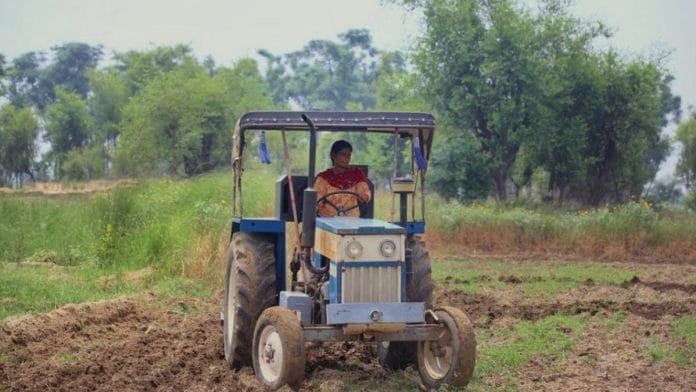
If you take a drive through rural Punjab today, you will find three incongruous elements that don’t belong in the same frame: a mortgaged field, an electrically powered tubewell for which no payment is made and which cannot be turned off, and a household with barely any young member—the family opted to sell land in order to finance their son’s migration to Canada than invest in a tractor. Three decades ago, the state’s economy was destabilised by insurgency. But today, it is threatened by fiscal mismanagement, a transition that has largely gone unnoticed.
In 1981, Punjab boasted the highest per capita income among Indian states. Even after two decades of militancy, it maintained a fourth-place ranking in 2001. Currently, it sits closer to the 10th position and bears the largest public debt burden relative to its economic size among the major states. The conventional explanation attributes this decline to armed conflict; however, this rationale does not align with the chronological sequence of events or theoretical analysis.
The timeline the militancy story ignores
Punjab’s income, when compared to the national average, remained stable through the insurgency and the subsequent decade. It was 119.6 per cent in 1960-61, reached a peak of 169 per cent during the Green Revolution in 1970-71, and remained at 146.2 per cent in 2000-01. A significant decline is observed only after the cessation of hostilities, with the income ratio decreasing to 106.7 per cent by 2023-24 and projected to be 105 per cent by 2025-26.
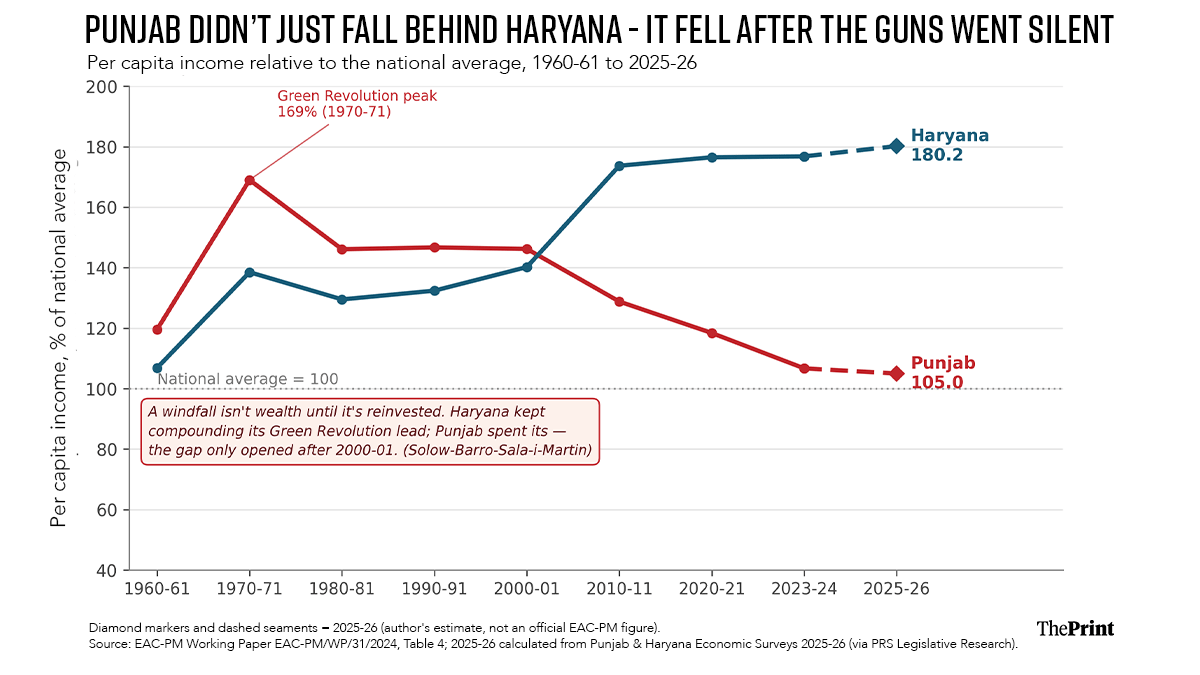
A security shock adversely impacts an economy during its occurrence. However, this particular shock manifests two decades later, during peacetime, indicating a failure in policy rather than the work of violence.
This scenario aligns precisely with growth theory. Punjab experienced a one-time productivity surge due to the Green Revolution’s high-yield seeds and guaranteed procurement, which increased output before the rest of the country could catch up. Subsequently, this advantage plateaued as the same seeds and irrigation technology became widespread nationally.
According to Robert Solow’s framework, further developed by Robert Barro and Xavier Sala-i-Martin’s work on conditional convergence, a region that initially advances due to a windfall will eventually regress toward the mean. This, unless it continues to deepen capital through reinvestment, retraining, and diversification, rather than relying on the initial gain. In essence, a windfall does not constitute wealth until it is reinvested.
Punjab expended its windfall instead of compounding it. In contrast, Haryana, which was formed from the same undivided state in 1966 and faced the same unstable years, pursued a different trajectory. Its income increased from 106.9 per cent in 1960-61 to an estimated 180.2 per cent by 2025-26. Despite having the same origin and instability, the outcomes diverged, with the disparity emerging only after 2000-01, an entire decade after Punjab’s militancy had ceased. It is challenging to attribute this divergence to violence alone. It aligns with convergence theory, which predicts such outcomes when one region continues to reinvest while the other does not.
Also read: Modi govt can’t see the difference between confidence and arrogance. What it means to people
A debt trap built on one crop
The fiscal narrative after 2000 is characterised by the mortgaged field from the earlier example. According to Evsey Domar’s 1944 r-versus-g condition, a state’s debt-to-GSDP ratio remains broadly stable only when economic growth surpasses the interest rate on its borrowing. This dynamic is mechanical rather than moral: interest compounds annually regardless of new governmental actions, implying that a debt ratio that does not decrease is being sustained rather than reduced. The only mechanisms to alter this are accelerated growth or a reduced deficit.
Punjab’s revenue deficit increased from Rs 544 crore in 1990-91 to Rs 24,588 crore in 2022-23, representing a five-fold increase even when adjusted for inflation. Its debt-to-GSDP ratio has consistently remained between 45 per cent and 47 per cent in recent estimates and is projected to be 45.1 per cent in the state’s 2026-27 budget—the highest among large states.
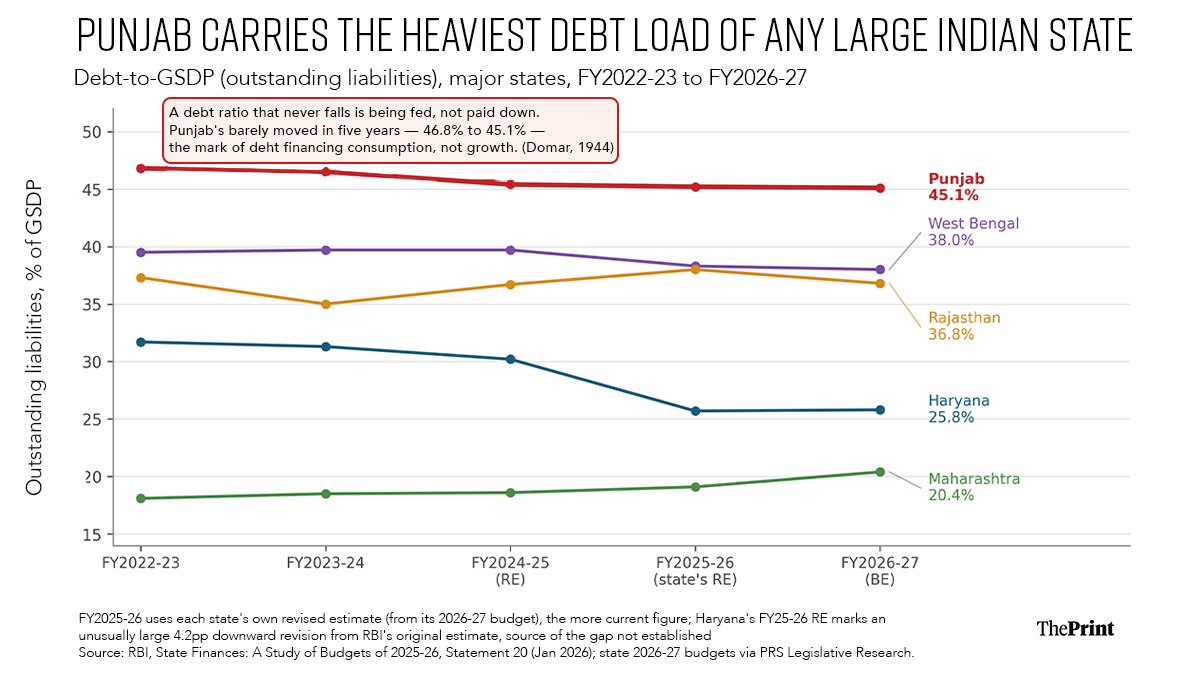
What transforms this situation from a simple arithmetic issue into a complex trap is the nature of the expenditures financed by borrowing. Public finance differentiates between revenue expenditure—such as salaries, pensions, interest, and subsidies—which do not generate future assets, and capital expenditure, which does. In Punjab’s 2026-27 budget, revenue expenditure amounts to Rs 1,48,146 crore, while capital outlay is merely Rs 18,381 crore, indicating approximately eight rupees of consumption for every rupee of investment, despite a genuine 76 per cent increase in capital spending that year. Committed expenditures, including salaries, pensions, and interest, accounted for 72 per cent of revenue receipts in the 2026-27 estimate and 85 per cent in the previous full year of actuals; interest payments alone consume nearly a quarter of the state’s total revenue. This represents a mortgaged field on a governmental scale: debt that does not fund capital deepening fails to enhance the growth rate sufficiently to surpass it, instead financing past payrolls with future revenue. The fiscal deficit is projected at 4.1 per cent of GSDP, exceeding the 16th Finance Commission’s recommended ceiling of 3 per cent, a limit that Punjab surpasses in its own published figures.
The issue persists due to political economy rather than mere arithmetic, with three distinct failures reinforcing each other in a cycle that warrants explicit identification.
Mancur Olson’s theory of distributional coalitions posits that entrenched interest groups resist reallocation because the costs of change are concentrated on them, even when the benefits are broader and more diffuse. Punjab’s MSP-and-procurement framework for wheat and paddy has established such a coalition, and with committed expenditure already consuming three-quarters of revenue, the coalition’s influence now serves as both a budgetary and political constraint.
A 2024 EAC-PM paper questions whether this situation constitutes Dutch disease, a term coined by Max Corden and Peter Neary in 1982 to describe a dominant, state-favoured sector that hinders diversification, mirroring the coalition’s economic impact. The more the budget is skewed towards one crop, the more challenging it becomes to cultivate alternatives. This protectionism explains the tubewell from the initial example.
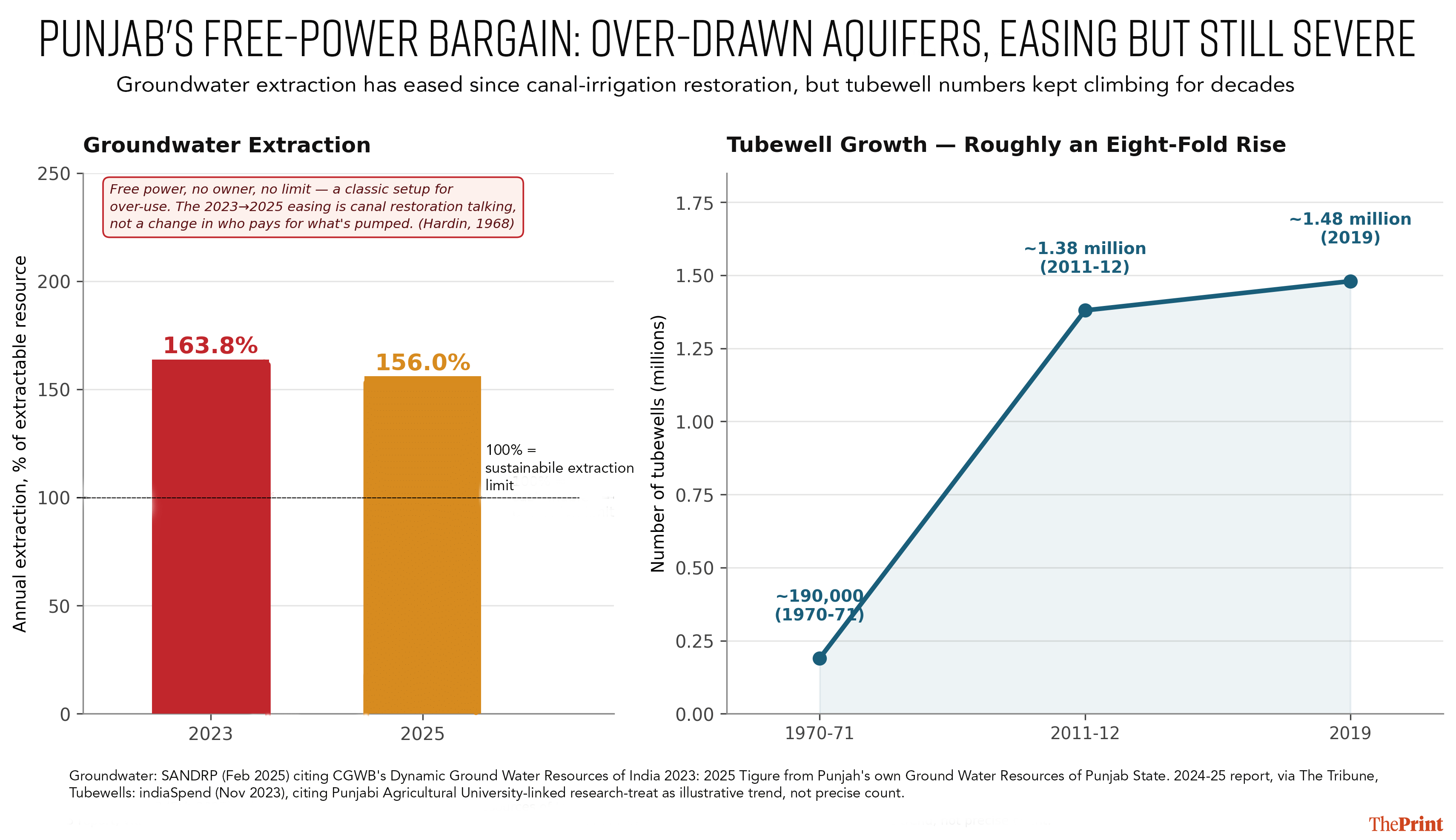
Free electricity has turned groundwater into a classic example of the tragedy of the commons, a concept introduced by Garrett Hardin to describe a shared resource for which no one bears the true cost of exploitation. With free electricity, no ownership, and no limits, overuse is inevitable. Punjab extracted 163.8 per cent of its replenishable groundwater in 2023, which reduced to 156 per cent by 2025 as canals were restored—a genuine improvement. However, the approximately Rs 15,200 crore spent on power subsidies for 2026-27, with agriculture accounting for nearly Rs 8,800 crore, indicates that the underlying incentive remains unchanged: the reduction is attributed to canal restoration, not a shift in who bears the cost of extraction.
Also read: Why trust in international relations needs to be incentivised
The exodus no one is charting
The third figure in the opening scene, the empty house, completes the narrative. The classic brain-drain theory, as articulated by Jagdish Bhagwati and Koichi Hamada, conceptualises skilled emigration as a net loss for the country of origin. Subsequent research, particularly by Michael Clemens, has demonstrated that remittances can mitigate this loss. This is exemplified by the Kerala model, where financial transfers persist long after the migrant’s departure.
Punjab illustrates a more severe interpretation of this theory, as capital often exits prior to the migrant. While migrants from Kerala remit funds to their homeland, those from Punjab frequently relocate their capital abroad. Despite representing only 2.19 per cent of India’s population, Punjab accounted for nearly 60 per cent of new Indian student permits for Canada in 2022, contributing approximately $3.7 billion of the $11.7 billion spent by Indian students on Canadian education. This signifies a disproportionate financial outflow, given Punjab’s relatively small population size compared to the national total.
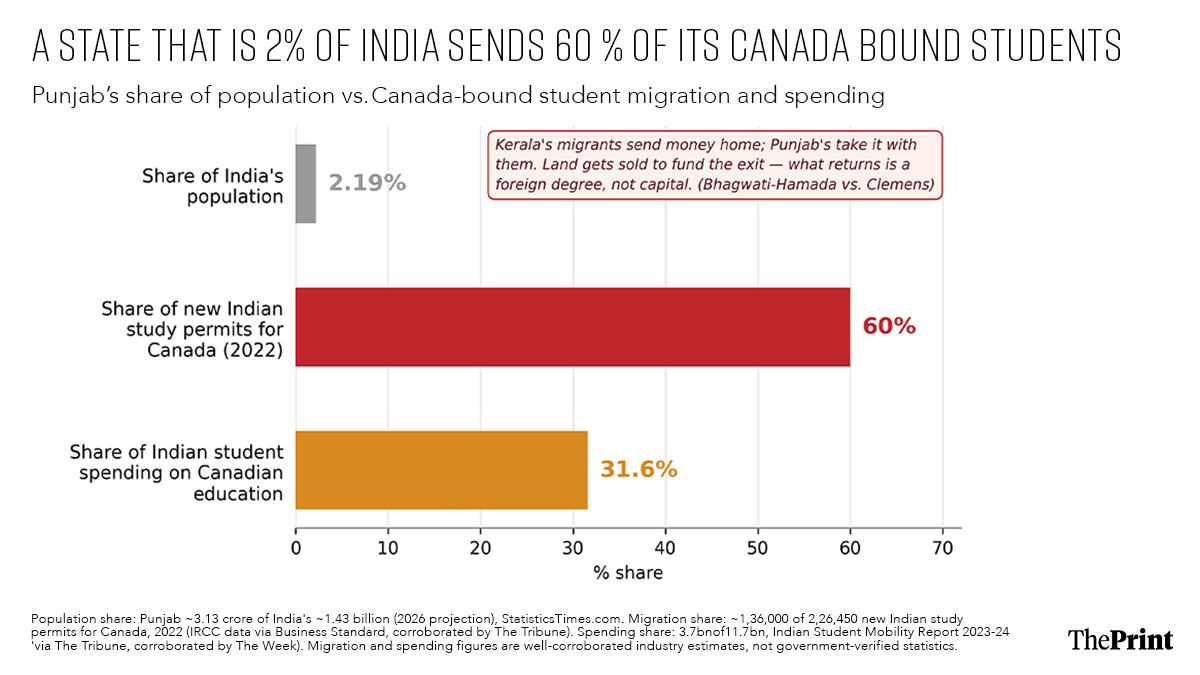
Kerala experiences a capital account surplus due to migration, whereas Punjab faces a deficit. In Punjab, families often resort to borrowing or selling land to finance emigration, with the return being a foreign degree rather than capital for local enterprises. Arthur Lewis’ model, which posits labour migration from low- to high-productivity sectors, assumed that such movement would remain within the national economy, benefiting urban areas while depleting rural ones. However, in Punjab, this migration increasingly bypasses the state, and frequently, the country as well.
No policy should attempt to directly halt visa issuance, nor is it feasible to do so. The primary objective should be to provide more productive uses for loans and land, through robust industrial policy and business-friendly reforms, making investment in Punjab businesses more attractive than financing emigration. Haryana demonstrates that such a transformation is achievable from a similar starting point, though it does not suggest the process is straightforward.
When evaluated over time, militancy does not account for a decline that commenced a decade after the cessation of violence. Instead, three subtle, cumulative failures provide the explanation: a debt dynamic where borrowing funds consumption rather than growth, a coalition that safeguards a single crop while depleting water resources, and a transformation occurring abroad rather than domestically. This situation did not necessitate any violence; rather, it resulted from 30 years of mundane bureaucratic processes, including loan agreements, subsidy bills, and visa applications. Reversing this trend will require precisely the type of unremarkable, coalition-challenging reforms that governments find difficult to promote.
Bidisha Bhattacharya is ThePrint Consulting Editor (Economics) and an Associate Fellow, Chintan Research Foundation. She tweets @Bidishabh. Views are personal.
(Edited by Prasanna Bachchhav)
Socialism, corruption, and drugs.