


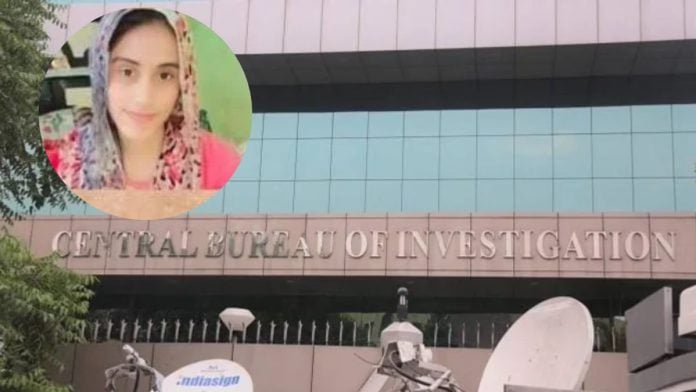
Chandigarh: On 11 August 2025, 18-year-old Manisha left the Kids Care Play School in Singhani village of Bhiwani district a little before 2 pm. A CCTV camera at the school caught her leaving at 1.58 pm. She told a colleague she had some urgent work at the Ideal Nursing College nearby, wanting to ask about a B.Sc. Nursing seat.
Manisha never reached home. On 13 August, her body was found in a field near a canal. Her neck had been severed and her face was beyond recognition.
The Haryana Police said Manisha had died by suicide, and that her body had been bitten by animals. The Central Bureau of Investigation (CBI), which took over the case about a month later, filed a closure report in August this year that largely agreed.
However, on 31 October, a CBI court in Panchkula rejected that report, and ordered a fresh probe. Special Judicial Magistrate Anil Kumar Yadav called the investigation by both the local police and the CBI “biased and defective”.
The 26-page order made available Monday, passed on a protest petition by Manisha’s father Sanjay, explains why. Almost every pillar of the suicide story, the court found, had either collapsed in court or been contradicted by AIIMS doctors.
Manisha’s death and the suicide theory floated by the police had led to anger and protests that spread well beyond Singhani last year. Within days of the body being found, people in Bhiwani and neighbouring Charkhi Dadri had joined protests. Students, villagers, khap panchayats and social groups joined in. Shops stayed shut in Dhigawa Mandi, Loharu, Badhra and Dadri, and the Delhi-Pilani road was blocked.
Manisha’s father Sanjay rejected the police’s suicide claim outright. He said the police were overlooking key facts. The family’s village, Dhani Laxman, refused to let the cremation go ahead until its demands were met. One of them was a third post-mortem at AIIMS, Delhi. A mahapanchayat repeated the call for a CBI probe. The administration had to cut mobile internet in both districts for 48 hours as the protests intensified. The government transferred the Bhiwani Superintendent of Police and suspended five policemen over lapses.
On 20 August, 2025, Chief Minister Nayab Singh Saini announced that the CBI would take over the case. The agitation ended, and Manisha was cremated the next day.
Also Read: A Haryana police dog died of starvation. The case outlived the constable punished for it
AIIMS said it was neither poison nor animal bite
The suicide theory rested on poison. The police and the CBI said Manisha drank monocrotophos, a pesticide. They said animals mutilated her face and neck afterwards.
A five-doctor medical board of AIIMS Delhi, reviewed the case afresh and gave a unanimous opinion. Death was caused by a massive ante-mortem injury on the neck, made by a sharp-edged weapon. The face was skeletonised by a skin-dissolving fluid, possibly corrosive. There was no sign of any animal bite on any part of the body.
The board also rejected the opinions the CBI had sought from doctors in March 2026. These came seven to eight months after the death. The board said they were neither required nor desired. They were based on tissue reports from a post-mortem examination done about 48 hours after death, which carry no significance in forensic practice. The court said the viscera reports, which the CBI had used to show poison, were “inconsequential”.
The court also looked at the photographs. Manisha’s salwar, kameez and dupatta were almost intact. The only injury was at the back of the neck. In the court’s view, animals could not have done this. It added that the theory of animal bites was not supported by a single witness.
Poison purchase was never shown
The police had told mediapersons that surveillance camera footage showed Manisha buying a litre of monocrotophos at Devender Khad Bhandar in Singhani. During arguments, the court asked the CBI’s investigating officer, DSP Shalinder Mayal, whether any such footage was on the judicial file. He said no. The court noted that he had earlier said the footage existed.
The shop’s register did not help either. The entry for the alleged sale did not carry the name of Manisha’s father, though almost every other entry did.
The court then listed what the CBI had left unanswered. Nobody saw her buy the poison, and nobody saw her drink it. Nobody smelt it, though the court said opening a container of such poison spreads a strong odour over a wide area. Her father’s counsel had put the radius at 500 metres. No bottle was found at the spot. And the counsel had argued that dogs which fed on a poisoned body would have died, but none did.
The court also took note of the complainant’s argument that Manisha was in a normal mood that day. She spoke to her father, her aunt and her colleagues. Documents collected by the CBI showed no sign of anxiety or depression.
Also Read: No DJ, no liquor, no pre-wedding shoot—Agrawal mahapanchayat frames 8 ‘rules’ for couples
The ‘two suicide notes’
The police claimed two suicide notes. The court found the recovery of both doubtful.
The first was said to have been handed over to Deputy SP Sanjeev Kumar, head of the Haryana Police’s Special Investigation Team (SIT), on 17 August 2025. That was four days after the body was found. It was allegedly given by a distant relative at the DSP’s office. Manisha’s parents were not told.
The DSP gave a statement to the CBI’s first investigating officer, Inspector Vivek Kumar, on 24 September, 2025. It made no mention of a suicide note. He spoke of it for the first time in a supplementary statement on 17 February, 2026.
During the hearing, the relative was called on the phone with the speaker on. This was done in front of the CBI’s public prosecutor and DSP Mayal. He said he had never handed over any note. According to the order, the DSP had only shown him some writing on his mobile phone and said it was Manisha’s suicide note. The police had not made him a witness and had not recorded his statement under Section 180 of the Bharatiya Nagarik Surakhsha Sanhita (BNSS).
The second note was allegedly found in a polythene bag near the body. No family member signed the recovery memo. No independent witness was joined. The court said no video of the recovery was made, though Section 105 of the BNSS makes it mandatory. The note has no date and no signature. Manisha’s counsel pointed out that it does not even use the word suicide. The court noted that she left no message on her phone either.
On handwriting, the CBI relied on an expert board that found a match with Manisha’s writing. The court compared the note with her Class 12 register and saw differences in the formation of letters and the spacing between them. It cited Supreme Court rulings in Machindra, Tomaso Bruno and the 2026 Gopal Pathak case. Courts are not bound by expert opinion that is not backed by convincing reasons, these rulings say.
The DVR that sat with a DSP for 40 days
The court was harshest on the handling of surveillance camera evidence. Manisha’s family had acted within hours. By about 6.45 pm on 11 August, her parents were outside the nursing college. They called 112 and asked the police to search the premises and check the cameras.
Her father also told the police about a black Scorpio parked near the college, with two people sitting in it after coming out of the college. ASI Shakuntla, the SIT’s investigating officer, admitted this in her statement. The court said the police did not trace the vehicle or check its registration number.
On 12 August, Assistant Sub-Inspector Shakuntla went to the college. The staff did not let her in. They told her the footage would be shown “tomorrow”. The court called this the helplessness of the police before powerful people, or collusion. On 13 August, a large crowd protested in the area and demanded a search of the college. The college had around 20 cameras. The court said it was a blind spot that should have been sealed at once. The police did not do it.
DSP Sanjeev Kumar took the digital video recorder (DVR) from college owner Ashok Kumar Sangwan on 17 August 2025. He made no seizure memo. He did not record the recovery on video, or join any independent witness. In his statement to the CBI, he said the DVR was with him without any memorandum. He also said the cameras had not been working since April 2025. It stayed with him for almost 40 days.
The court asked how a senior officer “dared” to do this in such a sensitive case. It said keeping electronic evidence for 40 days without legal process leaves full scope for tampering. It added that the footage appeared to have been tampered with, or that serious efforts were not made to retrieve it. The CBI’s public prosecutor had argued that the agency took over a month later and had no role in any tampering. The court was not persuaded.
The SIT’s make-up also drew a mention. It had a DSP, three inspectors, a sub-inspector and two ASIs. Yet the junior-most officer, an ASI, was made the investigating officer.
Also Read: Panchkula school assault: 6-yr-old out of danger as 8-yr-old who attacked her undergoes psych eval
The body, drag marks and missing phone
The court said the CBI could not explain how the body came to be where it was found. The spot was near the main road. Relatives had searched the area several times on 11 and 12 August and found nothing. Yet on 13 August, the body was lying there.
The crime scene team had noted parallel drag marks, which the court said point to the body being brought from elsewhere. It said these marks contradict both the poison theory and the suicide theory. The court also asked who first informed the police about the body and why that person was never examined. ASI Shakuntla’s own case diary does not say who told her.
Manisha’s phone was found broken in two. One half was in the canal and the other near the body. Just after midnight on 12 August, a relative called her number at 12.05 am and it rang. Calls at 12.06 am and 12.07 am also went unanswered. By 1.04 am and 3.46 am, the phone was switched off. The family asked the police and the CBI to trace where the phone was, but nothing was done. The court called this a lost lead.
What happens now
The court rejected the closure report and directed the CBI to carry out further investigation. It must be done by any Station House Officer or a branch head of the CBI, as per its manual. Witness statements are to be recorded at that officer’s dictation, and not by a subordinate. The complainant had wanted an officer above the rank of Inspector General.
The court ordered a fresh handwriting examination by a board of at least three experts from two laboratories, one preferably from the southern states. It ordered a probe into the role of ASI Shakuntla, DSP Sanjeev Kumar, the owner of Devender Khad Bhandar and Ashok Kumar Sangwan, including their call records. They are to be asked to undergo narco analysis, brain fingerprinting and BEOS tests, but only with their consent. The data of Manisha’s phone and that of a relative, Sanjay Kumar, will be collected. The black Scorpio is also to be traced.
The court said faith in the CBI “appears to have been shaken”. It cited the Supreme Court’s ruling in Edakkandi Dineshan, which says that lapses by investigators should not be held in favour of the accused. A copy of the order has been sent to the CBI director. The case will come up on 23 December 2026, when a status report is due.
(Edited by Nardeep Singh Dahiya)
Also Read: Who is gangster Himanshu Bhau: Bishnoi rival was a ‘studious child’ who found crime in his teens