


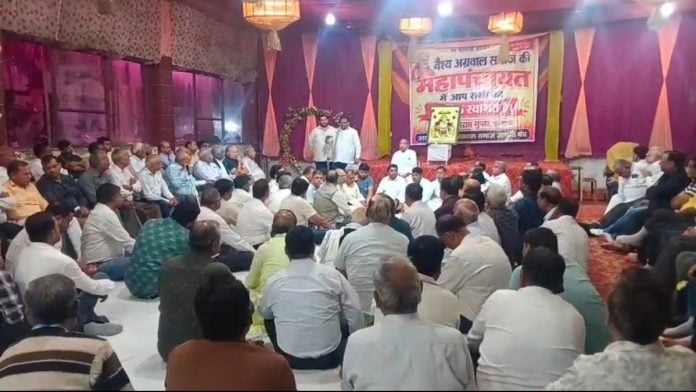
Chandigarh: A boy and a girl who are about to be married cannot go out together. Nor can they get a pre-wedding photo shoot done. That is what the Vaishya Agrawal community’s mahapanchayat held in Palwal has now decided for its young.
The decision was taken at a mahapanchayat held Sunday evening at Shyama Kunj banquet hall, and attended by members of the community from Palwal, Faridabad, Gurugram and Delhi. After around three hours of discussion, the gathering passed eight resolutions, aimed at ending what it called ‘social evils’ and ‘wasteful spending’ on weddings and funerals.
The ban on couples meeting before marriage is the one that stands out. Most of the other resolutions deal with money and show-off. This one tries to set rules for the personal conduct of two young people before they are even married.
Balram Gupta, a former municipal councillor who convenes the Vaishya Agrawal Samaj Jagriti Manch and led the meeting, told ThePrint Tuesday that pre-wedding shoots, and a boy and a girl going out together before marriage, were not part of the community’s culture. He said the trend had grown in recent years and was now causing problems in society, particularly when the relationship breaks down before the wedding.
The other resolutions are about the big Indian wedding. DJs will not be allowed, and music inside a banquet hall will have to stay within the government’s noise limits. No liquor stalls will be set up at weddings. Expensive invitation cards, and the sweets and gifts sent with them, will give way to WhatsApp messages and phone calls. Guests from both sides together will be limited to 300 to 400. The number of dishes on the menu will be capped between 21 and 31, and families will be encouraged to hold the pheras and the wedding during the day rather than at night.
The community also turned its gaze to death rituals. The mahapanchayat has decided to stop the death feast, or mrityu bhoj, altogether. Fewer sheets will be offered on the bier at the cremation. People coming to condole will be asked to bring gola, ghee, camphor or other items needed for the last rites instead, so that the grieving family gets some real help.
Gifts to the transgender community will also be capped. At weddings and births, the shagun to kinnars will not exceed Rs 5,100. At festivals such as Holi and Diwali, what they collect in the market will be limited to Rs 500.
Gupta said many customs had turned into a show, and that this weighed most on poor and middle-class families. The aim, he said, was not to hurt anyone’s sentiments but to end practices that had become an economic and social burden.
Those present pledged to follow the decisions in their own families first and then carry the message from house to house.
Gupta said he would soon call a bigger mahapanchayat, inviting community members from across Haryana and from neighbouring Rajasthan and Uttar Pradesh, to spread these bans across the region.
(Edited by Amrtansh Arora)
Also Read: ‘Divisive agenda’ — why Mewat Jat khaps boycotted ‘Hindu mahapanchayat’ after Nuh violence