





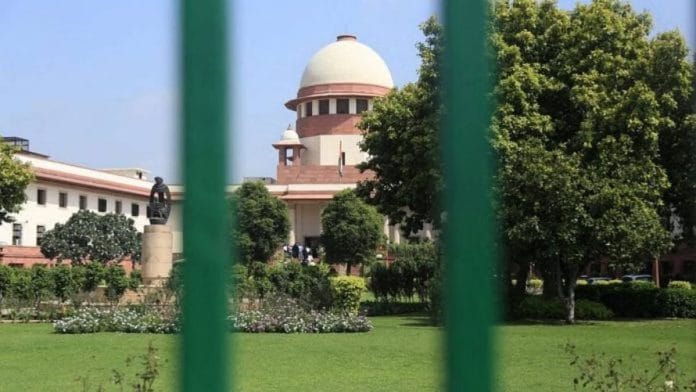


New Delhi: The Supreme Court ruled Tuesday that a Border Security Force (BSF) constable could pursue his service dispute in the Delhi High Court despite the disciplinary proceedings against him having occurred elsewhere.
The dispute arose after Baksish Ahmad, a BSF constable posted with the 44th Battalion at Narayanpur in West Bengal’s Malda district, was dismissed from service in 2022 following a departmental inquiry into allegations that he had contracted a second marriage while his first marriage was still valid, without obtaining permission from the competent authority. His statutory petition was subsequently rejected by the Inspector General, Frontier Headquarters, BSF, based in Jammu.
When Ahmad approached the Delhi High Court to challenge both orders, the court declined to entertain the petition, reasoning that the relevant events had occurred in West Bengal and Jammu & Kashmir, and that the mere presence of BSF headquarters in the national capital did not make Delhi the appropriate forum.
The Supreme Court, however, disagreed. Reversing the high court ruling, it held that “the Delhi High Court would have territorial jurisdiction in light of the situs of office of the Union of India and the Director General”, and stressed that Article 226 “permits filing of a writ petition as per situs of office of the respondent(s) [clause(1)] and cause of action [clause(2)]”.
The bench further held that “the doctrine of forum non conveniens has been misapplied by the Division Bench in the context of writ jurisdiction referrable to Article 226 of the Constitution”, adding that where a litigant invokes Article 226(1), “the doctrine of forum non conveniens may rarely apply”.
In a passage likely to inform future jurisdiction disputes, the top court cautioned that directing a litigant away from a forum chosen on the basis of the respondent authority’s location could be “likely to deny access to justice rather than advancing it”.
At its core, the judgement revisits a question that has shaped Indian writ jurisdiction for over six decades: What determines a high court’s territorial jurisdiction under Article 226 of the Constitution? Is it the place where the dispute arose, or the place where the authority exercising power is located?
Article 226 & past rulings
For most of the last half-century, courts have increasingly answered that question by focusing on the “cause of action” under Article 226(2).
In the Baksish Ahmad case, however, the Supreme Court revived an older idea embedded in Article 226(1): that the location of the authority itself remains an independent basis of jurisdiction. In doing so, the court elevated an obscure 2012 order, unsettled a line of Delhi High Court precedent, and reopened a constitutional debate that many had assumed was settled.
The Constitution’s Article 226, which governs the jurisdiction of high courts, initially stated that HCs would have the power to “throughout the territories in relation to which it exercises jurisdiction, to issue to any person or authority, including in appropriate cases any Government, within those territories directions, orders or writs”.
Courts quickly interpreted the wording as implying that the relevant territory was the territory of the ‘authority’ in question, and not necessarily where the dispute had taken place.
In 1961’s Lt. Col. Khajoor Singh vs Union of India, the Supreme Court considered whether an officer stationed in Jammu & Kashmir could appeal to the J&K High Court against his dismissal. It unanimously ruled against him, interpreting Article 226 to mean that the only High Court with jurisdiction was the court of the territory in which the ultimate authority sat – in all military cases, of course, this would be Delhi, which not only houses the Army’s headquarters but also the Union of India’s government.
The decision, and other contemporary judgments in the same vein, effectively implied that the Delhi High Court was the only allowable forum for such service disputes, or indeed many disputes in which one litigant had their ultimate headquarters and top authorities in Delhi.
In response, in 1963, Parliament passed the 15th Amendment, adding an extra clause to Article 226. This new item, now reflected as Article 226(2) introduced the doctrine of ‘cause of action’ – a High Court could hear cases if the cause of action originated in that court’s territory. The original clause, which had originated the ‘authority’ jurisprudence, then became 226(1).
Subsequent litigation gradually began to rely on cause-of-action analysis under Article 226(2) to determine jurisdiction. In 1994’s ONGC vs Utpal Kumar Basu, for instance, the Supreme Court ruled that mere receipt of communications in West Bengal did not give the Calcutta HC jurisdiction over a dispute in Gujarat. In 2004’s landmark Kusum Ingots & Alloys Ltd vs Union of India, the Court ruled that the Delhi HC did not automatically have jurisdiction over a challenge revolving around a law, just because the law was passed by Parliament in Delhi.
The doctrine was adopted by High Court cases such as 2011’s Sterling Agro Industries Ltd vs Union of India, in which the Delhi HC clarified that a customs and excise dispute could not go to that court only because the ultimate excise authority was headquartered there.
The HC in Sterling Agro made it clear that while a court may have partial jurisdiction over a case, it also has the discretion to reject said jurisdiction by citing forum conveniens—the doctrine that a case should be heard in the most appropriate forum, and that other courts should exercise their discretion not to hear a case for which they were not the appropriate venue.
Thus far, things had been consistent—disputes should go to the HC in whose territory the ‘substantial cause of action’ had taken place, and the presence of a litigant’s overall authority in Delhi did not mean the Delhi HC automatically had jurisdiction. Shortly afterward, though, the SC made a slight reversal.
In 2012, the Supreme Court heard the case of a CISF constable who had been dismissed for gross negligence; the Delhi High Court had refused to take up his appeal for lack of jurisdiction, citing forum conveniens. In Abrar Ali vs CISF, the Supreme Court ruled that the Delhi HC had erred in not sufficiently considering its jurisdiction under Article 226(1), regardless of the cause of action.
The decision, however, was a brief, unreported order that remained obscure in the years after it was passed. No Supreme Court cases cited the Abrar Ali order; instead, it was largely acknowledged by the Delhi High Court. Even then, application was inconsistent. Some benches of the Delhi HC cited the order to claim jurisdiction, such as in 2025’s Sunil Kumar vs Director General, SSB, and 2026’s Ajit Kumar Singh vs Union of India.
Other cases, however, declined to rely on Abrar Ali. In 2024’s Naman Sharma vs Union Of India, the Delhi HC declined to assert jurisdiction over a suit against the ONGC; it perfunctorily remarked that Abrar Ali “would not be applicable”.
The recent case, Baksish Ahmad, was one such example. The Delhi HC declined to entertain the petition, holding that although the BSF headquarters was located in Delhi, the dispute was more appropriately connected to West Bengal and Jammu & Kashmir and therefore Delhi was not the forum conveniens.
In reversing this, the SC has abruptly brought the Abrar Ali precedent into the spotlight, cementing the idea that courts—and the Delhi HC in particular—must not ignore 226(1) when considering forum conveniens. It explicitly criticised the HC’s rejection of jurisdiction, remarking that “In our considered opinion, the doctrine of forum non conveniens has been misapplied by the Division Bench.”
The judgement is a step towards a balanced approach between 226(1) and (2), and represents a shift away from a purely cause-of-action centric view of jurisdiction. The SC has taken, rather, a ‘chain of command’ view, ruling that the ultimate authority—the HQ, or even the Union of India itself—is responsible for the decisions taken, and therefore can be sued in their own locations. In doing so, it has re-emphasized that, while 226 (2) is still in play, 226(1) remains an independent jurisdictional basis and forum non conveniens should not be used to nullify it.
For now, the immediate beneficiaries may be CAPF personnel. For constitutional lawyers, it reopens an old question thought largely resolved after the rise of cause-of-action jurisprudence: whether the location of governmental authority matters as much as the place where a dispute occurs.
(Edited by Archishman Ganguly)
Also Read: Inside India’s public defender experiment: The lawyers fighting for those who can’t afford one