



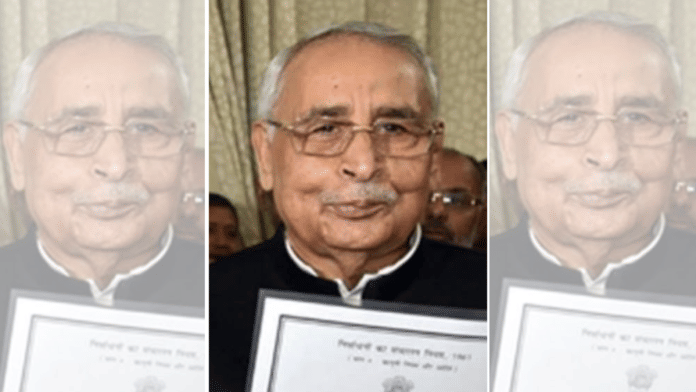
New Delhi: In a searing indictment of the Enforcement Directorate’s investigation tactics, the Delhi High Court has slammed the ED for continuing with its probe against family and companies of the late industrialist-politician Mahendra Prasad, despite the police closing the FIR that was the basis of its money laundering case.
The FIR was registered in February 2021 against Aristo Group of Companies, company directors as well as Prasad’s family members.
After a thorough probe, Delhi Police’s Economic Offence Wing (EOW) had filed a cancellation report before a court, which accepted it and closed the case. This FIR was registered on a complaint given by Prasad’s two sons.
However, the ED continued to investigate the case and justified its probe by relying upon an unrelated FIR against Prasad, registered in 2019 at the behest of his wife. This FIR contained allegations of wrongful confinement and removal of certain jewellery and offences under the Passports Act.
Justice Anish Dayal, while quashing the ED case termed its probe as a “colourable exercise of power”, observed that continuing a money laundering probe without an active scheduled offence is akin “to exhume a corpse from which the life breath has gone”.
The court has quashed all money laundering proceedings against Prasad’s company and his family members. The 115-page judgement ruled that the ED cannot continue money laundering investigations once the underlying predicate offence has been legally closed.
The genesis of the case lies in a family and estate dispute within Prasad’s family.
After the seven-time Rajya Sabha MP from Bihar died in November 2021, two factions of the family—one led by daughter-in-law Kanchana Rai and her children, and the other by his sons Rajeev and Ranjeet Sharma—were engaged in multifarious civil and criminal litigation over the control of the family’s vast assets and corporate shareholdings. Kanchana Rai is the widow of Devendra, the other son of Prasad.
In February 2021, the EOW registered the second FIR against Kanchana, Aristo’s MD Umesh Sharma, and other senior management. The FIR alleged that share transfers and bank transactions had been fraudulently executed by forging the signatures of Prasad’s wife, Satula Devi.
Based solely on this second FIR, the ED registered its money laundering case in December 2021.
The foundation of the ED’s case crumbled when the EOW completed its investigation into the alleged forgery. Backed by forensic reports, the EOW concluded that the signatures of Satula Devi on the cheques, share transfer forms, and bank joint signatory documents were genuine.
Accordingly, the EOW filed a closure Cancellation Report in December 2022 following which the Additional Chief Judicial Magistrate (ACJM) at the Patiala House Courts accepted it on 12 June, 2025. In doing so, it dismissed a protest petition filed by the rival family faction.
Also Read: ED must press on with money laundering probe even if accused let off in original case, says ASG Raju
ED’s re-animation attempt
Despite the judicial closure of the scheduled offence, the ED refused to halt its proceedings under the Prevention of Money Laundering Act (PMLA).
Instead, on 20 August, 2025—more than two months after the ACJM accepted the cancellation report—the ED issued an administrative “addendum” to the ECIR. Through this addendum, the agency incorporated a completely separate case: the “first FIR” registered in 2019.
This first FIR, registered in September 2019, primarily concerned allegations against Prasad’s acquintance second wife Uma Devi, regarding the alleged wrongful confinement of Satula Devi, domestic disputes, and passport irregularities.
The ED used this six-year-old FIR as a legal anchor to conduct fresh searches, freeze bank accounts, and issue extensive summonses demanding the petitioners’ financial records dating back to 1998.
In written submissions filed 11 February, the ED claimed that it had only acquired knowledge of the 2019 FIR in July last year.
Justice Anish Dayal exposed this claim as demonstrably false, noting that the ED’s own legal filings proved otherwise. The first FIR was explicitly referenced in the second FIR, the EOW Cancellation Report, and most tellingly, in the ED’s own counter-affidavit filed in August 2023.
“The conduct of the ED in this regard is found wanting and raises serious concerns… Despite such knowledge, no ECIR was registered on the basis of the said FIR, nor was it sought to be incorporated into the existing ECIR at that stage,” Justice Dayal said.
He further ruled that the ED acted only after the second FIR collapsed, using the addendum as a “malevolent exercise of power” to resurrect a dead investigation and retain its coercive powers under the PMLA. The court found the addendum to be “vitiated by illegality, procedural impropriety, irrationality and a colourable exercise of power”.
No ‘umbilical cord’, no case
Justice Dayal noted that there exists an “umbilical cord” between a money laundering investigation and the primary crime that birthed the “proceeds of crime”. Once the predicate case stands judicially extinguished, the ED cannot continue to exercise its civil or coercive powers on an abstraction.
The court further ruled that the two FIRs did not form part of the “same transaction”, as the first FIR was a private domestic dispute involving Uma Devi and recovered jewellery, whereas the second was of corporate stock transactions dating back decades.
In its 18 August order, the high court fully quashed the 2021 ECIR and all consequential PMLA proceedings. It declared the August 2025 addendum legally unsustainable and quashed all coercive steps, searches, and bank freezes executed under its guise.
While the court noted that the ED remains at liberty to seek a revival of PMLA proceedings if a superior court reverses the ACJM’s order and revives the predicate FIR, the money laundering case cannot legally exist in a vacuum as long as the primary case remains closed.
(Edited by Tony Rai)