



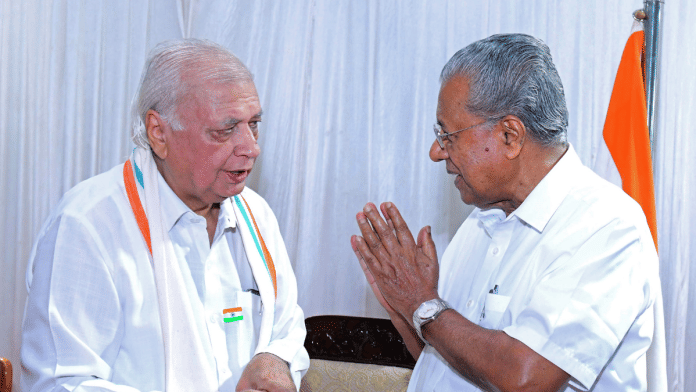
New Delhi: The Kerala government and the Governor have resolved their dispute over the latter’s power to appoint a temporary vice-chancellor to state-run A.P.J Abdul Kalam Technological University and Kerala University of Digital Sciences, Innovation and Technology.
After a bitterly-contested two-year litigation, which reached the Supreme Court, the two sides entered into an amicable settlement during the Supreme Court-organised Samadhan Samaroh.
Importantly, besides agreeing not to pursue the case currently pending in the Supreme Court, the settlement agreement signed before a pre-special lok adalat conciliation meeting held before the District Legal Services Authority (DLSA), Thiruvananthapuram, records that the state government “proposes necessary amendments in the University Act to make the provisions in tune with the UGC regulations”.
This means that the state will make required changes to the two laws governing the A.P.J Abdul Kalam Technological University and Kerala University of Digital Sciences, Innovation and Technology to follow the UGC guidelines on vice-chancellor’s appointment.
As per the University Grants Commission (UGC) norms, a V-C is chosen from a panel drawn out by a search-selection committee of three members. It includes a nominee of the Chancellor/visitor, nominee of the UGC chairperson, and a nominee of the university’s apex body (Executive Council or Syndicate).
This stand of Kerala government is significant since it has opposed imposition of UGC regulations on a V-C’s appointment to state-run universities, strongly objecting to the Governor’s interference in such hirings.
The settlement deed was signed 17 July by the deputy secretary, higher education department and the deputy secretary, governor’s office. Since the settlement deed of an amicably resolved dispute cannot be made public, it is not known whether the proposal to amend the University Act will apply to other state universities .
Sources aware of the development told ThePrint that the settled agreement was placed before the Lok Adalat that was held in the Supreme Court to conclude the 90-day Samadhan Samaroh. Justices Aravind Kumar and A.S.Chandurkar, who presided over one of the sittings on 30 August, took note of the settlement deed and disposed of the Kerala Governor’s appeal pending since July last year.
In terms of the settlement deed, the two V-Cs appointed in December last year, pursuant to a Supreme Court-appointed committee’s intervention, will complete their term. It also recorded that the legal issue that emerged from the dispute on whether the Governor can appoint a temporary V-C for an unlimited period will be left open for a judicial determination in some other case.
The dispute arose in 2024 when the state was ruled by the Left Democratic Front (LDF). The state had approached the Kerala High Court against the Governor’s 27 November, 2024 notification, which appointed an interim V-C to the two universities.
The notification was assailed because the interim appointment came with an immediate effect and until further orders. The state contended that in case of vacancy arising for the V-C post, the Governor could have appointed a temporary head for a six-month term and not more than that.
The state petition was upheld by the HC single-bench, which was challenged by the Governor before a division bench. On losing the appeal, the Governor moved SC in July last year.
On 30 July, 2025, a bench led by Justice J.B.Pardiwala prima facie agreed with the HC’s opinion. However, to end the stalemate and keeping the students’ interest in mind, it had requested senior counsel for both parties to work out some mechanism to resolve the issue until it decided the law point raised in the appeal.
Later, the top court constituted a committee led by former SC judge Sudhanshu Dhulia to break the deadlock between the two sides. On 18 December, the top court was informed that the panel had resolved the crisis by finalising the appointment to both universities, which were acceptable to both sides.
However, the court had not finally disposed of the case, while adjourning it. “The other questions of law arising in this litigation are kept open,” the order had noted, as it directed listing of the case after two months.
Meanwhile, when the top court initiated the Samadhan Samaroh in April this year, it identified the disputes as one of the many cases where a possibility of a settlement could be explored. As part of the procedure, the case was sent to the DLSA, Thiruvananthapuram where the settlement talks took place.
(Edited by Tony Rai)
Also Read: No stay on OBC creamy layer order, Supreme Court to hear govt’s objections ‘next week’