



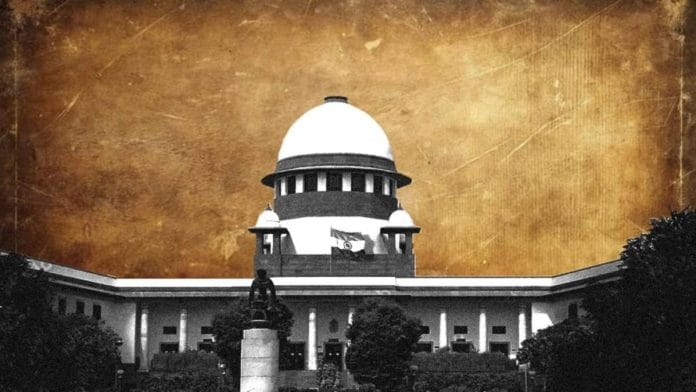
New Delhi: The Supreme Court Tuesday refused to stay its five-month old judgement that directed the Modi government to implement its 1993 office memorandum, which said creamy layer status of Other Backward Classes (OBC) candidates cannot be decided either on parental or agricultural income alone.
A special bench of justices P.S. Narasimha and R. Mahadevan issued notices on the Centre’s modification application which sought to put on the record the government’s reservations over the court’s 11 March judgement on determination of OBC creamy layer and its retrospective implementation.
The apex court had in March ruled that children of Public Sector Undertaking (PSU) and private sector employees cannot be denied OBC reservation benefits simply because of their parents’ salary. The bench had affirmed that social status must be the primary measure for identifying the “creamy layer”.
The legal battle had pitted the Centre against successful civil services candidates who were denied their preferred service allocations because their parents were employees of PSUs or private firms.
The Supreme Court had highlighted the “hostile discrimination” arising from differential criteria applied to government officers, PSU employees and private sector workers in determining OBC creamy layer status. The court had given six months to the Centre to implement its verdict, meaning it would be followed when allocating cadre to this year’s successful civil services candidates.
However, while seeking clarification on the judgement’s application to this year’s civil services allocations, the Centre has raised concerns over the “wide-ranging” ramifications of the decision, saying it will result in candidates, whose parents have high-income, being considered as belonging to non-creamy layer.
On Tuesday, Solicitor General Tushar Mehta, appeared on behalf of the Department of Personnel and Training (DoPT), requesting the bench to hear the application. Mehta’s request was met with stiff opposition from candidates who were beneficiaries of the 11 March judgement. A host of senior advocates objected to the maintainability of the modification application, saying it was akin to a review.
“We won in CAT (Central Administrative Tribunal), in the High Court and then there was a stay for such a long time before we won again. And, now they come with a modification application. This is not fair,” one of the lawyers told the court.
However, the bench issued a notice, with a one-line observation: “We have not given a thought to the merits. You can raise your objections. We will hear it next week.”
Mehta then spoke of a pressing concern about allocation of cadre to the newly-inducted civil services officers.
As he was about to request the court to give an interim order, the bench declined. “There is no question of an interim stay or order,” one of the judges said.
The Supreme Court’s 11 March order had ruled that the salary of a parent employed in a PSU or private company could not by itself determine whether a candidate belonged to the creamy layer.
The judgement had put an end to what the petitioners said was a discriminatory practice. It was their contention that while PSU and private sector salary incomes were considered for determining creamy layer status, the same was not consistent for candidates whose parents were employed in the public sector.
The court had said that according to the 1993 memorandum, the parent’s post and employment category must also be examined along with the prescribed income and wealth criteria.
In its modification application, the Centre has emphasised on the possible implications the judgement can have on its policy governing exclusion of creamy layer among OBCs, particularly in the context of changing employment, considering a significant proportion of the workforce is engaged in the private sector.
“…. the current basket of OBC candidates has great diversity as the candidates getting selected are from very divergent economic/social strata,” it added, saying the judgement may adversely affect the spirit and intention of the reservation policy as it can potentially impact the interests and prospects of those candidates who actually belong to the lower income group of OBC non-creamy layer vis-à-vis those who are economically well-off and having greater exposure to better facilities by virtue of their financial positions.
(Edited by Amrtansh Arora)
Also Read: Inside Centre’s plea on ‘wide-ranging ramifications’ of SC’s creamy layer verdict
The courts in this country have to be curtailed. They are a big reason for a bad business environment.
Time and time again courts have been passing judgments on matters which would be considered judicial overreach.