





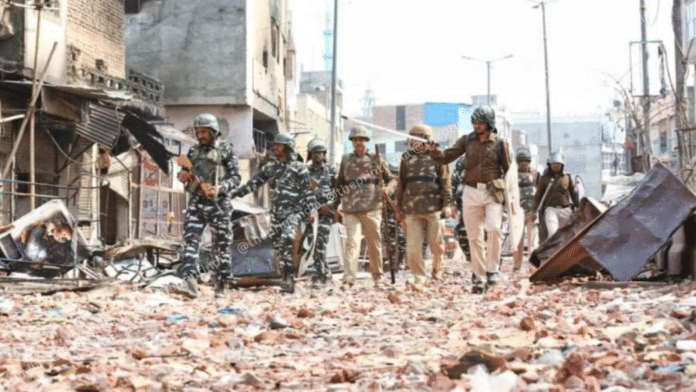


New Delhi: The Delhi High Court on Tuesday refused to grant bail to Athar Khan, an accused in the February 2020 Delhi riots, saying there was prima facie evidence he was a “core conspirator” in the case.
Justices Prathiba M. Singh and Madhu Jain noted that incriminating WhatsApp chats and witness testimony established Khan’s role in the conspiracy, and he therefore was barred from bail under Section 43D(5) of the Unlawful Activities (Prevention) Act (UAPA).
The 2020 riots, which broke out in northeast Delhi amid protests against the Citizenship Amendment Act (CAA) and proposed National Register of Citizens (NRC), were among the most violent episodes in Delhi in recent years. The violence left 53 people dead, over 100 injured, and more than 1,500 properties damaged.
The FIR was initially registered under Indian Penal Code (IPC) provisions, but later expanded to include UAPA, the Arms Act and Prevention of Damage to Public Property Act charges. It was alleged that there was a criminal conspiracy behind the riots.
Khan argued he was initially examined as a witness, but during the course of the investigation, he was arrested and named as a co-accused in the main charge sheet.
The appeal arose from Khan’s second application for regular bail before the trial court. His first application was dismissed by the trial court in 2022. The order was upheld by a coordinate bench of the Delhi High Court in 2025.
Khan did not challenge the 2025 High Court order before the Supreme Court, which later granted bail to several co-accused in Gulfisha Fatima vs. State (2026).
In this case, the Supreme Court granted bail to several co‑accused, distinguishing between core conspirators, like Umar Khalid and Sharjeel Imam, who were denied bail, and field‑level operators, who were released.
‘Only a facilitator’
Khan argued that the prosecution had listed more than 880 witnesses for examination, and he had already spent nearly six years in custody.
He said that his role was comparable to that of co‑accused Gulfisha Fatima and another accused who were granted bail by the Supreme Court.
Khan argued that he was only a local‑level facilitator, without any significant decision‑making authority in the alleged conspiracy. His counsel argued that the Supreme Court’s decision in Gulfisha Fatima vs. State should be applied to his case, and Khan should be extended the benefit of bail.
Khan also said that the prosecution’s reliance on the statements of a protected witness was misplaced. He argued that the witness’s account during police examination and the judicial statement recorded before a magistrate were inconsistent.
The prosecution argued that the 2025 Delhi High Court judgement has attained finality because it was not challenged before the Supreme Court.
It said that the statutory bar on bail under UAPA continued to apply, as none of the findings against Khan in that decision had been set aside. Therefore, Khan could not rely on subsequent rulings such as Gulfisha Fatima.
The prosecution also argued that, unlike the other co‑accused who were granted bail, there was specific evidence suggesting he was linked with acts allegedly “intended to cause killings”. As 53 people lost their lives during the riots, the prosecution argued that this aspect could not be overlooked.
Indications of active role, says court
The court noted that WhatsApp chats and witness statements indicated Khan’s active role in the riots, including messages suggesting violent intent and participation in acts leading to deaths and destruction of property.
On that basis, the court held that Khan’s role was that of a core conspirator, not a ground‑level participant, and the statutory bar on bail under UAPA therefore applied.
It emphasised that earlier bail rejections had attained finality, and unlike other co‑accused who were granted bail, Khan’s alleged role was directly linked to killings. The court also observed that releasing Khan could pose a flight risk and allow interference with witnesses.
For context, the court referred to the Supreme Court’s ruling in Gulfisha Fatima, where co-accused Sharjeel Imam was denied bail as his role was not episodic but part of a sustained mobilisation strategy, and Umar Khalid was held to be a principal conspirator promoting violent protest. By contrast, bail was granted to certain co‑accused who were treated as field‑level operators.
The court noted that Gulfisha was more of a field‑level operator, involved in mobilising and participating in protests but not in conceptualising or orchestrating the larger conspiracy. On that basis and considering her prolonged custody, she was granted bail.
The high court upheld the trial court’s order and dismissed Khan’s bail appeal, clarifying that its observations were confined to the bail stage and would not affect the merits of the trial.
(Edited by Sugita Katyal)
Also Read: How SC relied on prosecution theory of ‘vertical chain of command’ to deny bail to Umar, Sharjeel