







Firozabad: It took just about five weeks for the Firozabad district court of Agra division to convict and sentence a man accused of killing an 18-month-old child by repeatedly smashing him into the ground.
Terming the crime as rarest of rare, Firozabad District and Sessions Judge Babbu Sarang said that sparing the man by giving any less punishment will not only endanger the life of the victim’s mother, but also be a grave injustice. In less than six weeks from the murder, the crime was investigated, evidence gathered, chargesheet filed, trial conducted, and sentence pronounced.
According to the Investigating Officer in the case, Inspector Anuj Kumar, Jitendra Pathak alias Viraj, has been sentenced to death, along with a fine of ₹50,000 for the murder of 18-month old Aarav, son of Rati Sharma.
Jitendra was related to Aarav, being a cousin of Aarav’s father. Jitendra, however, wanted to marry the child’s mother Rati; considering the child an obstacle in his plans, he eliminated Aarav in a premeditated act of brutal violence. As per the prosecution, the child was taken away from his mother to ‘buy chocolates’ and was then killed by repeatedly slamming him into the ground—eight times in all—a little distance from the house. Death was instant.
This act was not only a blot of familial relationships, but had also shaken the foundation of the social and family values, which was inexcusable and deserved no less punishment than a death sentence, the court said. “This incident will give message in the society not to believe any close relative… ” and “therefore, the present incident is going to break the family network in the society… ” the judge noted in his order.
Murder most foul
Inspector Kumar told ThePrint that digital and forensic evidence gathered by the police was instrumental in the conviction. He said Rati Sharma was a resident of Bamai village in the Araon area of Firozabad and married Sumit Kumar in February 2024. They had separated, and she had been living with her parents since January 2026.
Jitendra, who was Sumit’s cousin, visited Rati in that period and proposed marriage several times; Rati was steadfast in her refusal. Enraged at being turned away, Jitendra began believing Rati’s son from Sumit was the reason for the refusal. He began to plan Aarav’s murder, and put his plan into action on 30 May this year, when Rati and her mother Pinki Devi were staying at a relative’s house in Shikohabad’s Yadav colony in connection with an appointment with their lawyer.
Jitendra lured the 18-month old out of the house by offering him chocolates. “Barely 50 m outside the house, he picked up Aarav in his arms and repeatedly slammed him into the ground eight times, killing him on the spot. The entire act of violence took 27 seconds, and was captured by surveillance cameras at neighbouring houses, which formed the mainstay of the prosecution’s case,” Kumar said.
He said that the gruesome footage of the incident showed Jitendra slamming the child six times into the ground and then picking him up to check if he was still alive. Finding him still breathing, he slamming the child’s head on the concrete two more times with even more force, making sure of the child’s death.
“After crossing the parked car, he started slamming the innocent child on road. It is not one or two times, rather multiple times and he checked if the innocent child is dead,” the judge said in his order, noting that “the way he executed the incident is very heinous, gruesome, unprovoked, cold-blooded and brutal”.
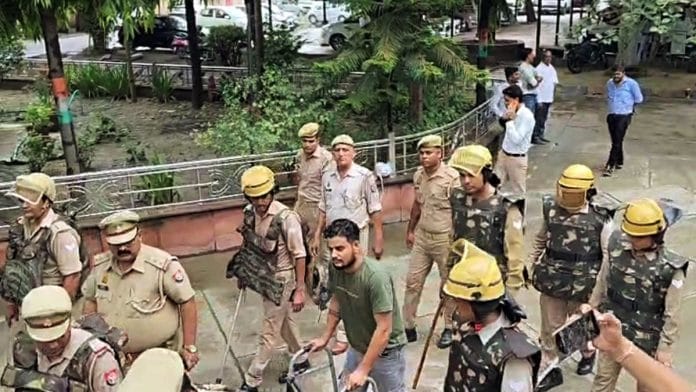
Jitendra did not leave the child at the murder spot, but carried him to the entrance of the house before fleeing. The murder spurred a manhunt that lasted barely a few hours; the Shikohabad police arrested Jitendra the same night after a brief encounter in which he was shot in the leg. Following treatment, he was remanded to judicial custody.
The investigating officer said that besides the surveillance footage recovered from nearby cameras and submitted in the court with proper digital evidence certification as required by the Bharatiya Sakshya Adhiniyam (BSA), eyewitnesses Deepansh and Shakuntala Devi were also produced. They testified that they saw Jitendra slamming the child repeatedly into the ground before carrying away the body. The digital evidence, eyewitness testimonies, and the forensic evidence collected by the police formed an unbroken chain of evidence proving Jitendra’s guilt beyond any doubt, and resulted in his quick conviction.
What court said
“In the present case, the prosecution effectively investigated the case and tried to collect all the important evidence to prove the prosecution story,” the court said. Kumar said that the defence claimed Jitendra was mentally ill after having fallen from a roof in 2018, and that he had been intoxicated at the time of the murder, in order to prove that this was not a premeditated crime. No certificates of a mental instability diagnosis could be produced in support of these claims, and they were dismissed.
“No evidence is on the record to show that he (the accused) was mentally ill or in a drunk state at the time of the incident” the judge said in the order.
District Government Counsel Rajiv Upadhyay said that Jitendra apparently broke down when the surveillance footage was shown during the trial, and started crying and slapping himself, The court, however, observed that the emotional reaction shown by Jitendra did not have any bearing on the severity of his crime.
The court observed that the sacred trust linked to family relations has been violated by Jitendra, and as the child’s uncle he was supposed to protect the child and not kill him to satisfy his personal obsession. “Hon’ble Supreme Court in 1983 (3) SCC, page 470, Machhi Singh’s case justified the death sentence in the situations, (i) extremely brutal, gruesome or diabolic murder, (ii) murder committed for depraved or heinous motive, (iii) crime that shocks the collective conscience of the society, (iv) extremely grave offence, victims who are particularly vulnerable such as children or murder committed in specially cruel circumstances. In these circumstances a case would be rarest of rare,” it said.
“It is a popular phrase that ‘iron cuts iron’. The fear developed in the locality can only be removed by giving severe punishment to the accused. Otherwise, society will remain in the fear that such a brutal killing ends with simple punishment. It is clear that the mitigating circumstances are not in any way above the aggravating circumstances. Therefore, this is a case of rarest of rare,” the order said.
Senior Superintendent of Police Aditya Langhe said that the police had sought the maximum punishment for Jitendra from the beginning, and credited the investigation with meticulous gathering of scientific and digital evidence and the quick filing of the chargesheet barely five days after the murder of Aarav. The testimony of 13 prosecution witnesses was recorded between June 15-21 and on July 10, Jitendra was sentenced to death.
(Edited by Nardeep Singh Dahiya)
Also Read: How man who raped, killed minor in Palwal cheated hangman but got 50 yrs in jail with no remission