





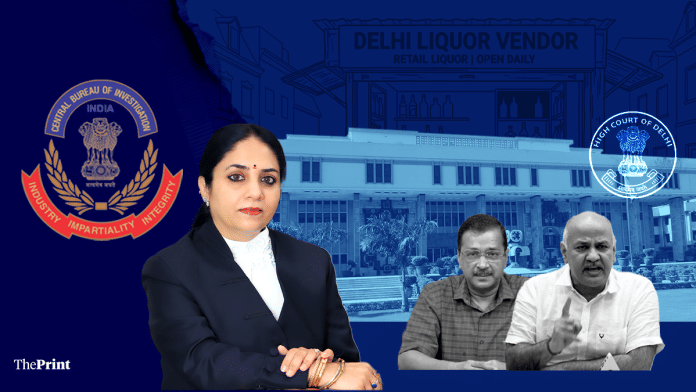


New Delhi: The Delhi High Court will next Monday resume hearing the CBI’s plea challenging the 27 February trial court order discharging former Delhi chief minister Arvind Kejriwal and deputy Manish Sisodia in the liquor policy scam case.
The case has been under the spotlight especially due to the recusal matter, wherein Kejriwal and other accused sought the withdrawal of Justice Swarana Kanta Sharma from the case alleging bias and conflict of interest. Justice Sharma, in a dramatic turn of events last week, refused to recuse herself from hearing the CBI’s plea.
Although Sisodia, Kejriwal and others have issued letters to Justice Sharma expressing their unwillingness to participate in the proceedings, the judge has given them a final chance to file their responses.
“Certain parties are yet to file their reply. Let this be done by Saturday. I will start hearing the case from Monday onwards,” she said Wednesday while calling for complete trial court records in the matter.
A day earlier, Vijay Nair, accused and former communications in-charge of the Aam Aadmi Party (AAP), filed a fresh application before the Delhi High Court seeking to challenge the CBI’s revision plea on grounds of non-maintainability,
The HC also issued notice to the CBI on an application filed by other accused in this case like Sarvesh Mishra, who sought to vacate or undo a 9 March stay order temporarily halting the trial court’s direction to initiate departmental action against the CBI’s investigating officer (IO) for alleged lapses in the excise policy case probe. The case will be heard next on 4 May.
On 9 March, the Delhi High Court bench of Justice Swarana Kanta Sharma had stayed the trial court’s February recommendation that departmental action be initiated against the CBI’s IO. Advocate Farrukh Khan, one of the lawyers for the accused, also said that they have filed an application seeking vacation of the stay order.
On 27 February, the trial court had discharged Kejriwal, and 22 others in the liquor policy case while observing that it could not withstand judicial scrutiny. The CBI had filed its revision plea before the Delhi HC the same day.
A revision petition is a legal mechanism filed with a higher court to review decisions of subordinate courts. It usually focuses on jurisdictional errors, material irregularities, or illegalities, rather than a reevaluation of the evidence.
What the fresh application says
Pointing out that the revision plea was not filed through the public prosecutor or through his office, as procedure demands under Section 18 of the BNSS, Nair has argued that such a plea is not maintainable before the Delhi HC.
He has also contended that the revision plea had been filed by private advocates having no statutory standing or competence.
It is further alleged that the CBI’s plea was not accompanied by any document, authorisation and vakalatnama. Such a revision plea deserves to be rendered non-maintainable in law, and is liable to be dismissed at the very threshold, Nair has argued.
Owing to the fact that no vakalatnama, authorisation, communication, direction or document has been placed on record with the revision plea, Nair contends, the lawyers who filed the revision petition have not been proven to be public prosecutors appointed under Section 18 of the BNSS, which governs the appointment of public prosecutors (PP) and additional public prosecutors (APP) by central or state governments for high courts and district courts.
A mere endorsement on the last page by the additional solicitor general, in his capacity as special public prosecutor, in no manner shows that the revision has been filed through the public prosecutor, as mandated by the statute, the plea says, while adding that the act of settling a draft is not synonymous with, and cannot be a substitute for the statutory requirement of the public prosecutor filing the proceedings before the HC.
The law is settled on the point that the PP or APP are in charge of the case and may appear, and plead without any written authority before any court, Nair contends, adding that if any private person instructs a pleader to prosecute the case, the PP or APP must conduct the prosecution.
However, in the present case, two private lawyers had directly filed the revision plea, under their own name or address, in violation of Section 338 of the BNSS, which dictates norms surrounding the appearance of PPs. This provision empowers only the PP or APP in charge of the case to appear and plead without any written authority, before any court.
Relying on the SC’s 1999 ruling in Shiv Kumar vs Hukum Chand, the plea says that the role of the public prosecutor has been upheld in law, and the presence of a private lawyer in the case would inexorably undermine the fairness and impartiality of the prosecution.
(Edited by Gitanjali Das)
Also Read: Is Kejriwal vs Justice Swarana Kanta unprecedented? How recusals work in Indian judiciary