



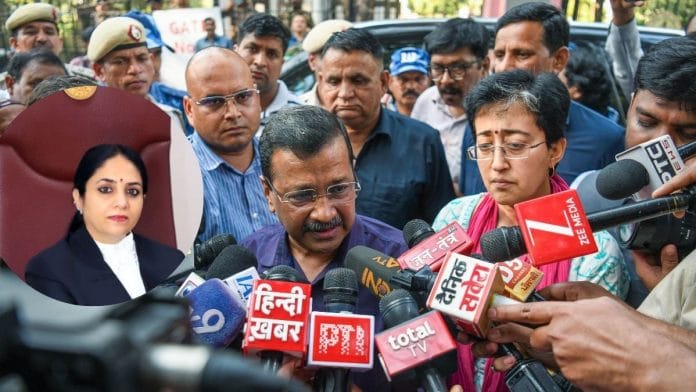
New Delhi: Underlining how allowing recusal on Aam Aadmi Party (AAP) leader and former Delhi Chief Minister Arvind Kejriwal’s request in the Delhi excise policy case would amount to sowing seeds of mistrust in the judiciary, Justice Swarana Kanta Sharma of the Delhi High Court Monday refused to recuse herself from the case.
In a strongly worded order, passed after the court’s working hours late in the evening, the judge said that an apprehension of bias, unsupported by tangible evidence, cannot be allowed to put the judiciary itself on trial, or set a precedent that undermines institutional integrity.
Recusal refers to the removal of oneself as a judge or policymaker in a particular matter, especially due to a conflict of interest. The recusal plea by Kejriwal, former deputy chief minister Manish Sisodia and other accused persons was made in the case before the Delhi High Court where the Central Bureau of Investigation (CBI) has challenged the 27 February discharge order of a trial court. The trial court had said that the CBI’s case against Kejriwal was unable to survive judicial scrutiny.
Hearing the matter concerning her own recusal from the case, Justice Sharma said that attempts were made to arm-twist and malign the court’s integrity in the present case. Making it clear that recusal must stem from law, and from a demonstrable cause, the single judge said that such matters cannot be based solely on perceived inclinations and could set dangerous precedent, if allowed.
Saying that the courtroom is not a theatre of perception, Justice Sharma added that the court’s reputation was not built in a day, but with case after case, and year after year. “If this court withdraws without demonstrable cause, based solely on perceived inclinations, it would set a dangerous precedent of deciding cases based on a person’s comfort or discomfort,” the court order read.
“The present case is not a dispute between two litigants but between the litigant (the accused) and me, the judge,” Justice Sharma noted. Pointing out how judges are expected to have an open mind and not an empty one, she said, “I just cannot recuse due to manufactured allegations otherwise it would be giving credence to an attempt to cast a shadow on this court.”
An accused who fears an unfavourable judgment cannot be made to arm-twist the court in such a manner, otherwise the rich and the powerful will start bending the court according to their whims and fancies, the judge said. The court also pointed out that without any proper material, or evidence, no one can cast aspersions on a sitting judge. “Even a political leader, however strong or weak he may be, can be permitted to taint an institution,” the court said.
“Relatives of this court whose empanelment has been mentioned by Kejriwal have never dealt with this case,” the judge said, rejecting claims of conflict of interest linked to her two children’s empanelment as Central government lawyers. “Is it being suggested that my judicial independence is compromised?” she asked.
Justice Sharma also dismissed arguments that her previous rulings against Kejriwal and other accused indicated bias. “Parties cannot question a judge’s competence on the grounds that a higher court set aside its orders,” she observed, adding that “a politician, or an accused person who is a politician, cannot cross a boundary”.
‘Accusations levelled implicitly against the institution’
By way of an unusually reflective order, Justice Sharma framed the issue as not merely as a personal question of recusal, but as one implicating “the institution and the process” of justice delivery. As she began writing the judgement, she noted, the courtroom had fallen silent, leaving behind “the pressure of being a judge” and a fundamental question: whether to step aside or confront allegations that, if left unanswered, could erode public confidence in the judiciary.
While acknowledging that recusal applications against sitting judges are not extraordinary and have arisen “many times” before, the court underscored that the easier course, that is withdrawal, was not always the correct one.
“Accusations and insinuations” had been levelled not only against the judge, but also, implicitly, against the institution itself, the judge said. Given that the case could be cited as precedent, the court chose to adjudicate the issue on settled jurisprudence governing recusals, rather than take what it described as the “easy and uncontroversial” path of stepping aside.
The court recorded that Kejriwal had expressly stated that he did not doubt the judge’s integrity, but nevertheless sought recusal on account of a perceived apprehension of bias. Justice Sharma emphasised that she was therefore dealing not with any demonstrable conflict, but with “the apprehension of bias in another’s mind”.
At the heart of the case was the contention that the court’s grant of limited interim relief had triggered a perception of bias. Rejecting this argument, the judge pointed to multiple instances where similar interim orders had been passed in favour of Kejriwal and other AAP leaders, including Rajya Sabha member Raghav Chadha, often without calling for responses from the opposing side. In none of those instances, the court noted, had any allegation of bias or procedural impropriety been raised.
Such interim relief, the court held, was a matter of judicial practice and could not retrospectively become a ground for recusal merely because subsequent proceedings did not favour the litigant. “A judicial practice, when not in one’s favour, cannot be a ground,” the court observed.
Kejriwal had argued that several adverse orders passed by the high court had later been set aside by the Supreme Court, suggesting a pattern that warranted recusal. Justice Sharma firmly rejected this line of reasoning, noting that appellate interference does not, by itself, cast doubt on the competence or impartiality of a judge.
Referring to cases involving Sanjay Singh and Manish Sisodia, the court pointed out that the Supreme Court had granted relief without making adverse observations on the merits of the High Court’s orders. In Sisodia’s case, for instance, bail had been granted on grounds of delay in trial rather than any infirmity in judicial reasoning. “Parties cannot question the competence of a judge merely because a higher court has taken a different view,” the court held, adding that litigants have no right to define such standards.
Another ground pressed for recusal was the judge’s participation in events organised by the Akhil Bharatiya Vidyarthi Parishad (ABVP). Dismissing the allegation, the court clarified that such events were professional gatherings—often centred on issues like women’s empowerment or legal awareness—where judges are invited in their official capacity to address members of the bar. Flyers placed on record showed that several judges had participated in similar programmes.
To equate such participation with ideological bias, the court said, would be a dangerous proposition. “What does it mean to say that addressing a legal gathering implies sympathy with the organising body?” the judge asked, noting that engagements at universities, private colleges, and bar forums are typically confined to legal discourse, irrespective of the affiliations of organisers.
Allowing such arguments, the court warned, would weaken the essential relationship between the bar and the bench, and risk isolating the judiciary. “Judiciary cannot be placed in an ivory tower,” the order stated, cautioning against “planting seeds of distrust” that could deter judges from participating in public legal discourse altogether.
On the allegation of conflict of interest, raised on the basis of information obtained under the Right to Information Act regarding the professional engagements of the judge’s children who are empaneled lawyers, the court found the claims to be factually incorrect and misleading. Kejriwal had relied on the number of dockets rather than actual cases, thereby misrepresenting the extent of involvement, the court said.
Crucially, the court held that there was no nexus whatsoever between the judge’s relatives and the present proceedings, nor any financial or personal stake in the outcome. The attempt, it said, appeared to create an “impression of conflict” without substantiating it with tangible evidence.
Justice Sharma took strong exception to what she described as a broader social media campaign built around these allegations, reiterating that judges are trained to remain unaffected by such pressures. Casting aspersions on the integrity of a judge, the order noted, is a serious matter and courts have consistently taken a strict view of such conduct.
Ultimately, the court held that mere apprehension, personal perception, or unsubstantiated allegations cannot form the basis for a judge to withdraw from a case.
(Edited by Nardeep Singh Dahiya)
Also Read: CBI case against Kejriwal & Sisodia falls flat. What agency alleged in Delhi excise policy case