



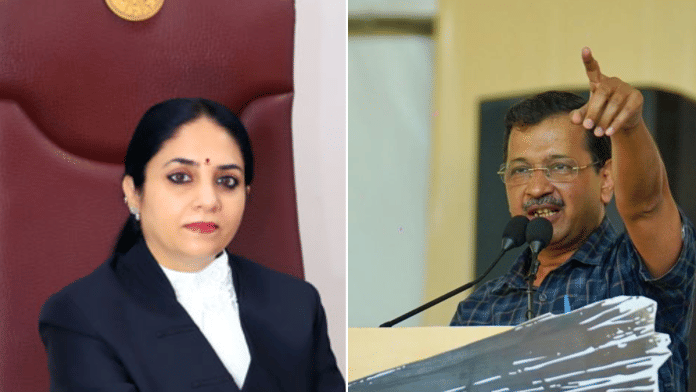

New Delhi: In a dramatic turn in the Delhi excise policy case, Delhi High Court judge Justice Swarana Kanta Sharma on Monday refused to recuse herself from hearing the matter, rejecting pleas by former Delhi chief minister Arvind Kejriwal, former deputy chief minister Manish Sisodia, Aam Aadmi Party leader Vijay Nair and other accused who had sought her withdrawal from the case, alleging bias and conflict of interest.
Pronouncing the order after a day of intense courtroom proceedings, Justice Sharma held that none of the grounds raised by the petitioners warranted her recusal, asserting that entertaining such pleas on “unfounded allegations” would undermine judicial independence and set a dangerous precedent.
“Relatives of this court whose empanelment has been mentioned by Kejriwal have never dealt with this case,” the judge said, while rejecting claims of conflict of interest linked to her children’s empanelment as central government lawyers. “Is it being suggested that my judicial independence is compromised?” she asked.
Justice Sharma also dismissed arguments that her previous rulings against Kejriwal and other accused indicated bias. “Parties cannot question a judge’s competence on the grounds that a higher court set aside its orders,” she observed, adding, “a politician, or an accused person who is a politician, cannot cross a boundary”.
An accused who fears an unfavourable judgment cannot be allowed to “arm-twist” the court in such a manner, otherwise the rich and the powerful will start bending the court to their whims and fancies, the judge said.
“Kejriwal began his arguments with a sentence in open court that he has the highest regard for my integrity and is not attributing any improper motive to this court. Without any proper material, or evidence, no one can cast aspersions on a sitting judge. Even a political leader, however strong or weak he may be, cannot be permitted to taint an institution”.
Pointing out that judges are expected to bring an open mind and not an empty one, the court said, “I just cannot recuse due to manufactured allegations otherwise it would be giving credence to an attempt to cast a shadow on this court.”
Saying that the courtroom was not a theatre of perception, Justice Sharma added that the court’s reputation was not built in a day, but with case after case and year after year. “If this court withdraws without demonstrable cause, based solely on perceived inclinations, it would set a dangerous precedent of deciding cases based on a person’s comfort or discomfort,” the court said.
“The present case is not a dispute between two litigants but between the litigant (the accused) and me, the judge,” Justice Sharma noted.
Addressing allegations over her participation in events organised by the RSS’ legal wing, the judge said attending legal programmes did not imply ideological sympathy or prejudice. “How can someone equate participation in a legal programme with a bias in my mind?” she asked.
The order, initially expected at 2.30 pm Monday, was pronounced after 6.30 pm after the court allowed Kejriwal to place additional submissions on record, including fresh grounds for recusal. One such ground related to the CBI’s alleged failure to dispute claims about the judge’s children being on central government panels.
Opposing the plea, Solicitor General Tushar Mehta, appearing for the CBI, argued that the application was based on “unfounded allegations” and warned that permitting such recusal pleas would encourage litigants to pressure judges. He also objected to fresh pleadings being taken on record after the court had reserved orders, stating that such a practice was virtually unheard of.
Kejriwal, who personally argued his plea, had cited multiple reasons for seeking Justice Sharma’s recusal. These included her earlier refusal to grant him relief in his challenge to his arrest, denial of bail to co-accused such as Sisodia and K. Kavitha, alleged “strong and conclusive” findings made in earlier proceedings, and what he termed “undue haste” in the handling of the present matter.
He also relied on the Supreme Court’s 1987 ruling in Ranjit Thakur vs Union of India to argue that the test for bias should be based not on the judge’s own perception but on whether a reasonable litigant may apprehend bias.
However, Justice Sharma said that if judges were to yield to social media campaigns or repeated attacks on their integrity, it would amount to “an attack on the institution”.
The recusal plea had added another dramatic layer to the long-running Delhi liquor policy case, especially after a trial court on 27 February discharged Kejriwal, Sisodia and others, holding that the CBI’s case was unable to survive judicial scrutiny.
(Edited by Viny Mishra)
Also read: Is Kejriwal vs Justice Swarana Kanta unprecedented? How recusals work in Indian judiciary
Politician’s cannot cross boundaries, but can judges do? Madam Judge, please ask yourself.