





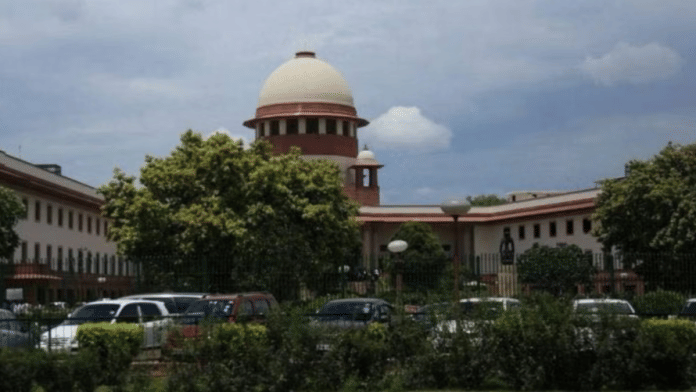


New Delhi: “Nothing can be more important than deciding the fate of an application for bail,” the Supreme Court said last week as part of a series of suggestions to high courts across the country aimed at avoiding delays in bail hearings.
A bench of Chief Justice Surya Kant and Justice Joymalya Bagchi passed the directions in the case of Sunny Chauhan vs State of Haryana (2026). On an earlier date, the apex court had directed all high courts to submit information relating to pending bail applications.
Expressing disappointment at the manner of dealing with bail applications and emphasising personal liberty, the court said, “We understand that courts bear the burden of heavy dockets, featuring several matters that demand prioritisation. However, among the miscellaneous matters, nothing can be more important than deciding the fate of an application for bail.”
The guidelines include high courts setting an outer time limit for deciding bail matters, discouraging casual adjournments for the Union or State and listing fresh bail applications within a week or on alternate days. The Supreme Court also suggested weekly or fortnightly listing of pending bail matters, automatic relisting of matters that are not taken up, filing of status reports before the first hearing, and advance service of petitions on the designated state agency.
The court commented on the “alarming situation” of bail pendency at the Madhya Pradesh High Court in the previous year, but expressed hope of progress in disposal. Incidentally, the Madhya Pradesh High Court Bar Association (Jabalpur) wrote to the Chief Justice of the Madhya Pradesh High Court before the Supreme Court suggestions, expressing serious concerns regarding bail and procedure.
“A substantial concern among members of the Bar is that in the race of improving disposal statistics, many matters are being disposed of through rejection or dismissal without adequate consideration of the settled principles governing bail,” said advocate Yogesh Soni, Joint Secretary of the Madhya Pradesh High Court Bar Association.
Delays in deciding bail applications usually happen because courts are dealing with heavy dockets, repeated adjournments, pending investigation material and prosecutorial objections. The court’s need to assess flight risk or risk of witness tampering on an individual case basis further adds to the delay.
Soni identifies further factors, including “the growing tendency of extremely detailed scrutiny even at the bail stage, sometimes almost resembling a mini-trial. This naturally increases hearing time and delays disposal”.
Also Read: National security over liberty: How SC’s Umar-Sharjeel bail order runs counter to earlier rulings
Not short on principle
This latest push on bail joins a litany of judgements from the apex court. Bail jurisprudence in India is not short on principle, but continues to be slow in speed. Statutory bail provisions do not make the Supreme Court the ordinary forum for first-instance bail, but they do not exclude the apex court from considering bail in exercise of its appellate or constitutional powers.
Senior advocate Sriram Panchu says the real problem in bail law is not doctrine, but the system’s inability to deal with the scale of undertrial incarceration. “Jurisprudence on bail is well known. There is no issue there,” he said, adding that India’s overcrowded prisons and the large number of undertrials show a deeper failure of the criminal justice system.
Panchu highlights that the real crisis lies in the scale of undertrial incarceration and the system’s inability to process such cases efficiently. According to a 2023 National Crime Records Bureau (NCRB) report, India had 3.89 lakh undertrial prisoners out of 5.3 lakh inmates, meaning roughly 74 per cent of prisoners were undertrials.
The urgency in matters involving personal liberty has been emphasised by the court, beginning with the landmark case of State of Rajasthan vs Balchand (1977). This case gave Indian bail jurisprudence the enduring principle of bail as the rule and jail as the exception.
A bench of Justices V.R. Krishna Iyer and N.L. Untwalia had then said: “The basic rule may perhaps be tersely put as bail, not jail, except where there are circumstances suggestive of fleeing from justice or thwarting the course of justice or creating other troubles in the shape of repeating offences or intimidating witnesses and the like by the petitioner who seeks enlargement on bail from the court.”
Soni says that “bail is the rule and jail is the exception” is undoubtedly one of the foundational principles of criminal jurisprudence and personal liberty under Article 21 of the Constitution. However, in practical functioning, particularly at the ground level, the implementation of this principle “still remains inconsistent in many cases”.
The principle established in Maneka Gandhi vs Union of India (1978) of procedural fairness, justice, and reasonableness in matters of personal liberty influenced multiple landmark Article 21 (fundamental right to life and liberty) cases.
Hussainara Khatoon vs State of Bihar (1979) underscored the right to speedy trial as part of Article 21 (fundamental right to life and liberty) while highlighting the plight of undertrial prisoners.
Justice Krishna Iyer, in Moti Ram vs State of Madhya Pradesh (1978), quoted French satirist Anatole France to establish that monetary surety for bail is discriminatory to the poor: “The law, in its majestic equality, forbids the rich as well as the poor to sleep under bridges, to beg in the streets, and to steal bread.”
The presumption of innocence in criminal law was emphasised by the Court in Sanjay Chandra vs Central Bureau of Investigation (2012). The apex court while granting bail to the accused persons, clarified that the object of bail is to secure presence at trial and not as a pre-trial punishment. Also, the seriousness of allegations should not influence continued detention.
In Satender Kumar Antil vs Central Bureau of Investigation (2022), the Supreme Court adopted a practical approach by dividing bail cases into four broad categories. By so doing, it endeavoured to create a more systematic rather than mechanical approach to bail applications. The court also acknowledged the scale of the undertrial prisoner crisis and monitored this matter for compliance over several dates. Such an approach is in line with the recent order in the Sunny Chouhan case.
Last year, in Anna Waman Bhalerao vs State of Maharashtra (2025), the court recommended that high courts dispose of bail applications within two months of filing. Describing the pendency of bail applications as the “sword of Damocles” for the applicant, the court directed: “Being the highest constitutional fora in the States, High Courts must devise suitable mechanisms and procedures to avoid accumulation of pending bail / anticipatory bail applications and ensure that the liberty of citizens is not left in abeyance.”
The accused is “entitled to bail as a rule”, except in the most serious cases, Panchu emphasises, warning that keeping an innocent person in prison can have damaging consequences. “We are manufacturing criminals in our jails,” he says, arguing that prolonged custody can expose undertrials with no criminal tendencies to hardened offenders and create the very criminality the system is supposed to prevent.
Interestingly, in the case of Umar Khalid, the court appears to have given decisive weight to the stringent bail framework under the Unlawful Activities (Prevention) Act (UAPA), rather than the broader liberty-focused principles that ordinarily inform bail jurisprudence.
On Monday, a division bench of Justices B.V. Nagarathna and Ujjal Bhuyan disapproved of this denial of bail, emphasising that ‘bail as the rule’ is not a procedural code but a constitutional principle “flowing from Articles 21 and 22 of the Constitution and the presumption of innocence”.
“Therefore, we have no manner of doubt in stating that even under UAPA, bail is the rule and jail is the exception,” the court said.
On the same day that the court issued the bail suggestions, Chief Justice Surya Kant announced the launch of the ‘One Case, One Data’ initiative. It aims to integrate information from all levels of the judiciary to create a digital database and streamline case management. Such measures attempt to tackle the chronic delays and backlogs that plague the court system.
Panchu also speaks of working on a possible solution of “using mediation for working on effective and safe conditions of release, which will address the concerns of all parties – the victim, the police, and the accused.” He clarifies that “this is an idea very much in its infancy”, but he hopes that something good will come out of it. “And if it does, it will be of massive benefit to the criminal justice system and the many lakhs of undertrials,” he adds.
Saumya Sharma is an alum of ThePrint School of Journalism & an intern with ThePrint.
(Edited by Nardeep Singh Dahiya)
Also Read: Two judgments, no single standard: Why terror law UAPA’s bail threshold isn’t a straight line