



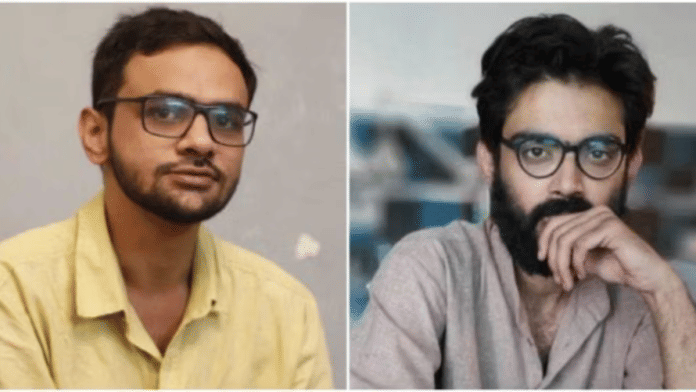
New Delhi: The Delhi High Court on Wednesday rejected the bail pleas of former JNU students Umar Khalid and Sharjeel Imam in the 2020 Delhi riots conspiracy case, holding that it was bound by the Supreme Court’s January order denying them bail.
A division bench of Justices Prathiba M Singh and Dinesh Bhatt said granting bail at this stage would effectively amount to modifying the Supreme Court’s directions. The apex court had said in January that Khalid and Imam could renew their bail pleas after the examination of protected witnesses or after one year from its order, whichever was earlier. Neither condition has been met.
Both have been charged under the Unlawful Activities (Prevention) Act (UAPA) and have been in custody for six years in connection with the violence that erupted in parts of northeast Delhi in February 2020 during protests against the Citizenship (Amendment) Act and the proposed National Register of Citizens (NRC). The riots left more than 50 people dead.
The two argued that their prolonged incarceration and a subsequent Supreme Court ruling in another UAPA case constituted a change in circumstances. The high court, however, held that a judgment by another bench could not override the specific directions passed by the Supreme Court in their case.
Also Read: ‘Terror’ under UAPA not just conventional violence—what SC said in denying bail to Umar, Sharjeel
Gulfisha Fatima case
In its 5 January judgment, the Supreme Court had taken a different approach towards five other accused in the case and granted them bail. While denying bail to Khalid and Imam, it granted bail to Gulfisha Fatima, Meeran Haider, Shifa-ur-Rehman, Mohammed Saleem Khan and Shadab Ahmed, subject to 12 conditions.
The court held that the five were on a qualitatively different footing and that their continued custody was not shown to be indispensable for a fair trial. In Khalid and Imam’s case, however, it found that the material against them attracted the bar under Section 43D(5) of the UAPA.
The court nevertheless acknowledged the constitutional concern over prolonged pre-trial incarceration and allowed Khalid and Imam to seek bail again after the protected witnesses were examined or after one year.
For Khalid, Wednesday’s order is the third time the Delhi High Court has rejected his regular bail plea, following similar orders in October 2022 and September 2025. The Supreme Court subsequently upheld both. Imam’s bail plea has now been rejected by the high court for the second time.
The larger UAPA question
The case comes amid a wider debate over prolonged incarceration under the UAPA. Courts have recently granted bail in several cases where trials were unlikely to conclude for years, citing the constitutional guarantee of a speedy trial under Article 21 (Protection of life and personal liberty) of the Constitution.
The Delhi High Court, for instance, granted bail to Kashmiri human rights activist Khuram Parvez and journalist Irfan Mehraj after more than four years in custody. Other courts have similarly considered the pace of trials while examining UAPA bail pleas.
At the centre of the debate is Section 43D(5), which sets a stringent threshold for bail when a court finds reasonable grounds to believe that the accusation is prima facie true. The Supreme Court’s 2021 K.A. Najeeb ruling and subsequent judgments have also addressed how the statutory restriction must be balanced against the Article 21 guarantee.
Aditya Edara is a TPSJ alum, currently interning with ThePrint.
(Edited by Chingkheinganbi Mayengbam)
Also Read: Hum Dekhenge to Khalid, Utho—Delhi poets, singers mark Umar Khalid’s sixth year in jail