



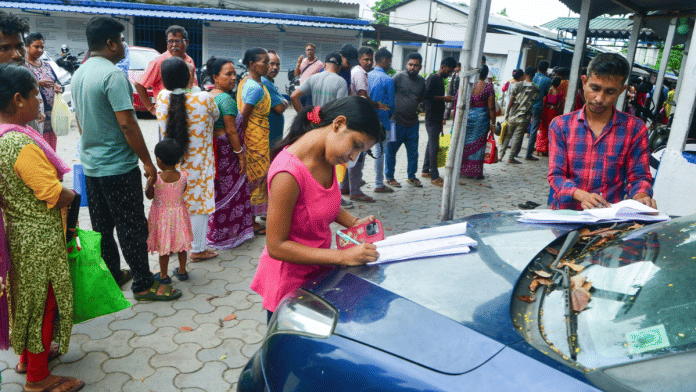
New Delhi: The 16 lakh voters against whose inclusion appeals were filed by the electoral authorities were entitled to exercise their voting rights in the West Bengal elections held earlier this year, the Election Commission (EC) clarified in an affidavit filed in the Supreme Court.
“…another contention raised in the Writ Petition is that Appeals have been filed against the orders of inclusion of the applicants/electors in the Electoral Rolls in West Bengal. It has been contended that it is not clear which authority had permitted filing of all those Appeals,” it informed the apex court.
“It is submitted that the names of those Electors are already in the Electoral Rolls and accordingly they have been entitled to exercise their voting right in the recent assembly elections. Their documents are available on the portal and there is a favourable order passed by the Ld Judicial officer in their favour.”
The clarification came on a petition filed challenging the decision-making process pertaining to the conduct of the Special Intensive revision (SIR) exercise, following the Indian Express investigation into the EC’s functioning.
Among other things, the petition sought the suspension of Chief Election Commissioner (CEC) Gyanesh Kumar and a declaration that the decisions for the EC cannot be taken unilaterally by the CEC.
Election Commissioners Sukhbir Singh Sandhu and Vivek Joshi, according to The Indian Express investigation, objected on record at least 14 times in 10 months to decisions being taken without keeping them in loop.
It had raised several concerns over changes made in Form 6, which new voters have to fill, without adequate authority and had revealed chinks in the ECINet platform. The Election Commissioners even knocked on the Cabinet Secretary’s door on concerns over the integrity of voter software, according to the investigation.
Questions also arose over the appeals filed in Bengal against inclusion of voters.
An affidavit filed by the EC earlier this year before the Supreme Court said that there were 38 lakh appeals pending before the tribunals in Bengal to hear the appeals pertaining to the inclusion, exclusion or deletion of voters during SIR.
It said 22.21 lakh appeals were filed by deleted voters seeking to be restored. The other 16.10 lakh were filed against voters the judicial officers had included, seeking their deletion.
According to The Indian Express article, Sandhu wrote to Commission officials in August, asking, “Who was authorised to file these appeals on behalf of EC, and by whom?” and “Who actually filed these appeals on behalf of ECI” He recorded that neither he nor Joshi nor the West Bengal Chief Electoral Officer was informed about the basis or process of filing the appeals.
The response, filed by Deputy Election Commissioner Bhanu Prakash Yeturu on behalf of EC, CEC and the two Election Commissioners (ECs), now cites an order passed by the Supreme Court in April, when the court addressed appeals against decisions taken by judicial officers during the West Bengal SIR.
In the 1st April order, the Supreme Court took note of an EC submission that the tribunals would have access to the relevant records in appeals filed by both—voters challenging their exclusion and by the EC authorities aggrieved by the inclusion of certain voters. In another order passed 6 April, the court clarified that the appeals can be filed by voters whose names were excluded, “or by such objectors/authorities of the EC, who might be aggrieved by the inclusion of certain names in the voter list”.
Relying on these observations, the ECI affidavit now says, “As per provisions of the RP Act (Representation of the People Act), the CEO/DEO/ERO/AERO are the authorities in respect of electoral rolls,” referring to the Chief Electoral Officer, District Election Officer, Electoral Registration Officer, and Assistant Electoral Registration Officer, respectively.
It then says that a communication was received from the West Bengal CEO office, stating that the appeals have been filed by the officers of the CEO office, “in their capacity as authorities under the RP Act”.
“The officers had the authority to file the Appeals as per the orders of this Hon’ble Court and these matters were not brought to the Commission.”
Also Read: All of the eight past SIRs upped the electorate. Why this is the only time voter numbers shrank
The decision-making process
On other points of disagreement between the Election Commissioners and the CEC, the affidavit asserts that the orders pertaining to SIR were “issued in accordance with decision of the Election Commission of India arrived at unanimously and taken in due compliance of Article 324 of the Constitution of India read with Section 18 of the Chief Election Commissioner and other Election Commissioners (Appointment, Conditions of Service and Term of Office) Act 2023”.
The abovementioned Article establishes and vests the superintendence, direction, and control of the entire electoral process in the Election Commission.
The EC’s submission says that any decision-making process, suggestions, observations, varying views or queries by any official in the chain of command are taken into consideration for arriving at the decision of the competent authority.
The affidavit also elaborates on the decision making process within the Commission, saying that deliberations and discussions take place on issues.
“The respective divisions put up the concerned file with relevant documents, and as per rules, regulations etc for approval by the Commission on such issues. The files put up by the respective divisions are sent first to one Election Commissioner and thereafter to the other Election Commissioner and then finally to the Chief Election Commissioner.
“Such approved decisions of the Commission are duly noted in the concerned files of the Election Commission and bear the signature of the ECs and CEC,” it says, adding that it is only after this that the decision is notified and implemented by the EC Secretariat.
(Edited by Tony Rai)