



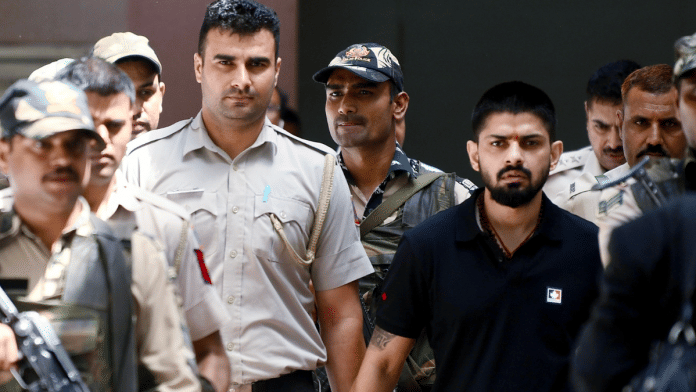
New Delhi: The US Department of Justice (DoJ) has announced the indictment of three Punjab-linked transnational groups that were carrying out criminal operations across the United States, Canada, and Europe. These syndicates are led by Lawrence Bishnoi, Jaggu Bhagwanpuria, and Ravinder Singh Dhanda.
However, among the most prominent names in the indictment are those of Lawrence Bishnoi, currently lodged in Gujarat’s Sabarmati Central Jail, and his associate, Goldy Brar, also known as Satinderjeet Singh, whom the indictment refers to as the “North American leader of the Bishnoi enterprise”.
“Law enforcement in the United States, Canada, and Europe has arrested 24 defendants—11 of them in California—connected to three India-based transnational organized crime groups charged with a litany of criminal acts, including the assassination in Canada in 2023 of a prominent Indian political and religious figure,” the Justice Department announced on Tuesday.
These indictments are likely to be followed by a formal request for Bishnoi’s extradition to the United States. A DoJ official confirmed to some media organisations that they would be seeking his extradition.
After the USA formally requests the extradition through the diplomatic channel, a lengthy process—that could take months or even years—would kick in, involving the government referring the matter to a magistrate. Based on the magistrate’s report and other considerations, the Centre may take a call on extradition. Bishnoi will have the option to challenge the order in court.
Also Read: Minor recruits, web of lieutenants & ‘patriot’ image—US indictment lays bare Bishnoi syndicate
The relevant treaty and the law
The Bilateral Extradition Treaty between India and the United States, signed on 25 June 1997, governs the extradition of individuals accused or convicted of serious crimes between the two countries.
Under this Treaty, the contracting States agree to extradite to each other “persons who, by the authorities in the Requesting State are formally accused of, charged with or convicted of an extraditable offense”.
It does not matter if such an offense was committed before or after the Treaty came into force.
Lawrence Bishnoi has been in jail for years in multiple criminal cases across states, including allegations of murder, attempted murder, extortion, criminal conspiracy, arms act offences, and running an organised crime syndicate. Currently, he is lodged in the Sabarmati Central Jail in Gujarat.
His extradition would be governed by the 1997 Treaty. Article 14 of the Treaty allows India the option to either surrender him temporarily or postpone it till the case in India reaches its conclusion.
Article 14 states that in case of an extradition request for a person being prosecuted or serving a sentence in the Requested State (India, in this case), the Requested State, subject to its own laws, can temporarily surrender the person to the Requesting State (USA) for prosecution there.
“The person so surrendered shall be kept in custody in the Requesting State and shall be returned to the Requested State after the conclusion of the proceedings against that person,” the provision adds.
The Treaty also provides for the option of postponing the extradition proceedings against a person who is being prosecuted or who is already serving a sentence. The postponement may continue until the person’s prosecution in the Requested State has been concluded, or until such person has served any sentence imposed, the provision adds.
According to Advocate-on-record Sriram Parakkat, one of the other provisions that would play an important role is Section 21 of the Extradition Act 1962. “The accused is not to be tried for any offence which is not in the extradition request and subsequently in the extradition order.”
Apart from this, several provisions of India’s Extradition Act, 1962, would also come into play in the extradition process.
Section 31 of the Act says that a fugitive criminal shall not be surrendered or returned to a foreign State, if the offence for which surrender is sought is “of a political character”, or if he proves to the satisfaction of the magistrate, or court or the Centre that the requisition or warrant for his surrender was made with a view to try or punish him for an offence of “political character”.
Other situations in which extradition can be refused is if the country seeking extradition can no longer legally prosecute the person because too much time has passed since the alleged offence.
However, if the Central government decides that a fugitive criminal cannot be surrendered or returned, it may take steps to prosecute them domestically for those charges, according to section 34 of the Act.
This ensures refusing extradition does not result in impunity.
“While the US indictment is a significant legal development, it does not by itself result in Lawrence Bishnoi being transferred out of Indian custody. It merely creates the basis for a formal extradition request through diplomatic and legal channels,” advocate Raghvendra Pratap Singh, Partner at the Lucknow-based law firm One India Law, told ThePrint.
Bishnoi has remained in continuous Indian custody since 2015 and is currently lodged in a high-security ward of Sabarmati Central Jail while facing multiple pending prosecutions in India, including murder and Maharashtra Control of Organised Crime Act (MCOCA)-related cases, he said.
“Given these ongoing domestic proceedings, India would likely seek to complete its own prosecutions before considering extradition. Such competing jurisdictional claims are a common point of friction in extradition treaty practice,” Singh added.
Why does the US want Bishnoi
According to the press release by the US Department of Justice, Lawrence Bishnoi is charged in incidents linked to the extortion crisis plaguing communities in Ontario and British Columbia, and the assassination of Sikh separatist leader Hardeep Singh Nijjar in Surrey in 2023.
Prosecutors described the three groups, including the one led by Bishnoi, as transnational enterprises involved in racketeering, extortion, drug trafficking, kidnappings and targeted killings across North America and beyond.
“Lawrence Bishnoi, 33, of Punjab, India, a gangster long imprisoned in India, was a self-styled university student leader before tiring of politics and turning himself and his followers to crime, according to a nine-count indictment that a federal grand jury returned on July 1,” the DOJ’s release said.
Using contraband cellphones and other voice-over internet protocol devices smuggled into his jail cell, Bishnoi personally directed political assassinations, murders, shootings, extortions, kidnappings, drug trafficking, human smuggling, and other crimes committed by members and associates of the Bishnoi enterprise worldwide, according to the indictment document.
The Canadian government in September 2025 designated the Bishnoi “enterprise” as a terrorist entity.
According to the indictment, to help manage his enterprise’s day-to-day operations, Bishnoi delegated control to trusted lieutenants and regional leaders of the enterprise, including Goldy Brar, Rohit Godara, and Sukhraj Singh Kang.
The document said both Brar and Godara effectively spoke for Bishnoi and helped direct the actions of members and associates of the Bishnoi enterprise worldwide, including acts of violence committed by the gang’s members and associates in the United States, Canada, and elsewhere.
Significantly, the document charges Bishnoi and Brar with ordering the assassination of Hardeep Singh Nijjar, which occurred when two gunmen shot and killed H.S.N. as he left a Sikh temple in Surrey, British Columbia on June 18, 2023.
According to the indictment, the enterprise routinely targeted prominent religious, social, and political leaders with violence and used these high-profile acts to terrorise and extort members of the Indian community in the US.
The Bishnoi enterprise also funded its activities through international drug trafficking and stealing drug shipments from rival gangs. For example, in November 2024, Bishnoi and Brar oversaw the transportation of 49 kilograms (108 pounds) of cocaine that was intercepted in Redlands. It was intended for shipment via long-haul semi-trucks from the U.S. to Canada, according to the indictment.
In total, the indictment charges Bishnoi, Brar, Godara, and six others with one count of racketeering conspiracy, one count of conspiracy to interfere with commerce by extortion (Hobbs Act), six counts of attempted Hobbs Act extortion, and one count of conspiracy to distribute controlled substances, namely cocaine and methamphetamine.
Previous extradition cases
On 9 April last year, the United States extradited Tahawwur Hussain Rana to India to face justice for his role in planning the horrific 2008 Mumbai terrorist attacks.
“These attacks resulted in the tragic loss of 166 lives, including six Americans, and shocked the entire world. The United States has long supported India’s efforts to ensure those responsible for these attacks are brought to justice,” the DOJ website had said.
In December last year, Belgium’s supreme court, the Court of Cassation, rejected the appeal of fugitive diamond trader Mehul Choksi challenging his extradition to India in connection with the alleged Rs 13,000 crore fraud in Punjab National Bank.
India had also requested the extradition of David Coleman Headley, a Pakistani-American terrorist who was the mastermind behind the 2008 Mumbai attacks, from the US.
The request was sent to the US in December 2012. In January 2013, Headley was sentenced to 35 years in prison, followed by five years of supervised release, by the US Court for 12 terrorism crimes relating to his role in planning the Mumbai attacks.
“No official confirmation for the rejection of the extradition request has been received yet,” then Minister of State in the Ministry of Home Affairs Ratanjit Pratap Narain Singh had said in the Lok Sabha in response to a question in March 2013.
India was unable to secure the extradition of Headley due to a plea agreement it finalised with the US government. Under the terms of the deal, Headley pleaded guilty to 12 federal terrorism counts linked to the 26/11 Mumbai terror attacks and a separate plot targeting a Danish newspaper. In return for his full cooperation, the US government agreed to bar his extradition to India.
(Edited by Ajeet Tiwari)
Also Read: Lawrence Bishnoi regrets that his younger brother followed his footsteps in crime