



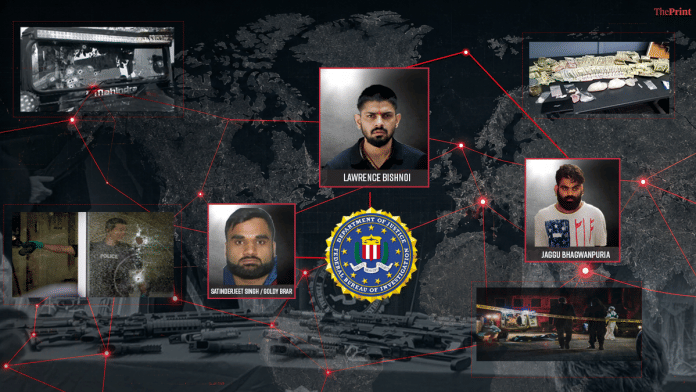
New Delhi: Recruiting minors from Punjab through student visas and forged documents, building a drug trafficking network and orchestrating political killings—the US indictment exposes how jailed gangster Lawrence Bishnoi, operating from inside Sabarmati Central Jail in Gujarat, expanded his criminal empire across the United States, Canada and Europe, turning it into one of India’s most seizable transnational crime syndicates.
The indictment also exposes the full extent of Bishnoi’s criminal network, laying out its role in extortion, murders, besides drug and arms trafficking, and use of violence and intimidation. It also details the syndicate’s structure, global reach and methods.
The DOJ Tuesday unsealed three indictments naming 37 defendents across the US, Canada and Europe. The sweeping crackdown, it said, also led to the arrest of 24 people across countries, with alleged links to at least three India-based organised crime syndicates, including networks associated with Bishnoi and Brar.
According to the indictment, Bishnoi, lodged in Sabarmati Central Jail in Gujarat, built his gang into a transnational crime syndicate headquartered in India, with operatives across the United States, Canada, the UK, Europe and Australia targeting prominent political, business and cultural figures in India and the diaspora. It alleged the gang used high-profile violence to instil fear and amplify its acts.
According to the indictment, targets were identified through government databases, social media and physical surveillance. Members also collected “pattern-of-life” intelligence and details of victims’ family members—often those in India—to increase pressure during extortion attempts, it added.
Once a target was identified, members allegedly contacted them through encrypted messaging applications, demanding money while threatening to kill or harm them and their families if they refused.
Despite being in prison, Bishnoi allegedly ran the syndicate through a network of “trusted lieutenants” and regional leaders.
The indictment identifies his childhood friend Goldy Brar as the head of North American operations and another associate, Godara, as overseeing Europe. Together, they allegedly directed targeted killings, shootings, kidnappings, assaults, extortion and drug trafficking in their respective territories.
The indictment also alleges that Bishnoi cultivated the public image of a “patriot”, “nationalist” and deeply “religious” individual to attract recruits and expand the syndicate’s influence.
Also Read: 2 ‘Bishnoi gang members’ held over firing outside Guru Randhawa’s Delhi gym; Salman angle under lens
Drug trafficking
Detailing the Bishnoi syndicate’s role in drug trafficking, the indictment alleges that the gang imported, exported and distributed controlled substances in the US, besides providing transportation services to other drug trafficking organisations. It further alleges that the gang routinely stole, or “ripped”, bulk quantities of cocaine and methamphetamine from rival trafficking groups, including consignments it had been hired to transport for them.
According to the indictment, they also coordinated routes for the transportation of cocaine and methamphetamine on long-haul semi-trucks across the United States and to the US-Canada border and also ensured protection of these trucks.
“Members and associates of the Bishnoi gang shared profits obtained from criminal activities conducted on behalf of the enterprise,” the indictment says.
“The Bishnoi gang distributed certain profits to gang members and associates operating in the region of the relevant criminal activity, and directed other profits back to members and associates in India,” it says.
According to the indictment, his teams would collect extortion payments from targets on behalf of Bishnoi and would oversee and manage the transportation of bulk quantities of cocaine and methamphetamine across the United States and to the US-Canada border for drug trafficking organisations in the United States, Mexico and elsewhere.
Recruited minors, sent them abroad on student visa
The indictment alleged that the Bishnoi gang recruited new members primarily from “vulnerable, disadvantaged populations in India,” primarily Punjab, through promotional videos and messages posted on social media sites, to work for him.
“The Bishnoi OCG (Organised Crime Group) targeted minors for recruitment to minimize the sentencing exposure that would otherwise attach to violent criminal activity committed by members and associates of the enterprise,” the indictment says.
Recruitment coordinators for the Bishnoi OCG enticed impoverished minors in India to join the enterprise by promising, among other things, money, notoriety, and protection, it says.
“The Bishnoi OCG sent loyal members to countries outside India, including the United States and Canada, on student visas and foreign worker visas—often containing fraudulent information—to assist the enterprise’s criminal operations in those countries,” the indictment says.
‘Decentralised membership’
According to the indictment, membership in the Bishnoi gang was decentralised and, except key leaders, Bishnoi gang members and associates often had limited information on the identities or backgrounds of other members.
“This decentralized structure created a level of separation between the Bishnoi gang members and the crimes committed by its members and associates. This decentralized structure also protected the enterprise and its members from criminal liability in the event a Bishnoi OCG member or associate was arrested for a crime and decided to cooperate with law enforcement,” the indictment says.
“All key leaders of the gangs and associates knew that if they were disloyal to the enterprise, other Bishnoi OCG members or associates would kill or otherwise harm them or their family members, particularly those located in India,” it adds.
(Edited by Sugita Katyal)
Also Read: ‘Stop selling Punjab’s pain’—Congress leader slams makers of Lawrence Bishnoi docu-series