



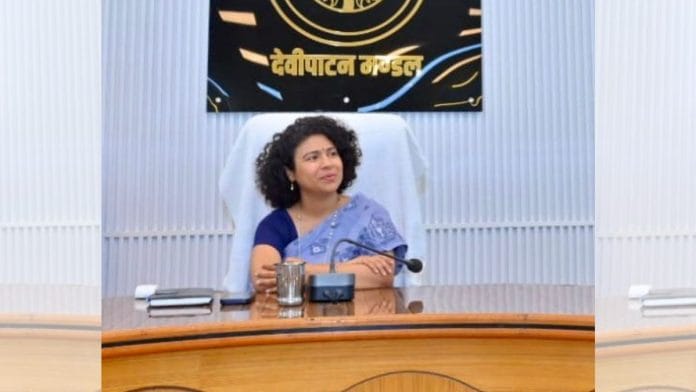
Lucknow: Indian Administrative Service (IAS) officer Durga Shakti Nagpal is caught amid yet another controversy, this time over allegations that she attempted to influence and intimidate a judicial officer in connection with a pending civil dispute.
An officer of 2010 batch, Nagpal is currently the Divisional Commissioner of Devi Patan. She has come under the scrutiny of the Allahabad High Court’s Lucknow Bench after Gonda Civil Judge (Senior Division) Shabina Khan alleged that the senior Uttar Pradesh cadre officer contacted her over phone regarding a case pending before her court.
The high court has observed that, prima facie, the alleged conversation appeared to be an attempt to influence the judicial officer, and has referred Nagpal’s conduct to the court dealing with criminal contempt matters.
Justice Syed Qamar Hasan Rizvi made the observations while hearing a petition related to the transfer of a civil suit that has been pending since 1997 between Jyoti Vidya Mandir School and the Nagar Palika Parishad, Gonda.
The dispute concerns several parcels of Nazul land recorded in the name of the Commissioner of Devi Patan division. Nazul land is owned by the state, and usually managed as leasehold property.
According to the commissioner’s stand before the court, the land had been reserved for an office building and other government purposes. It was alleged that a school building was subsequently constructed on the land, leading to a dispute that has remained pending before the civil court for over two decades.
The case is currently at the evidence stage, and a status quo order is also in force. The school had alleged that state officials were misusing their positions to exert undue pressure on the court and had sought the transfer of the case outside the Devi Patan division.
Also Read: How Gen Z protests in Delhi have fired up Gen Alpha in UP
The allegation
The controversy intensified after Civil Judge Shabina Khan informed the court about an alleged telephone conversation with Nagpal on 15 July.
In her written statement that went viral on social media, Khan alleged that Durga said, “I am a senior IAS officer, and you have behaved improperly by not taking my phone call.” She added, “It is good that you spoke to me; otherwise, I was going to file a complaint against you in the high court.’
Justice Rizvi observed that the tone and language of the alleged conversation gave a direct impression that an attempt was made to influence the presiding officer of the court. The high court also noted that Nagpal had not denied making the phone call. It expressed surprise that a litigating party or the state could approach a court through a phone call in connection with a matter that was still pending.
The court said the alleged conduct, prima facie, amounted to a direct attack on the independence of the judiciary and an interference with the administration of justice. Referring to Supreme Court rulings that have treated threats or attempts to pressure judges in judicial matters seriously, the high court said the matter required consideration under criminal contempt.
It directed that, after obtaining necessary instructions from the chief justice or the senior judge concerned, the matter be placed before the appropriate court dealing with criminal contempt cases.
ThePrint has approached Nagpal for her version. This report will be updated if and when a response is received.
Previous controversies
This is not the first time Nagpal is at the centre of a major controversy.
In 2013, when she was posted as Sub-Divisional Magistrate (SDM) in Uttar Pradesh’s Gautam Buddh Nagar district, Nagpal launched a crackdown against alleged illegal sand mining along the Yamuna and Hindon rivers.
Nagpal’s action against illegal mining operations, including raids and action against those allegedly involved, spawned a major controversy when she was suspended by the then Akhilesh Yadav government in July 2013 after the demolition of a wall of an under-construction mosque in Kadalpur village. The state government had alleged that her action threatened law and order by involving a religious structure.
Nagpal, however, did not accept the allegations against her. The suspension triggered a debate over whether civil servants could be suspended under political pressure for carrying out their duties. The controversy grew beyond Uttar Pradesh, with widespread criticism of the state government’s decision. The Centre had sought a report from the Uttar Pradesh government.
Nagpal continued her legal challenge and maintained her stand. Facing mounting criticism and scrutiny, the Akhilesh Yadav government eventually revoked her suspension in October 2013.
(Edited by Nardeep Singh Dahiya)
Also Read: Why Allahabad HC slammed Uttar Pradesh govt’s ‘well-orchestrated’ plan in Sugriv Kila land dispute