




New Delhi: The Allahabad High Court has slammed the Uttar Pradesh government for what it termed a “well-orchestrated” attempt to oust a historic temple in Ayodhya from its land under the guise of development for the Ram Janmabhoomi project, without paying the entire agreed sale amount.
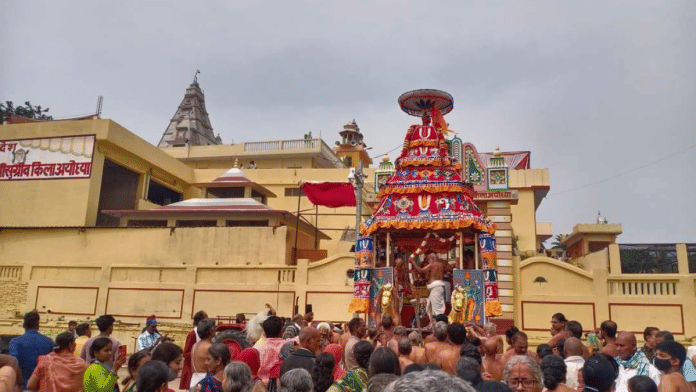
The dispute centres on 1,512 square metres of land belonging to the Shri Thakur Ram Janki Sugrivji Virajman Mandir, also called the Sugriv Kila, located near the Ram Janmabhoomi Temple.
According to the temple’s authorities, the state authorities “lured and prevailed upon” the temple’s Sarvarahkar, or manager, to hand over the land in the name of public purpose and the development of the Ram Janmabhoomi Temple. However, after taking possession of the land, the state delayed payments to the temple authorities, the temple said.
In an order passed on 11 August, a division bench of Justices Shekhar B. Saraf and Abdhesh Kumar said, “The whole story seems to be well orchestrated and a product of some fertile mind to somehow delay and postpone the payments of sale consideration to the petitioner merely to take the possession in a jiffy and deny the legitimate payment of sale consideration thereafter.”
The court described it as an “interesting issue of trust, lie and red-tape” where the state essentially “fooled” the temple authorities into surrendering possession of the property.
The court noted the “tearing hurry” shown by the public works authorities, highlighting that the sale deed was registered at 9:00 p.m. on 22 December, 2023. The temple handed over possession immediately, reposing faith in the state’s promise that the sale amount of Rs 1.38 crore would be paid via RTGS within 15 days.
However, while the state paid approximately Rs 17.48 lakh for the cost of construction (tin sheds), it withheld the remaining Rs 1.20 crore for the land itself.
The state’s ‘volte-face’ and the Nazul claim
Once in possession of the land, the state authorities executed a “volte-face”, claiming that the property was actually ‘Nazul’ (government land) and, therefore, did not need to be purchased from the temple.
The court noted that the state further filed a civil suit to cancel the very sale deed it had executed, alleging that the temple’s Sarvarahkar was not authorised to sell the property.
The division bench was unimpressed by this reasoning.
Invoking the legal principle of caveat emptor (buyer beware), the court noted that a purchaser is expected to conduct a title search before executing a sale deed. In this instance, however, the state chose to “put the cart before the horse” by taking peaceful possession under a sale deed and only then claiming the title was defective to avoid payment.
The court stated that such conduct from a welfare state and a model party could not be appreciated in any sense.
It further noted that if the state was truly unconvinced of the temple’s ownership, the property should have been “reverted to the petitioner” rather than the state continuing to occupy it while litigating to cancel the deed.
Verdict: Mandatory deposit with interest
While the High Court declined to settle the final title dispute and relegated it to the pending civil suit, it took decisive action to protect the temple’s interests.
Relying on the Supreme Court precedents like Dahiben v. Arvindbhai Kalyanji Bhanusali (2020) and Raziya Begum & Ors. v. Nafisa Begum Abdul Hamid (2026), the court clarified that the non-payment of a balance sale price does not invalidate a registered sale deed; rather, the remedy is a suit for recovery.
Consequently, the court directed the UP government to deposit the balance sale amount plus 8 percent interest per annum into an interest-bearing Fixed Deposit (FD) in the name of the trial court within four weeks. This amount will remain secured pending the outcome of the civil suit, though the temple may apply for the release of funds.
It also ordered that the trial be expedited, with an endeavour to conclude the proceedings within one year, ensuring that what it described as the “clandestine manner” in which the government took possession does not result in an indefinite delay of justice.
(Edited by Sugita Katyal)
Also Read: ‘We will pray, but not donate’: How Ram Temple donation theft row is affecting Ayodhya’s livelihood