





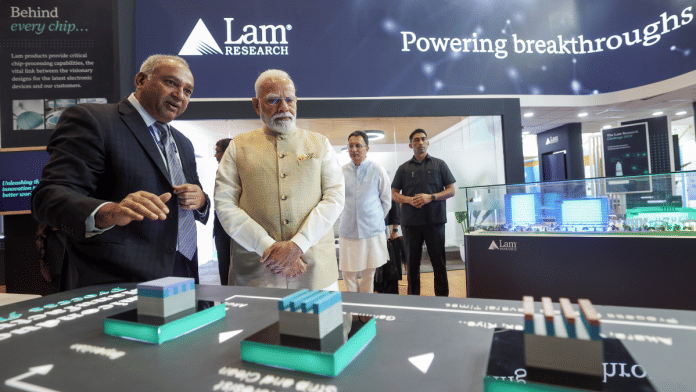


New Delhi: Prime Minister Narendra Modi will meet global semiconductor chief executives at a roundtable in New Delhi on 16 September, a day before he inaugurates SEMICON India 2026, the Centre said Tuesday.
The roundtable with global CEOs will be held the day before the SEMICON inauguration, Additional Secretary, Ministry of Electronics and Information Technology (MeitY), and CEO of the India Semiconductor Mission (ISM) Amitesh Kumar Sinha said.
Modi will inaugurate the two-day conference and exhibition on 17 September at Yashobhoomi in Dwarka. Modi held a similar roundtable at the 2025 edition, where executives briefed him on their investment plans.
The meeting places the government’s pitch before the firms it is courting for fabrication plants and packaging lines. With India importing close to 90 percent of the chips it uses at an estimated $30 billion a year, the government is seeking to build capacity at home.
SEMICON India 2026, themed ‘Silicon to Systems: Building the Ecosystem’, is the fifth edition of the conference and the third held with SEMI, the association that runs the SEMICON events across eight locations. It is organised by ISM, MeitY and SEMI.
Over 240 international companies will attend this year’s event. The 2025 edition, held in New Delhi, drew more than 350 exhibitors and over 20,750 attendees, with 2,500 delegates from 48 countries.
MeitY secretary S. Krishnan said this year’s exhibition would be larger, as the full venue is available. He said it would have more than 500 exhibitors, more than 150 speakers, delegations from more than 40 countries, six country pavilions and 10 state government pavilions, across 15,000 square metres.
The event comes with three units cleared under the first phase now in commercial production—Micron, Kaynes and CG Semi, all at Sanand in Gujarat.
Modi inaugurated the first on 28 February, Krishnan said, adding that five or six units could be running by the end of the year. Kaynes shipped India’s first commercially produced multi-chip modules in late 2025, and Micron runs an assembly and test plant built with a $2.75 billion investment.
Among the units expected to start this year is the Tata-Powerchip fab in Dholera, Gujarat, which would be the first plant to fabricate silicon on Indian soil rather than package imported chips. The Rs 91,000-crore plant, built for 50,000 wafers a month on the 28-nanometre node, targets its first chip in December.
Twelve projects were approved under the first phase, Semicon 1.0, with a combined investment of more than Rs 1.64 lakh crore across Gujarat, Assam, Uttar Pradesh, Punjab, Odisha and Andhra Pradesh.
“The actual on-ground success of Semicon 1.0 will be there on display for everyone to see,” Krishnan said, adding that it added to India’s standing as a destination for the industry.
Semicon 2.0
The Centre, he said, would issue the notification for the second phase, Semicon 2.0, shortly. The Union Cabinet approved the phase on 15 July with an outlay of Rs 1,27,500 crore, against Rs 76,000 crore for the first phase, which was launched in December 2021. The government has extended the programme’s timeline to 12 years from five, a change aimed at investors in projects that take years to build.
Semicon 2.0 covered six areas: chip design; machines and materials; fabrication units; assembly, testing and packaging, with a focus on advanced packaging; research and development in fields such as silicon photonics and power semiconductors; and talent development.
The research component, Krishnan said, would draw on existing national research funding.
On the workforce, Krishnan said India had a presence in chip design but had ground to cover in manufacturing. “Once we start training people for the manufacturing of semiconductors, then it will be relevant not just for India, but for other countries of the world,” he said, adding that India could supply personnel to the rest of the world.
MeitY additional secretary Amitesh Sinha said participation had risen 30 to 40 percent each year.
He said the government’s programmes now covered each segment of the value chain, from design to electronic systems, citing Semicon 1.0 and 2.0 alongside the mobile, IT hardware and component manufacturing schemes. “Every segment of this value chain is now covered,” he said, and the electronics and semiconductor tracks would run together at the conference.
Sinha said global semiconductor demand would rise from $1 trillion to $2 trillion, and India’s from $100 billion to $200 billion. “Our policy supports domestic manufacturing as well as global manufacturing,” he said, adding that the government had created a demand pipeline that would draw companies to the country.
Six country roundtables would be held, Sinha said, bringing together companies, trade associations and Indian firms looking for joint ventures and technology partnerships. He said the conference would also hold a session on women in the industry, covering entry into the sector and progression to senior roles.
In a statement, SEMI president and CEO Ajit Manocha said that India was positioned to grow in the sector. “India’s opportunity is not simply to join the global supply chain, but to become integral to it. That is the ambition SEMICON India 2026 exists to accelerate.”
SEMI India and IESA president Ashok Chandak said the event would introduce a ‘Sand to Silicon to Systems’ value chain experience. “India is progressing from building credibility to demonstrating capability,” he said.
The event will feature companies including ASML, Applied Materials, Teradyne, Infineon, Micron, Tata Electronics, Lam Research, Tokyo Electron, NXP and IBM Research, according to the organisers.
The government has also provided design tools to more than 332 academic institutes and 105 startups, and approved 24 startups under the Design Linked Incentive scheme, the MeitY said. It has set a target of placing India among the world’s top five chip ecosystems by 2029.
(Edited by Tony Rai)
Also Read: What is ISM 2.0 launched by Sitharaman to boost India’s semiconductor sector?