







New Delhi: It’s a ‘week’ solution, but just might work. If a Non-Resident Indian (NRI) decides to marry in India, their registration and passport linkage must be completed within seven days, the BJP in Madhya Pradesh has suggested as a solution to the fairly common evil of NRIs abandoning their wives and fleeing abroad soon after marriage.
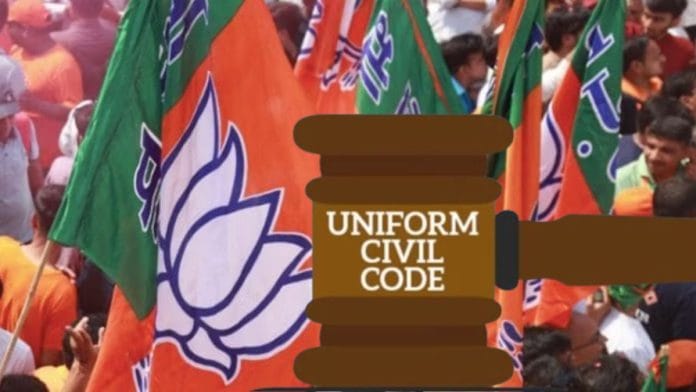
The BJP in Madhya Pradesh has submitted these suggestions to a Uniform Civil Code (UCC) committee headed by Justice Ranjana Desai. The committee sought oral and written suggestions from various stakeholders, including political representatives and religious leaders, to finalise the draft UCC for the state.
“Monitoring of NRI marriages: In the interest of the country and the safety of daughters, it is very important that if any NRI marries in India, their registration and passport linking should be mandatory within 7 days, so that cases of running away abroad after marriage and abandoning wives can be completely stopped,” the BJP said in its suggestions submitted to the committee.
The suggestions, a copy of which is with ThePrint, were submitted by S.S. Uppal, State Coordinator, Election Commission Coordination Department, of the BJP in Madhya Pradesh, and Rahul Kothari, state general secretary of the unit.
The Madhya Pradesh government led by Mohan Yadav, has formed a high-level committee for the implementation of the Uniform Civil Code. The committee held consultations with stakeholders in Bhopal and indicated that the much-awaited UCC draft is likely to be ready by the first week of July. According to sources, the Congress did not attend the meeting.
“The primary objective of the Uniform Civil Code is to bring uniformity in personal laws (marriage, divorce, inheritance, adoption, etc.) for all citizens,” the BJP said in its written submission while stating that the minimum legal age of marriage has been fixed for men and women of all religions (for example, 21 years for men and 18 years for women).
Pointing out that these provisions are not followed in some cases, the party has advocated strict action. “It is proposed that legal registration of all marriages be made compulsory. Strict Action Against Child Marriage – if anyone marries or causes a marriage to be performed before the prescribed age, the marriage should not only be declared invalid, but strict punishment and fines should also be imposed on the guardians involved,” it said, suggesting that action should be initiated against the parents in case of a child marriage.
The state unit also said that if children do not care for their elderly parents, provisions should be made for cancellation of property transfers and for maintenance payments to be deducted directly from the children’s income.
“In the event of divorce, any property purchased by the husband and wife after marriage should be divided equally, with both parties having a 50–50 share, so that homemakers are not left helpless or without support after divorce,” it added.
The BJP-ruled state of Uttarakhand became the first state to implement the UCC, with Gujarat recently passing a bill on the same. A number of BJP-ruled states have already implemented UCC, including Assam where the party had promised it in their manifesto. In West Bengal too, the BP has promised to introduce the UCC.
On 6 April, Prime Minister Narendra Modi while highlighting that the BJP government had delivered several of its promises, including the Citizenship Amendment Act (CAA) and the construction of Ram Mandir, pointed out that the UCC and ‘one nation, one election’ missions were still underway.
The Congress has termed UCC a “diversionary tactic”. State Congress president Jitu Patwari took to social media platform X, asking the BJP to discuss how many guarantees of Prime Minister Narendra Modi have been fulfilled to date, before holding UCC discussions.
(Edited by Nardeep Singh Dahiya)
Also Read: Why Assam UCC can face more questions in court than in the state Assembly