



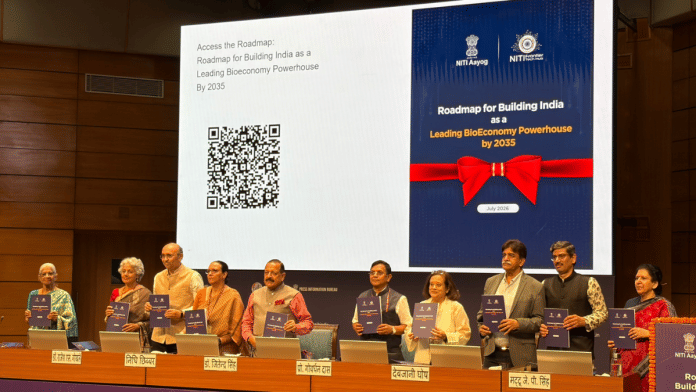
New Delhi: India must move beyond being the ‘pharmacy of the world’ and emerge as a global biotechnology innovation hub if it wants to build a $691-billion bioeconomy by 2035, according to a roadmap NITI Aayog released Thursday.
The report, ‘Roadmap for Building India as a Leading BioEconomy Powerhouse by 2035’, proposes a Rs 50,000-crore BioEconomy Growth Fund, six mission-mode national programmes, faster regulatory approvals, AI-led biotechnology, and stronger industry-academia collaboration to help India create over 30 million high-value jobs and become one of the world’s top three biotechnology powers.
The roadmap was launched by Jitendra Singh, Union Minister of State (Independent Charge) for Science and Technology, NITI Aayog CEO Nidhi Chhibber, and Debjani Ghosh, Distinguished Fellow and Head of NITI Frontier Tech Hub.
At the launch, Singh said the world was entering a “biological century”, adding that while India lagged behind during the IT revolution, it is now among the few countries with a dedicated biotechnology policy under BioE3 (Biotechnology for Economy, Environment and Employment).
“If the 20th century was the IT century, the 21st century would be the BT [bio technology] century,” he said, adding that India was not going to lag behind this time.
In the last decade, India’s bioeconomy has expanded nearly sixteen-fold from $10 billion in 2014 to $195.3 billion in 2025—and now contributes 4.8 percent to GDP. The report projects this could grow to $691 billion by 2035 and eventually touch $2.6 trillion by 2047 through mission-mode implementation.
The report notes that for the next phase of growth, India needs to build on its strengths which include the world’s largest vaccine manufacturing ecosystem, over 10,000 biotech startups, more than 700 US FDA-approved manufacturing plants outside America and over 20 biosimilar products in global markets.
However, it argues that these capabilities remain fragmented and require coordinated execution.
“The next phase must go far beyond incremental growth,” the report says, arguing that decisive execution can transform India into one of the world’s leading biotechnology powers.
Also Read: In Modi’s 12 years, this is what science and technology ministry achieved
Six National BioMissions
The report’s biggest recommendation is replacing multiple standalone biotechnology programmes with six National BioMissions backed by dedicated funding, timelines and accountability.
These include GeneIndia for affordable gene and cell therapies, AgriBio 2.0 for climate-resilient crops, BioX Foundry to commercialise synthetic biology products, One Health Grid for AI-enabled disease surveillance, Marine Biotechnology to boost the blue economy and BioPharmaNext to establish India as a global hub for biologics, biosimilars, vaccines and AI-driven drug discovery.
“These missions should evolve beyond grant-based programmes into integrated delivery platforms, combining R&D, manufacturing scale-up, regulatory alignment, workforce development, and assured procurement pathways to drive measurable outcomes,” the report stated.
India, Singh said, had already demonstrated its capabilities through indigenous vaccines, affordable CAR-T cell therapy and the development of indigenous antibiotics, adding that the country had become “a cost-effective global destination” for healthcare innovation.
He also stressed that greater collaboration with private industry would be essential to achieve the roadmap’s ambitions.
Funding, reforms & talent
The roadmap identifies financing, regulation and skilled manpower as the biggest constraints holding back India’s biotechnology ambitions.
It recommends establishing a Rs 50,000-crore BioEconomy Growth Fund between 2026 and 2035 to bridge the gap between laboratory research and commercial manufacturing. “This fund would deploy blended finance, catalytic equity and infrastructure support for biomanufacturing, advanced therapeutics, fermentation platforms, biomaterials, diagnostics and synthetic biology.”
The roadmap also proposes Production Linked Incentive (PLI)-style support for biomanufacturing, along with regulatory sandboxes, modernised approval systems and streamlined clearances to reduce delays that discourage innovation and investment.
To improve coordination, the report calls for creating an Empowered Committee on National BioMissions, a National BioData Council, and a BioEconomy Investment and Policy Forum.
It also recommends strengthening biotechnology education, expanding PhD and post-doctoral programmes and developing expertise in computational biology, AI-driven biotechnology and regulatory science.
The report concludes saying that “the coming five years will determine whether India merely scales or shapes the biological century”, arguing that biotechnology should now be treated as core national infrastructure, much like digital public infrastructure.
(Edited by Tony Rai)
Also Read: India can add $700 bn to $1.4 trn to GDP with higher female workforce participation, says CSEP study