





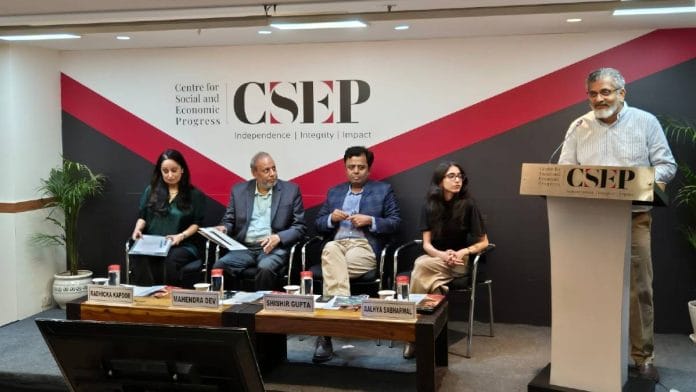

New Delhi: India is letting go between $700 billion and $1.4 trillion in economic output because millions of women remain outside the workforce, according to a study by Centre for Social and Economic Progress (CSEP), a policy think tank, that argues that the country’s biggest challenge is not just social norms but a shortage of quality jobs for women.
A seminar on the study, titled ‘Why Do Fewer Women Work in India? A Supply-Demand Perspective’, was held Friday at the CSEP. The study estimates that India would need to add nearly 90 million women to the labour force to match female workforce participation levels of developed economies.
At current levels of productivity, India could raise its gross domestic product (GDP) by around $736 billion, but shifting more women into non-farming and higher-productivity jobs could nearly double this gain to $1.4 trillion.
Speaking at the seminar, S. Mahendra Dev, Chairman of the Economic Advisory Council to the Prime Minister (EAC-PM), said increasing women’s participation in the workforce would be crucial to achieving India’s 2047 Viksit Bharat ambitions.
“Creating quality employment is most important for inclusive growth. If we take women’s participation rates to around 54 percent, comparable to developed economies, India can add between $700 billion and $1.4 trillion to GDP while making growth more inclusive,” Dev said.
The paper challenges the conventional view that India’s low female labour force participation is primarily due to patriarchal norms, unpaid care work and household responsibilities. It instead argues that weak labour demand and the economy’s inability to generate enough suitable jobs is an important reason why women remain outside of formal employment.
Discussing the findings, while speaking at the seminar virtually, Franziska Ohnsorge, Chief Economist for South Asia at the World Bank, said India would need both demand-side and supply-side reforms to bring millions of women into the workforce.
“The breakthrough in employment may only come once we have a big break in demand,” she said, adding that new free trade agreements and stronger exports could create the demand shock needed to generate more formal jobs for women.
Also Read: Will India grow old before it grows rich? Economists sound a warning
Rising participation, but not better jobs
The study paper outlines India’s changing female labour force participation over the past two decades.
Participation level declined from 37 percent in 2004-05 to 21 percent in 2017-18, before recovering to 34 percent by 2023-24.
According to the study, the earlier decline was largely driven by supply-side factors, including higher education enrolment among young women, rising rural incomes and stronger wage growth, which reduced the immediate need for many women to seek paid work.
However, the recovery post 2017-18 presents a more complex picture. Much of the increase has come from self-employment and subsistence work, particularly in rural India rather than formal salaried employment.
Agricultural productivity declined by around 9 percent, while earnings of self-employed workers fell by 32 percent, suggesting that many women entered work because of financial pressure rather than improved employment opportunities.
Radhicka Kapoor, Senior Employment Specialist at the International Labour Organization (ILO), said the focus should not only be on bringing more women into the workforce but also on improving the quality of jobs available.
“What is important is what they are doing,” Kapoor said, arguing that policymakers should prioritise better-paying jobs with written contracts, social security and opportunities for career progression.
She also noted that the recent rise in women’s participation has been driven overwhelmingly by rural employment, while urban participation has increased only marginally.
Study’s recommendations
The paper recommends shifting policy from encouraging women to work towards creating more labour-intensive employment opportunities.
It calls for more flexible labour markets, noting that around 15 percent of Indian companies identify labour regulations as a major constraint, higher than the Bangladesh (3.4 percent) and Philippines (6.4 percent).
It also recommends strengthening labour-intensive manufacturing sectors such as textiles, rationalising tariffs, expanding free trade agreements and improving export competitiveness to create more jobs.
The study also calls for higher spending towards health and education, as both sectors employ large numbers of women while also help improve human capital. India’s public health expenditure remains around 1 percent of GDP, well below the recommended 3 percent.
The study concludes that while reducing unpaid care work, improving childcare facilities and making workplaces more flexible are essential, social reforms alone will not substantially increase female employment participation.
Unless India’s economy generates millions of additional quality jobs, particularly in labour-intensive industries, it will continue to leave a significant share of its growth potential untapped.
(Edited by Nida Fatima Siddiqui)