





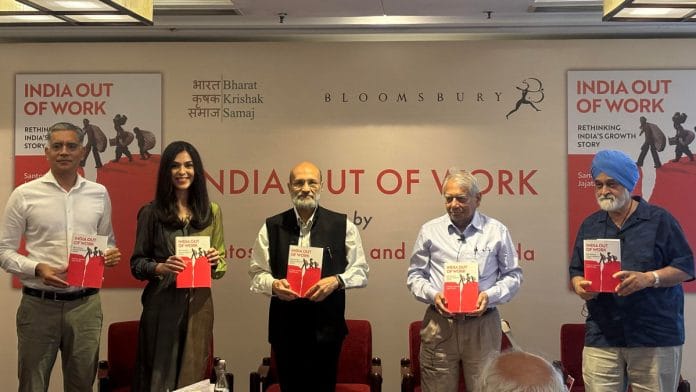


New Delhi: Time is running out. That was the overarching theme as a group of economists discussed whether growth without jobs risks squandering India’s greatest economic advantage—its demographic dividend. That window begins closing in about 15 years as the population ages.
“India is one of the fastest-growing major economies in the world, yet manufacturing has stagnated, agriculture has reabsorbed millions of workers, real wages have barely grown for a decade, and educated unemployment remains persistently high,” said economist Santosh Mehrotra at the launch of his book India Out of Work: Rethinking India’s Growth Story, co-authored with Jajati Parida.
The book, published by Bloomsbury, argues that India must rethink its growth model, creating 350 million non-farm jobs by 2055 while sustaining annual economic growth of around 9 per cent.
The panel at the India Habitat Centre on July 9, also featuring economists Montek Singh Ahluwalia and Rakesh Mohan, debated whether India’s problem is a shortage of jobs, quality employment, or a deeper failure of structural transformation.
Moderated by CNBC-TV18 Managing Editor Shereen Bhan and organised by the Bharat Krishak Samaj, the discussion—attended by academics, students, researchers, and policy professionals— opened with Mehrotra describing the jobs-growth disconnect as the defining puzzle behind the book.
Also Read: Rights or benefits? Azim Premji handbook examines shift in India’s welfare architecture
‘Structural retrogression’
Mehrotra argued that India’s growth story remains incomplete because the economy has expanded without the structural transformation seen in other rapidly industrialising countries.
Instead of steadily moving workers from agriculture into manufacturing and modern services, India has seen a reversal, he said. Manufacturing’s share in gross value added fell from 17 per cent in 2011 to 14.3 per cent in 2024, despite initiatives such as Make in India and the Production Linked Incentive scheme. Mehrotra attributed this to demonetisation and other policy-induced shocks.
At the same time, agriculture has absorbed millions of workers since the pandemic, much of it as unpaid family labour. Female labour force participation has risen, he noted, but much of the increase has also come in unpaid work rather than formal employment.
“This is a structural retrogression,” Mehrotra said.
But India’s employment crisis cannot be understood through unemployment figures alone, according to him.
“Employment outcomes depend not only on the rate of growth, but also on the composition of that growth,” he said.
India, in his view, faces four linked labour market crises: millions of young people entering the workforce every year, the persistence of surplus labour in agriculture, rising educated unemployment, and a disconnect between education and labour market demand.
Graduate unemployment, he noted, has climbed sharply over the past decade even as higher education has expanded.
Mehrotra also questioned whether flagship industrial initiatives were sufficient to reverse the trend.
“PLI is not a manufacturing strategy,” he said, calling instead for a broader industrial policy focused on labour-intensive manufacturing, stronger exports and greater public investment in human capital.
A quality problem
The panel also turned to the quality of jobs available in India— whether they provide liveable wages, security, and opportunities for advancement.
This is as urgent a question as the employment numbers themselves, according to Montek Singh Ahluwalia, former deputy chairman of the Planning Commission.
“The poor are too poor to stay unemployed,” he said, noting that without unemployment insurance, most people accept whatever work they can find. “We need to look at the quality of employment.”
Quoting a line his mentor, former prime minister Manmohan Singh, was fond of repeating, he added: “Everything they say about India is true—but the opposite is also true.”
Despite India’s economy expanding at around six per cent annually, wages at the lower end of the labour market have barely kept pace. At the same time, the expansion of universities and colleges has raised expectations among young Indians entering the workforce.
“The jobs available are simply not up to people’s expectations,” Ahluwalia said.
He also cautioned against treating manufacturing as the sole engine of employment. Services could deliver sustained productivity growth and higher wages too, according to him, though AI could threaten employment even in India’s globally competitive IT sector.
Old before rich
Former RBI deputy governor Rakesh Mohan argued that creating jobs at the scale envisioned in the book would require much higher investment.
“To get to the kind of growth rate he’s talking about, we do need to increase the investment rate to in excess of 35 per cent,” Mohan said, adding that this would also require higher domestic savings.
Like Mehrotra, Mohan argued that India’s structural transformation depended on moving workers into labour-intensive manufacturing, noting this would also have a positive ripple effect in the services sector.
“If you do much more in labour-intensive manufacturing, you also generate more service jobs,” he said.
Urbanisation, he added, was another missing piece of the puzzle. India is under-urbanised compared with many of its Asian peers, and stronger cities capable of supporting large manufacturing clusters would be essential for sustained employment growth.
As the discussion drew to a close, Mohan struck an optimistic note, pointing to the rapid expansion of higher education as one of India’s greatest strengths. Better urban governance, public transport and civic infrastructure, he argued, could create meaningful work for an increasingly educated workforce.
An educated workforce, he added, was more likely to demand accountability from governments: “If they’re unemployed, they will agitate—which is terrific, as far as I’m concerned.”
Mehrotra returned to the urgency of the demographic window. India’s expansion of education over the past three decades, particularly schooling for girls, had created a generation with higher expectations from work. The economy now has to create enough productive non-farm jobs before that window closes.
“Otherwise,” he warned, “we may well become old without becoming rich.”
(Edited by Asavari Singh)