



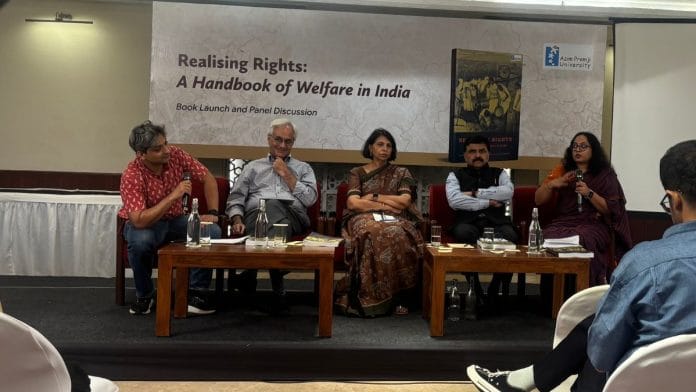
New Delhi: Has India quietly moved from guaranteeing welfare as a right to delivering it as a benefit? That question dominated the launch of Realising Rights: A Handbook of Welfare in India, published by Azim Premji University, at Delhi’s India Habitat Centre on Friday, where economists, former bureaucrats, and journalists debated whether the country’s welfare architecture is shifting away from rights-based entitlements toward cash transfers, digitisation, and discretionary benefits.
While speakers acknowledged that technology and direct benefit transfers had improved welfare delivery, they argued that efficiency should not come at the cost of rights, public institutions and accountability. As economist AK Shiva Kumar put it: “India’s welfare imagination is being renegotiated—from rights, entitlements and public systems towards cash transfers, digital delivery and the language of beneficiaries. We should not be debating ‘freebies’; we should be asking whether welfare programmes expand dignity, citizenship and capabilities, or produce dependency and political patronage.”
Edited by the Centre for the Study of the Indian Economy at Azim Premji University, the handbook examines India’s welfare architecture and the evolution of major social protection programmes, including maternity entitlements, ICDS, the Mid-Day Meal Scheme, the Public Distribution System (PDS), MGNREGA, social security pensions, school education, health, Ayushman Bharat-PMJAY, the Right to Education, PM-KISAN, and state-level cash transfer schemes. It also explores broader themes of social justice, accountability, decentralisation, and digitisation.
The book was presented by Dipa Sinha, a development economist, along with Rajendran Narayanan, an associate professor with the School of Arts and Sciences at Azim Premji University, who said the volume seeks to understand how welfare has evolved in India and the challenges confronting it today.
The launch was followed by a panel discussion titled Welfare in India and Future Prospects, moderated by Azim Premji University professor Arjun Jayadev. Panellists included economist AK Shiva Kumar, former IAS officers Arti Ahuja and PV Ramesh, and journalist Sobhana K Nair.
Kumar said the handbook arrives “precisely at a time when India’s welfare imagination is being renegotiated — from rights, entitlements, and public systems toward cash transfers, digital delivery, and, once again, the language of beneficiaries.”
“The book gives us the vocabulary to understand this shift rather than simply celebrate or condemn it,” he said.
While rights-based welfare had suffered from implementation failures, he argued, it also created “something politically and institutionally precious” by allowing citizens to make claims on the state.
Also read: How did Odisha fix its finances? Ex-civil servants, economists trace its fiscal journey
‘Who deserves welfare?
Ahuja argued that the language surrounding welfare itself has shaped the relationship between citizens and the state.
“When we talk welfare, we upend ‘We the People’ into ‘We the Receivers’,” she said, adding that while digital delivery has improved efficiency, “technology is good, but with a huge pinch of salt,” especially when exclusion and accountability are not addressed.
Ramesh pointed out that successive governments had increasingly substituted public services with cash transfers. “What has really happened is that the state has contracted—both physically and in terms of capacity,” he said, arguing that governments had gradually shifted responsibility for essential services such as health and education onto citizens and markets. Recounting a recent visit to tribal villages, he said the absence of Aadhaar had left some families unable to access schools, Anganwadi centres, healthcare or food rations.
For Nair, the central question was no longer simply what welfare means. “I would ask who deserves welfare today? That, to me, is the much scarier question,” she said, referring to recent debates over linking beneficiary verification to electoral roll revisions in West Bengal. She described the handbook as “an investigation of Achhe Din—and Achhe Din for whom?”
Across the discussion, panellists returned repeatedly to one concern: that while digitisation and direct benefit transfers have transformed welfare delivery, they cannot replace investments in public institutions or dilute the constitutional promise of welfare as a right rather than a favour.
(Edited by Aamaan Alam Khan)