



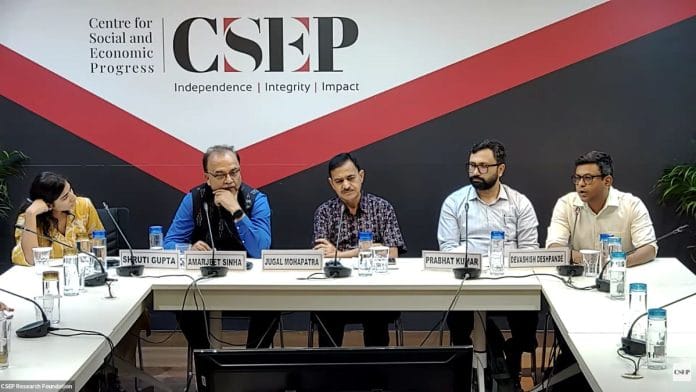
New Delhi: On most days, a seminar on public finance would struggle to fill a room. This one didn’t.
Around 40 people — former bureaucrats, economists, researchers, civil society representatives, and public policy professionals — packed into a conference room in Delhi on 18 June for a discussion on a subject that’s an unlikely contender for headlines: Odisha’s finances.
The event, organised at the CSEP Auditorium by the Centre for Social and Economic Progress and the India Public Finance Collaboration (IPFC), was titled What Odisha got right and the way forward for its finances. It was moderated by Shruti Gupta, Research Associate, CSEP.
The audience knew the subject. Questions were pointed. Interventions were informed. Participants seemed less interested in celebrating Odisha’s success and more in understanding what lessons it offered for governance elsewhere — and for Odisha itself in the years ahead.
For nearly two hours, the discussion moved between fiscal rules, debt restructuring, mining revenues, public investment, state capacity, and human development.
Yet beneath the fiscal jargon lay a simple question.
How did a state that once struggled to pay salaries become one of India’s most fiscally disciplined governments? And why has that success not translated into equally impressive development outcomes?
From crisis to credibility
The answer begins in the 1990s.
According to Jugal Kishore Mohapatra, former Odisha Chief Secretary and chairman of the state’s Committee on Administrative and Governance Reforms, Odisha’s finances had been deteriorating for years before the crisis became impossible to ignore.
Committed expenditure on salaries, pensions, and interest payments grew faster than revenue. Debt servicing consumed an increasing share of government income. Capital expenditure shrank.
By the end of the decade, the state’s financial position had become precarious.
Mohapatra recalled that the state’s leaders even had to reach out to then-finance minister Manmohan Singh because Odisha was running out of ways to pay its bills.
“There were occasions when the chief minister had to speak directly to Dr Manmohan Singh,” he said.
At the seminar, one statistic drew murmurs.
At one stage, Odisha reportedly spent nearly 250 days under overdraft arrangements and emergency financing mechanisms.
The 1999 super cyclone only deepened the crisis.
The state was approaching what officials would later describe as a near debt-trap situation, with borrowing increasingly required to sustain expenditure while debt obligations continued to grow.
“It was a period of real hardship,” Mohapatra said.
The reforms that changed Odisha
The turning point came after Naveen Patnaik took office in 2000.
What followed was one of India’s most ambitious state-level fiscal reform programmes.
With support from the Centre, the Department for International Development (DFID), World Bank, and the Asian Development Bank, Odisha restructured debt, rationalised expenditure, capped government guarantees, and undertook reforms in state-owned enterprises.
Large numbers of vacant posts were abolished, pension reforms were introduced, and fiscal management was tightened. Yet the government largely avoided politically explosive layoffs and cuts to employee entitlements.
“It was a coalition government. There was political risk involved,” Mohapatra said, referring to the BJD-BJP alliance that brought Patnaik to power.
Patnaik himself was still new to politics. Yet his government was attempting some of the most politically difficult reforms Odisha had seen.
The reforms coincided with favourable economic conditions. Rising mining revenues and China’s commodity boom further strengthened the state’s finances.
The results were dramatic.
By 2025, Odisha’s debt-to-GSDP ratio had fallen from 46 per cent in 1999 to around 13 per cent, among the lowest in India.
The turnaround was familiar to most people in the room. What came next was not.
The paradox of success
The central tension of the seminar was not fiscal. It was developmental.
Several speakers pointed to a striking contradiction. Odisha has become one of India’s strongest states fiscally. Yet it continues to rank in the lower quartile of states on several human development indicators.
If fiscal stability was the destination two decades ago, participants asked, what should the destination be now?
For many in the room, the answer was straightforward.
The next challenge is not generating fiscal space. It is using that space effectively.
Has Odisha become too conservative?
Mohapatra argued that Odisha’s success may have created a new problem.
The state became exceptionally good at preserving fiscal stability. It was less successful at converting that strength into investment.
Over the years, Odisha consistently generated revenue surpluses and built financial reserves. Yet actual capital expenditure often fell short of what its finances could support.
Projects were not ready. Administrative systems lacked capacity. Opportunities were missed.
From 2005-06 to 2013-14 alone, Odisha may have lost nearly Rs 45,000 crore worth of investment opportunities because projects could not be implemented in time, Mohapatra said. “The golden years were lost”.
Fiscal prudence is easy to celebrate. Missed opportunities are harder to measure.
If Mohapatra diagnosed the problem, other panellists focused on its causes.
Devashish Deshpande, Senior Technical Advisor, Strategic Public Finance (SPF), CEGIS, argued that Odisha has built strong fiscal and data systems but lacks the analytical and institutional capacity needed to fully leverage them.
“The analytical layer is missing,” he said.
Mining revenues have helped transform Odisha’s finances, but they remain volatile and generate relatively few jobs.
“The benefits do not necessarily stay within the state,” Deshpande said.
Large disparities also persist between tribal and non-tribal districts despite the state’s stronger fiscal position.
For Prabhat Kumar, Director of Public Finance at Janaagraha Centre for Citizenship and Democracy, while the money is there, the real challenge is its utilisation.
Drawing on his experience working with the Odisha government, Kumar argued that many departments lack the personnel and technical expertise needed to prepare projects, manage implementation, and monitor outcomes.
Whether the challenge is sanitation, drainage, public transport or pollution management, execution capacity often lags behind funding availability.
Increasingly, Odisha’s constraints appear institutional rather than fiscal.
Also read: Babur’s Baburi to Salim-Anarkali—an evening of Mughal romances in Delhi
The next frontier
For Amarjeet Sinha, Senior Fellow at CSEP and former civil servant, Odisha’s experience offers a broader lesson.
Successful reforms begin when governments acknowledge the scale of the problem they face.
“Ownership of the problem is critical,” he said.
But the state’s future challenges are very different from those of the late 1990s.
Odisha’s growth has been powered largely by mining, aluminium, steel, and power. These industries generate revenue but relatively few jobs.
Labour-intensive manufacturing remains limited. Capacity constraints persist across government departments. New skills are needed to manage increasingly complex public investments.
“Get new people and train existing people,” Sinha said.
(Edited by Aamaan Alam Khan)