




New Delhi: Baburnama, the memoir of Mughal Emperor Babur, repeatedly mentions a person by the name of Baburi Andijani. Babur writes about first meeting him in Uzbekistan as a 17-year-old and becoming deeply infatuated with him.
This was the central idea underscoring an event, Mughal Romances: Desires of Empire, hosted by Itihāsology in collaboration with Chor Bizarre on 19 June in Delhi. In the third chapter of the ‘A Course in History’ series, around 25-30 guests gathered for an evening of storytelling and sensory immersion.
While Baburi rarely appears in other historical texts, Baburnama chronicles him as the emperor’s beloved. On seeing him in the lanes of Andijan in Uzbekistan, Babur describes becoming flushed, at a loss for words, and simply walking away flustered.
“May none be as I, humbled and wretched and love-sick: No beloved as thou art to me, cruel and careless,” he wrote.
Comparing the descriptions to a high-school crush, historian Eric Chopra urged his audience to look at the Babur-Baburi chronicle outside of the overtly categorised idea of modern love that we know of now. Pre-modern vocabularies, he insisted, are too diverse to be narrowed into our current ways of looking at sexuality, love, and desire.
“This was a world that knew desire in a completely different way,” he said to an audience consisting of students, researchers, dancers, professors, engineers, and other history enthusiasts.
Chopra wove personal experiences, legendary romances, tragic histories, poetry, and literary texts into the session. The experience was complete with a specially curated Mughal-themed menu, designed by the team at Chor Bizarre, a 35-year-old restaurant housed in the 70-year-old property of Hotel Broadway.
Itihāsology reimagines how audiences engage with India’s past. Through public programmes, podcasts, writings, exhibitions, and immersive events like ‘A Course in History’, the platform bridges academic rigour with accessible, sensory experiences. The idea of the event, dining in a “storied context”, came alive at Chor Bizarre. The restaurant is situated on the historic Asaf Ali Road, which is bookended by two Mughal-era gates – Turkman Gate to the west and Delhi Gate to the east – and symbolically separates the historical Old Delhi from the imperial Lutyens’ Delhi.
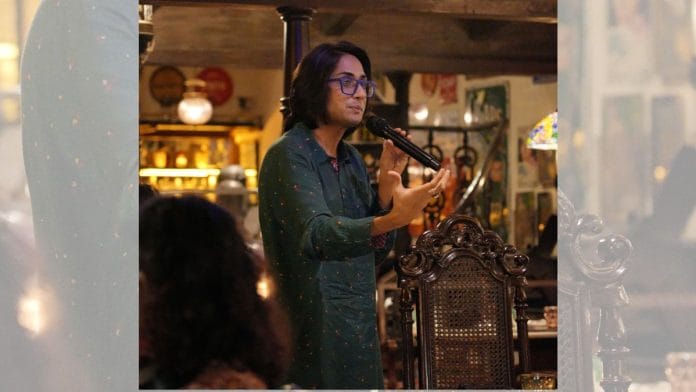
Chopra, founder of Itihāsology, holds the charm of a storyteller who knows how to bring the foregone to the common layperson. He moved through the room without a podium, commanding the attention of the entire gathering with warmth and scholarly depth.
Also read: Audience at Irish embassy’s music event became the choir themselves
Djinns, love, desire
The evening began with the tunes of Lata Mangeshkar’s song Ae Ishq Ye Sab Duniyawale, from the movie Mughal-e-Azam. Building on the premise of the film, Chopra went on to explore the legendary (and historically debated) romance of Mughal Prince Salim and courtesan Anarkali. Delving into the specifics of the story, he discussed both the known facts and the interpreted lores. He spoke of the 1615 tomb in Lahore and the debate surrounding its attribution to either Anarkali or another one of Salim’s wives.
Chopra marvelled at the fact that a story which is debated over its historical validity is the one that lives best in collective imagination. He called it the very power of love.
“That is what love does, that is what stories do. Even as a historian always looking at facts, I can’t help but be given to the sweep and imagination of love,” Chopra said.
He gave the floor to the chefs of Chor Bizarre, who presented the specially curated drinks and snacks to the audience. The menu was designed to fit the theme, consisting of famed Mughal dishes named after historical figures. As the audience sipped on the “Romance of Spirits”, they were served Mughalai appetizers before being lured back into the historical tales.
Chopra then shifted to more intimate and ambiguous stories. His storytelling took the gathering further down the lanes of Mehrauli to the tomb of Jamali-Kamali, drawn from personal experience and historical fact. He spoke of djinns, of desire, and of selective histories. He shared stories spanning from the mysterious figure of Begum Samru to the tale of Begum Mehr-un-Nissa, who came to be known and loved as Nur Jahan.
“Today, you would much rather believe that Jamali-Kamali is haunted by djinns than believe that it may possibly document a love story from pre-modern Mughal India that we hesitate to talk about,” said Chopra.
The night ended with dinner and desserts, during the course of which the guests mulled over the ideas Chopra had left them with.
(Edited by Aamaan Alam Khan)