



For almost two weeks now, we’ve been caught up with the Cockroach Janata Party protests. All this while, it’s not as if the news cycle came to a standstill in the rest of the world. The Ukraine-Russia war has taken another turn. It looks like Trump has fallen in love with Zelensky, again; the estrangement is over.
Netanyahu has got in bed with Trump. Israel is heading for elections. The US-Iran war has also taken a different turn because the Iranians are now hitting Jordan. And in the melee, looks like somebody fired two drones at an oil tanker close to Egypt as well. That was not an area of conflict earlier. That war is also expanding.
The PoK-marked zone: Some really interesting developments have taken place in our immediate neighbourhood as well, in fact, in the most interesting part of our neighbourhood. We are talking about what’s happening in the region that we call Pakistan-occupied Kashmir, or PoK.
Kashmir was divided in 1947. Between 1947, say about October 1947 to early 1949, the newly independent countries fought a two-season war. At the end of the two-season war, there was a ceasefire line where the war stopped. That ceasefire line was consecrated by the United Nations because Nehru decided to go to there, and there were UN resolutions. Since then, that ceasefire line has formed the de facto border in Kashmir, dividing the state of Jammu and Kashmir, which, as far as we are concerned in India—read your Constitution, look at the map of India—is part of India; all of it is part of India.
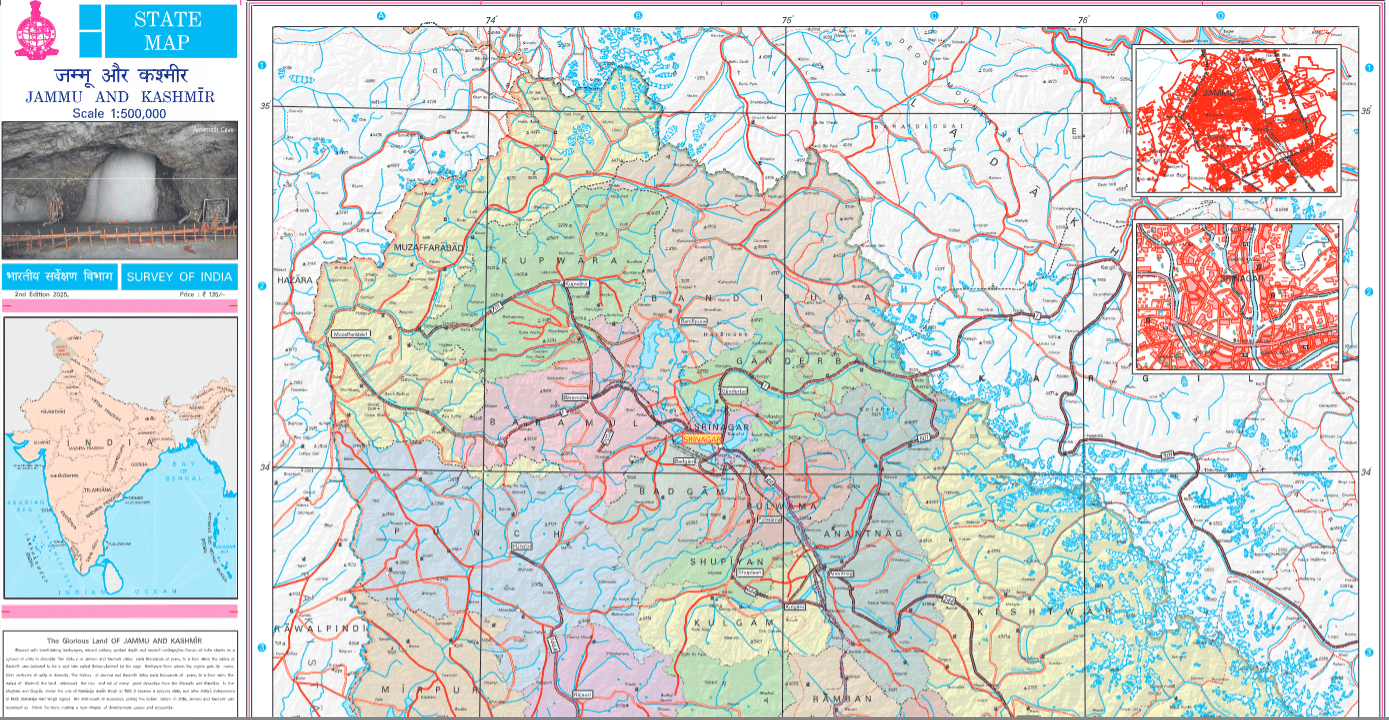
As far as Pakistanis are concerned, they don’t call it a part of Pakistan. They say this is Azad Kashmir. That’s a pretence. They say it’s Azad Kashmir and shall remain free until its people, through a referendum or a plebiscite, decide where they want to go. It’s a bit tricky; I will come to that. Because the Pakistanis always wanted to say that this is a separate entity, that region has had elections very often, even while they are not holding elections in Pakistan, to make the case that this is an autonomous, different territory. Yet again, there’s a twist there.
A divided land: But let’s go sequentially. That region, Pakistan-occupied Kashmir, is further divided into two. One part is what the Pakistanis now call Azad Kashmir, which is where they say the ultimate destiny will be decided after a referendum or a plebiscite. The other part, the more north-western part of this, which is more mountainous and less populated, is what we call Gilgit-Baltistan. It has three divisions: Gilgit-Baltistan and Diamer.
Diamer is where that big, humongous Diamer-Bashar Dam is being built, where a bunch of Chinese workers were killed just a couple of years back.
In what they call Azad Kashmir, they are holding an election for the local assembly. You can even call it parliament. It’s part of the Pakistani pretence that the leadership of the Kashmir that they control, part of Kashmir that they control, are called president and prime minister.
They are called president and prime minister as if it’s a country in its own right. That election is going on. That election process has to take place in three stages.
Also Read: Deadly violence mars polls in Pakistan-occupied Kashmir, 30 civilians killed in clashes with Army
Shot circuit: Protests have taken place in the first round. Those protests have been countered by the armed forces of Pakistan, who fired freely. There are videos of soldiers with AK-47s sometimes shooting at close range at people. The current toll over the past three days is 37 dead and more than 200 injured. In the series of riots since June, 90 people have been killed. That is pretty much confirmed by Pakistani and international media.
The Pakistan government’s response to this has also been that these are ‘anti-national elements’ or ‘anti-Pakistani elements’, and that they are Indian agents. The Pakistani politician who made this statement most clearly and in his typical direct style is Khawaja Asif, the defence minister of Pakistan. He’s also famous for many boo-boos and gaffes on the media.
He’s the one who said that these are Indian agents and this is India- inspired and anybody who’s agitating in their part of Kashmir is actually working at the behest of the Indians, is anti-national, anti-Pakistan and also that the Tehreek-e-Taliban Pakistan is involved, that many people wearing masks are firing at Pakistani soldiers and they happen to be from Tehreek-e-Taliban Pakistan.
Those are the allegations being made. However, the fact is that 37 have been killed on the day of the polling and after the first round of polling, on 27 July, in the Mirpur region. It is a very heavily populated region that has sent many people overseas. In fact, if you go to Britain now, there are large Mirpuri communities in Britain.
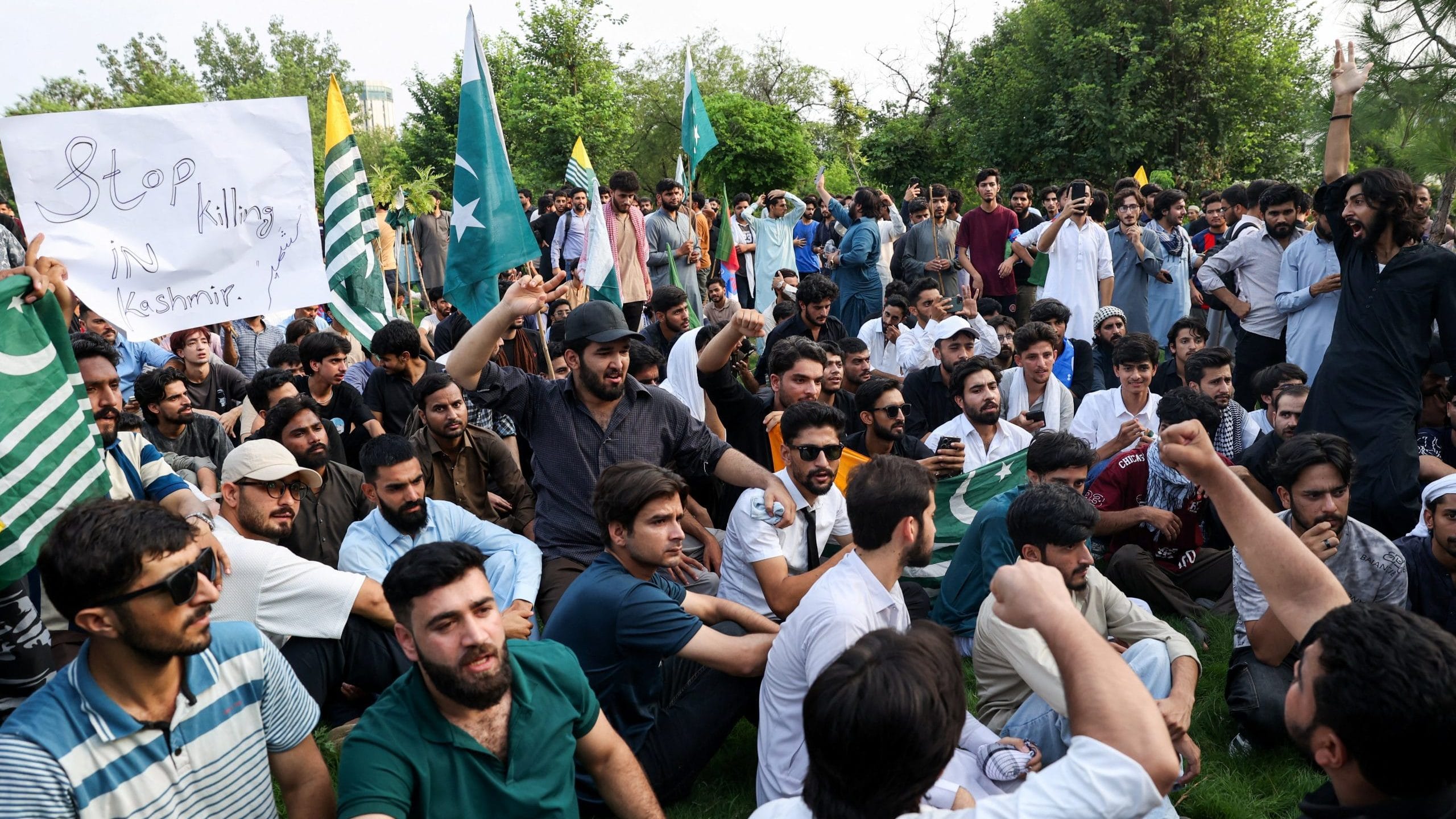
On 2 August, the Muzaffarabad region goes to the polls. Muzaffarabad is the capital of this region. And on 10 August, Poonch, the most rebellious region, will vote. The most intense protests have taken place in the town of Rawalakot, which is in Poonch. So the most rioting and killing has taken place in the region which will go to the polls last.
The riot act: Why are people angry? What are their demands? One has to be careful, for if you watch TV channels, the usual suspects sorry to say, you may hear voices saying these people want to join with India, that they are demanding secession from Pakistan. No, that is not happening.
Let’s stay with facts. People have local grievances and political grievances. Local grievances have manifested as protests in the past, in 2024 and 2025. The impulse was more economic earlier, in the sense that atta, or wheat flour, had become too expensive. The Pakistan government said, we will subsidise it. Then again, a regional demand: why are you charging a cess on electricity that we buy, the electricity produced in our region for all of Pakistan. The region is part of the Indus river system, and makes for excellent hydropower generation possibilities.
That’s why a lot of the power is produced there in what is called the Neelum-Jhelum. They are saying, look, you are using our mountains, our rivers to produce this power. You are taking it all over Pakistan, and when we buy this power, you charge a cess on it. There was another talked-about grievance, which has now taken centrestage because of the elections.
To understand that grievance, we have to see how the House or the Assembly of the so-called Azad Kashmir or Pakistan-occupied Kashmir is constituted. It’s a House of 53, so any outfit that gets to the majority mark of 27 should rule. But the devil is in the details: only 45 of the 53 members are elected, and within that number lies a great deal of complexity.
You will ask: if only 45 are elected, what happens to the remaining 8? These are nominated members, five of them women, one from the ulema (clergy), one a technocrat, and one is a non-resident Kashmiri, possibly living overseas. This means that the government can pretty much fill these 8 seats.
That leaves us with 45. Even those 45 don’t go to the polls in PoK; only 33 do. What happens to the remaining 12? They are allocated to what the Pakistanis describe as Kashmiri refugees, people from Kashmir who went all over the country. Seats have been allocated to them. They vote from wherever they are, and these 12 are elected like that.
Local people think that, first, the government controls the eight nominated seats, and, second, it has control or the ability to control or manipulate these 12 seats as well. In the process, 20 in a house of 53 are directly or indirectly controlled by the government which thus determines who will rule.
Locals feel they have no autonomy at all, that the elections are a sham, only in name. That is now the main source of protest and anger, plus the voting rights of these so-called refugees which have become hereditary.
Two generations have come and gone after the Line of Control as established in 1948 . They are asking why this privilege should be hereditary, and that you can have a nominal symbolic representation for these refugees but not this.
Even within the 12 refugee seats there is trouble, because six seats have been allocated to refugees from the Kashmir valley and six to those from the Jammu region. Once again, there is a belief that this division is not fair.
Also Read: India points to Pakistan’s track record, calls its embrace of Indus Valley Civilisation ‘phoney’
Smoke and mirrors: Now, why is Azad Kashmir is a big sham? First of all, through these nominated seats and refugee seats, Pakistan controls the Assembly. They also have a ministry for Kashmir and Gilgit-Baltistan affairs in their federal government because they have to keep up the pretence that this is a region whose fate is yet to be decided. They have not given that Kashmir, the Kashmir that they occupy any place in their National Assembly.
So in Pakistan-occupied Kashmir, no elections are held for the National Assembly because the people haven’t yet decided where they want to go. That’s ridiculous .
At the same time they have a ministry for Kashmir and Gilgit-Baltistan affairs, and they also have a Kashmir Council with 14 members that oversees all the affairs of the Kashmir that they occupy. Of the 14 members, there is the prime minister and president of their part of Kashmir. Six other members of that Assembly makes it eight, and then the remaining six are nominated by the government, by the federal government and this is headed by the Pakistan prime minister of the day. That’s why it is a pretence to call this an independent territory.
The description Azad is a sham too. Azad would indicate that could be a plebiscite. But there won’t be, because nobody even talks about those UN resolutions. Pakistan has been in violation of those UN resolutions for a long time; what they do is talk about the UN resolutions when they don’t have a choice, when they think they are losing out. The world is not interested in those UN resolutions.
Dealbreaker: The rest of the world knows that the spirit of the Shimla Agreement was that whatever issues remain, including Kashmir, will now be resolved bilaterally. The Pakistanis have stopped talking about the Shimla agreement for the past 15 years or so, but that is their problem. The rest of the world doesn’t bother.
In any case, even if a plebiscite is to be held based on those resolutions which I can guarantee will never be held, there will be only two choices because the UN resolutions say you can either choose India or choose Pakistan. There is no third box to tick. There is no option of an independent state.
There is a great deal of misconception: Kashmiris are unhappy because the independence option does not exist, and the Pakistanis would jump at even the thought of one. In any case, Pakistan has left no such choice for the Kashmiris who happen to be under its control. For example, after the Shimla Agreement in 1972, Pakistan in 1974 gave their part of Kashmir, Pakistan-occupied Kashmir a new constitution.
Clause 7.2 of that statute bars any person or political party from propagating or participating in any activity prejudicial or detrimental to the ideology of the state’s accession to Pakistan. Similarly, when ministers, or elected officials take oath of office in Pakistan-occupied Kashmir, they have to swear allegiance to the ideology that Kashmir will accede to Pakistan. It will become a province of Pakistan.
They are not given any other option and that is how they are sworn in. So, the constitution ensures they can’t vote for India in a plebiscite, and the option of independence is not available. In any case, while the pretence of an autonomous or independent state is kept up—that’s why the name Azad Kashmir, and why Pakistani authorities like, say, the Federal Board of Revenue, do not control taxation or law and order—but all of this is done with a heavy hand, because for all practical purposes this is a military state.
Also Read : Violence mars Pakistan-occupied Kashmir polls. What’s at stake & why it’s an Islamabad-backed farce
A sparse evolution: Pakistan-occupied Kashmir has a population of about 5 million. The last count was about 4.2 million almost 10 years back. Let me just say it’s five-and-a-half million. Gilgit-Baltistan, which for us is part of Jammu and Kashmir, has been annexed by Pakistan and made a province in their federation. That party has a population of 1.7 million even though it’s a very large area. In comparison, our Jammu and Kashmir has about 1.25 crore people, and Ladakh has about 3.5 lakh.
See how PoK has evolved on the Pakistani side. In 1945, there were two broad parties in all of Kashmir. They were still in charge. One was the Muslim Conference headed by Sardar Ibrahim. No illiterate, he had been to the University of London, a lawyer at Lincoln’s Inn. The Muslim Conference was more inclined to the idea of joining Pakistan. Then there was the National Conference headed by Sheikh Abdullah.
Initially, both thought that Kashmir could be independent. Soon enough, the Muslim Conference under Sardar Ibrahim decided that they were going to go with Pakistan. This is the around the time that Sheikh Abdullah, who was prime minister under Maharaja Hari Singh, decided to go in the other direction.
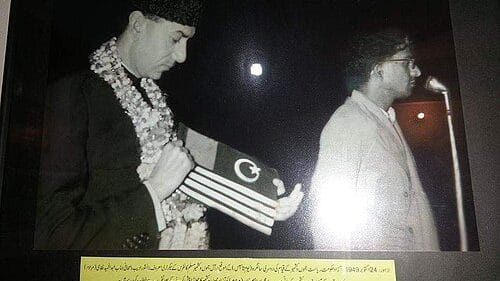
We know what happened. The Pakistanis invaded, with tribals as well as Pakistani regulars in mufti. That’s standard operating procedure for the Pakistanis. On the Pakistani side, Sardar Ibrahim became the first president of Pakistan-occupied Kashmir.
He had set it all out just about a month before independence for India and Pakistan. On 19 July 1947, he led what was called the Poonch Uprising which decided that the part of Kashmir—at least the part they controlled where they had influence—will go with Pakistan. He was sworn in as president, and also swore allegiance to the ideology of Pakistan and the ideology of accession of Kashmir to Pakistan. That’s how it started there.
First strike: What happened to Gilgit-Baltistan meanwhile? Gilgit-Baltistan had seen action in 1946. That is when British Major William Alexander Brown who was heading the Gilgit Scouts garrison in Skardu, called his troops and unilaterally declared that Gilgit-Baltistan was becoming a part of Pakistan.
That is even a year before the formal partition of the subcontinent. How how did the Pakistanis formalise that in October 1947? They came up with what was called the Karachi Agreement, where they met leaders of the Kashmir they controlled, including Sultan Ibrahim, to accept that Gilgit-Baltistan was a part of Kashmir. They signed another agreement ceding Gilgit-Baltistan to Pakistan.
Pakistan, in the course of time, annexed Gilgit-Baltistan, saying that this is just a province; this is not a part of Kashmir which we consider as a territory disputed with India. India, of course, maintains that Gilgit-Baltistan is as much a part of Jammu and Kashmir as the rest of it, and it’s a part of the map of India.
Now see how far the Pakistanis have pushed it. They hold elections separately for the Assembly of Gilgit-Baltistan as if it’s a province of Pakistan. That assembly has 33 seats of which only 24 go for elections. Another nine are nominated, six of these women and three technocrats. These technocrats also include at least one member of the ulema.
I’m quite tempted to go into the chequered history of political power in PoK in terms of who the leaders have been. Mostly the same people have been either president or prime minister. Sometimes the same guy has been both. You can Google Sardar Muhammad Abdul Qayyum Khan but right now we’ll be getting into too much information or because Gen Z language is so popular right now, TMI. We’ll get there in course of time.
Also Read : PoK polls: 90 civilians killed in 2 months, Pakistan’s justification—protesters ‘enemies like India’