






New Delhi: India has labelled Pakistan’s recent efforts to embrace the legacy of Indus Valley Civilisation as “phoney”, pointing to Islamabad’s dismal human rights record and protection given to minorities.
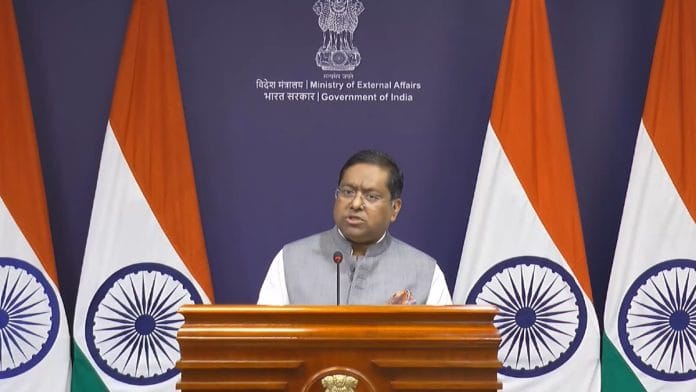
“A country which has been promoting cross-border terrorism, religious fundamentalism and violence for decades, cannot have any claim to any pluralistic cultural legacy,” Randhir Jaiswal, the official spokesperson for the Ministry of External Affairs (MEA) said Tuesday at a regular press briefing.
He added: “Their abysmal track record on the protection of minorities and their cultural rights make such desperate attempts look even more phoney.”
In the last year, top Pakistani political leaders have attempted to link the history of the Indus Valley Civilisation to the identity of Pakistan, making a claim on the history of the Bronze Age civilisation. India has long promoted the linkages of the Indus Valley Civilisation to its own historical identity and continuity as a state in the modern era.
Last year, Pakistan launched a new archaeological excavation around Mohenjo Daro, just months after India launched Operation Sindoor. Bilawal Bhutto Zardari, the leader of the Pakistan Peoples Party (PPP), has further claimed that Islamabad is the true “custodian” of the Indus.
The claims over the history of the Indus Valley Civilisation has cropped up as the two countries continue to spar over the fate of the Indus Waters Treaty. India has held the treaty in abeyance since April 2025, following the terror attack in Pahalgam, which left 26 people dead.
Pakistan has defended its right to the waters of the Indus basin, and has vowed to attack India if any of the waters are diverted by New Delhi.
Islamabad has sharpened its defence over the Indus waters, by bringing in the civilisational history of the region. Pakistan has long sought to promote its Islamic heritage, and the sudden shift to promote its pre-Islamic heritage comes in the wake of the politics over the Indus Waters Treaty.
Apart from public proclamations, Islamabad in recent months has held a conference on the Indus Waters Treaty and has started holding events in third countries on India’s move to hold the treaty in abeyance.
India has maintained that until Pakistan abjured from cross-border terrorism, the treaty will remain in abeyance. India has also rejected Pakistan’s attempts of taking the treaty or its projects on the rivers to an international court of arbitration.
For New Delhi, the treaty represents the geographical and political reality of the 1960’s, which has since drastically evolved. In the last six decades, the availability of water, climate change and the present and future needs of India has changed. Furthermore India had sought the appointment of a neutral expert almost a decade ago, a request Pakistan agreed to, before later withdrawing from, further eroding operationalisation of the agreement.
(Edited by Amrtansh Arora)
Also Read: Rajka Pottery reveals India’s ceramic heritage. It’s ethnoarchaeology in action