





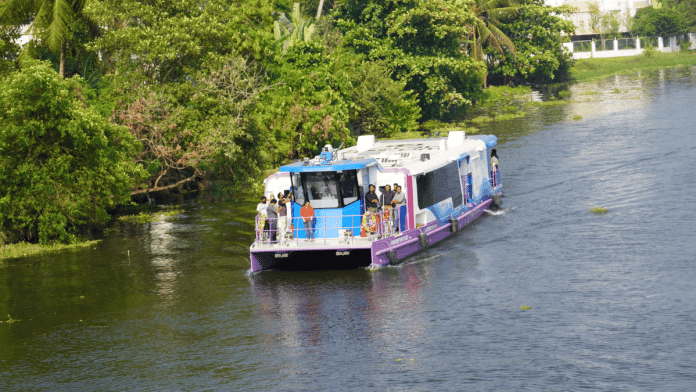

Being implemented by the Maharashtra Maritime Board (MMB), the project proposes a 340.68 km integrated passenger water transport network connecting Mumbai, Navi Mumbai, Thane, Kalyan, Vasai and Mira-Bhayander.
Modelled on the Kochi Water Metro project, the Mumbai water metro is expected to include 203 electric and hybrid boats, of which 197 will be passenger vessels while the remaining six will be emergency boats.
The idea of using Mumbai’s surrounding waters for commuter transport dates back to 1983, when a state home department expert group proposed developing waterways around the Bombay Harbour.
Several studies followed, and by 2008, the state drew up a concrete plan for a roll-on/roll-off (‘Ro-Ro’) specialised cargo ship designed for cars and heavy vehicular transport as well as a passenger transport system along the eastern coast.
But the project, then far bigger and costlier than the current proposal, made little progress as it moved between the Maharashtra State Road Development Corporation Limited (MSRDC) and the Mumbai Metropolitan Region Development Authority (MMRDA) until 2014, stalled by high costs and viability concerns.
In 2015, then Chief Minister Devendra Fadnavis transferred the project to the Maharashtra Maritime Board (MMB).
According to the MMB, around 1.8 crore passengers currently use 21 operational passenger water transport routes annually in the MMR. The proposed water metro seeks to build on this network by upgrading 20 existing terminals, adding 12 new routes and developing 24 new passenger terminals.
An MMB official told ThePrint that western routes will stay non-operational during the monsoon season.
“Inland routes in the rivers and creeks will be functional throughout the year, even during the monsoon season, unless the water levels rise, but the coastal routes on the western side will have to shut during the four months of monsoons,” the official said.
The current operational network of 125.40 km is proposed to be expanded by another 215.28 km, taking the total to 340.68 km. The government has projected daily ridership of over 2 lakh passengers by 2031 and annual ridership of nearly 7.39 crore.
The project is planned in three tentative phases—Phase 1 by 2029, Phase 2 by 2030 and Phase 3 by 2031. Kochi Metro Rail Limited, which developed and operates the Kochi Water Metro model, carried out the pre-feasibility study for Mumbai. A detailed project report is currently being prepared.
Under the proposed model, around Rs 3,078 crore of the total estimated cost is proposed for terminal infrastructure, navigational systems and emergency facilities, while Rs 2,988 crore is estimated for vessel procurement and operations.
The project also proposes standardised major, intermediate and minor terminals, an Operations Control Centre (OCC) for real-time monitoring, and emergency support vessels. The network is expected to cover the western suburbs, Thane Creek region, Navi Mumbai and south Mumbai, and improve access to the upcoming Navi Mumbai International Airport.
Kochi model, now a national template
Mumbai’s proposed project is part of a larger push by the Centre to replicate the Kochi Water Metro model in cities with navigable waterways.
In May 2026, the Union Ministry of Ports, Shipping and Waterways said it had circulated the Draft National Water Metro Policy, 2026 for inter-ministerial consultations.
The Centre announced plans to roll out water metro services in 18 cities, with Guwahati among those identified for Phase 1. Srinagar, Patna, Varanasi, Ayodhya and Prayagraj are also part of the first phase, while Tezpur and Dibrugarh in Assam have been proposed for Phase 2.
The proposed national framework is based on the success and learnings from Kochi, where the water metro was designed as a structured public transport network rather than a stand-alone ferry service.
The Kochi project was conceived to connect the mainland with island communities around the Vembanad Lake using fixed-headway boats, modern terminals and intermodal links with buses, Metro rail and railways.
According to a PIB press release on 18 May, the Inland Waterways Authority of India entrusted Kochi Metro Rail Limited in February 2025 to conduct feasibility studies for 18 cities. These studies examine existing public transport systems, travel demand, financial and economic viability, and multimodal integration.
As of May 2026, site visits had been completed for all 18 locations, and draft feasibility reports had been submitted for 17 cities, with Lakshadweep pending.
The Centre’s proposed criteria prioritise cities with continuous or semi-continuous waterways, population above one million and demonstrated transport demand, particularly in tourist corridors.
“However, these criteria may be relaxed in cases where projects significantly reduce road congestion, improve connectivity to remote or water-locked areas, or enhance resilience during floods and disruptions,” the PIB report noted.
In the case of Mumbai, the city’s geography—with the Arabian Sea, Thane Creek, Vasai Creek and several coastal settlements—makes the idea attractive on paper. However, in practice, commuter services have struggled to match the reliability, affordability and accessibility of trains, buses and roads.
Also Read: 3 years & Rs 17,000 crore later, Mumbai’s ambitious concrete roads project is 80% complete
Past struggles
Mumbai’s attempts at passenger water transport go back several decades. High operating costs, higher fares, weather constraints, objections from fishing communities and poor demand and ridership repeatedly affected such services.
The more recent water taxi experience has been equally uneven. In 2022, water taxi services were launched with routes linking Mumbai and Navi Mumbai, including Bhaucha Dhakka (Domestic Cruise Terminal), Belapur, Nerul, JNPT and Elephanta. The idea was to cut travel time between Mumbai and Navi Mumbai and offer an alternative to road congestion.
But several routes failed to draw enough regular passengers. Some services were discontinued or reduced soon after launch because of poor ridership. Fares were often seen as too high for everyday commuters, especially when compared with suburban trains and buses.
The Belapur-Gateway of India water taxi service was launched in February 2023 with the hope of serving daily commuters between Navi Mumbai and south Mumbai, but it was suspended within a little over a year.
Operators cited financial unviability, while ferry owners also flagged navigational problems, including poor draft and safety concerns in sea channels.
Meanwhile, there have been relatively better-performing ferry services, especially on tourism and weekend-oriented routes such as the Bhaucha Dhakka in Mumbai to Alibaug’s Mandwa Jetty and the highly active and functional Versova-Madh Island ferry route, which offers a short five-minute ride across the Versova Creek in Mumbai’s northwestern suburbs.
But these have not solved the larger urban commuting problem.
A similar passenger water transport plan was proposed for Mumbai’s western coast, linking Borivali in the western suburbs to Nariman Point in south Mumbai, but it too failed to move ahead despite multiple tendering attempts.
The main hurdle was viability as the western seafront is much rougher than the eastern side, making year-round operations difficult and requiring services to be suspended during the four monsoon months.
Officials told ThePrint in 2018 that this would make it financially unattractive for operators investing in costly vessels and equipment, while also making it hard to build a regular commuter base for a service unavailable during the rains.
Adapting the Kochi model will not be straightforward for Mumbai.
Kochi’s system was built around island-mainland connectivity and backwater routes. Mumbai’s commute patterns are more complex, with suburban rail already carrying large volumes at low fares and the road network, though congested, offering wider last-mile reach.
(Edited by Sugita Katyal)
Also Read: The story of Mumbai’s Garib Nagar slum—railways land, Sunil Dutt & Slumdog cameo