





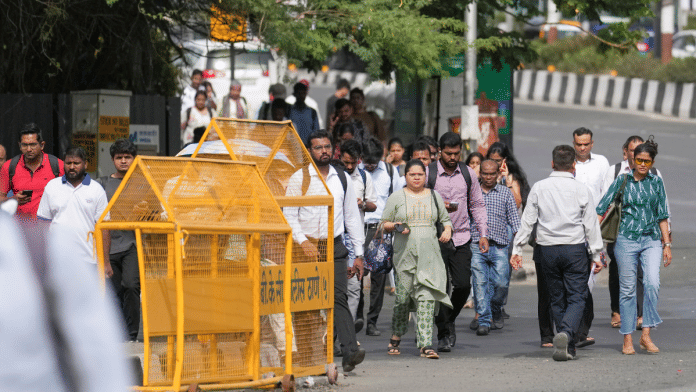


Mumbai: The no-car Friday initiative at Bandra Kurla Complex (BKC), one of Mumbai’s busiest and most prominent corporate hubs, fell short of the response that city planners and green activists had hoped for on its inauguration.
A large part of this lukewarm response could be blamed on BKC’s poor last-mile connectivity, and the not-so-frequent bus services among others, according to commuters.
Since the public transport facility is not up to the mark, the commuters said, they generally take private vehicles and app-based cabs, which leads to heavy congestion during morning and evening peak hours.
The ‘Friday Public Transport Day’, a pilot project by the Mumbai Metropolitan Region Development Authority (MMRDA) and the World Resources Institute (WRI) India, aims to reduce traffic congestion and promote sustainable commuting in BKC.
Under this initiative, employees and organisations in Bandra Kurla Complex are encouraged to commute by public transport such as local trains, metro, buses or opt for shared cabs every Friday. Currently, shared autos, app-based cabs, private bus Cityflo, and BEST buses are available in BKC.
A journey of a thousand miles begins with the first step.
BKC took that first step today, participating wholeheartedly in the BKC Public Transport Day, an MMRDA-led public initiative.
Dr Sanjay Mukherjee, IAS, Metropolitan Commissioner, MMRDA, wholeheartedly participated in… pic.twitter.com/14IAKoFrfM
— MMRDA (@MMRDAOfficial) June 12, 2026
On the launch day, the commuter crowd seemed usual at the BKC Metro Station, which is on Line 3 (Aqua Line) of the Mumbai Metro. Cars lined up on the Eastern Express Highway during the morning peak hours to get on the BKC connector.
Usually, another lane on the BKC connector is open from the other side so that cars can pass easily during peak traffic hours. The third lane was opened by the traffic police during the morning rush hours, ThePrint observed
Commuters exiting the Aqua Line metro station boarded shared auto rickshaws; very few decided to take the bus.
“There was a usual crowd in the metro station. I don’t think more people used the metro train today. Maybe not many are aware of this (initiative). Certainly not me nor my office colleagues. I would surely tell my colleagues about this initiative,” a commuter working at a private bank told ThePrint.
To address this problem, WRI India volunteers stood outside the BKC metro station with placards informing about ‘Friday Public Transport Day’. Others were present at bus stops, as well as Bandra and Kurla suburban railway stations.
“Our initiative is to try and reduce the congestion a little, and this is one of the initiatives we have started to reduce vehicular congestion. We will be standing here with placards and engaging with people. As there is no incentive for the people to use public transport, we will try to explain it to them. Let’s hope it works,” Zainab Sabunwala, a WRI volunteer, told ThePrint.
Sanika Sawant travels from Marol via metro. Her office is about 1.5 km away from the metro station. “Over here in BKC getting an auto or cab is a big issue since my office is 15-20 mins away. And walking is not feasible so I take an Uber or auto, which is challenging.”
She further said that most people in her office commute by their private vehicle. “If public transport is boosted, it will be more convenient to travel.”
BKC is a crucial business district in the centre of Mumbai with nearly 100 big and mega corporate offices. It also houses 75 percent of BSE Sensex companies and 50 percent of Nifty 50 companies, making it one of the country’s most important economic centres.
Nearly 2 lakh commuters arrive at BKC every single day, according to MMRDA officials. According to MMRDA, 52 percent of commuters rely on personal vehicles, taxis and auto-rickshaws, while only 25 percent use public transport for daily commute. More than 54 percent of commuters spend over two hours travelling every day, while one in five spends more than three hours.
Challenges within BKC
Another commuter Harsha Kortude, who comes from Tardeo in Mumbai Central, gave details of the transport options available at BKC.
“Travelling to BKC is good, but going from the metro station to the office is a bit difficult. You have to wait for autos or book app-based bikes or cars, which becomes time consuming. During the peak hours the traffic is very bad,” he said. “Even if we decide to take our vehicle because public transport isn’t much available, the traffic is horrible. So, they (authorities) have to double down on public transport.”
As part of the initiative, the Cityflo bus service has decided to operate twice the usual six buses each deployed in the evening and morning hours, on Fridays.
Sunil Damle, a Cityflo volunteer, said that the initiative would help reduce congestion and, in turn, reduce travel time for commuters.
“This will help Cityflo time management as well. Because of the traffic, commuters face a 15-20 minute delay. If the number of cars goes down, more buses will ply on the road. Right now, we operate buses in morning and evening hours. If traffic is reduced, we can think about expanding bus service,” Damle said.
On its part, the MMRDA is hoping that with the upcoming metro lines 2B and 4, most of the business establishments will be within one kilometre of a metro station in the entire business district.
For now, BEST has posted officers at strategic points like Bandra Station East, Kurla Station East in morning hours and at BKC in evening hours to assess passenger load.
The city’s primary public civic transport operates 125 buses on 16 dedicated routes connecting BKC with other parts of the city, BEST officials said. Out of these 16, four routes serviced by 33 buses are feeder routes exclusively operating from Bandra station (East) and Kurla station (West) up to BKC. About 20,000-25000 commuters take BEST buses in and out of BKC, they said.
“This is still the first day. I hope more awareness is spread and more people are encouraged to take public transport to work. For that, the government needs to step up,” office-goer Sawant said.
(Edited by Tony Rai)
Also Read: Coming up: Swanky six-lane cable-stayed bridge to replace Mumbai’s creaky British-era Tilak Bridge
Did senior MMRDA officials lead by example.