





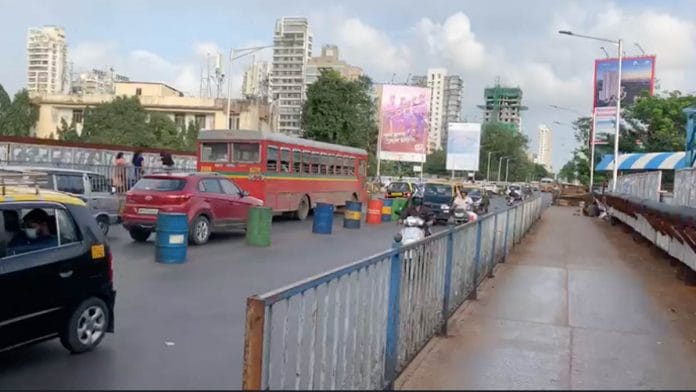


Mumbai: Mumbai’s Tilak Bridge in Dadar, a century-old vestige of the British era, is notorious for its slow-moving traffic. In the past eight months, travel on this key east-west connector has turned into even more of a nightmare with the closure of two other east-west links around it.
There is good news, however. Engineers have been silently working on the side of the bridge, building a new one without touching the existing structure, and keeping traffic moving. A new cable-stayed viaduct is taking shape bit by bit, next to the creaky old bridge, and is expected to be ready for use next year, with full completion of the project within two years of that.
The project is being carried out in two phases: Phase 1 is 40 per cent complete, and Phase 2 will begin after it is complete, an official from Maharashtra Rail Infrastructure Development Corporation (MRIDC), a joint venture between the Ministry of Railways and the Maharashtra government, constituted in July 2018, told ThePrint.
“Considering the massive [amount of] traffic that this bridge handles and since it is a crucial connector, we have decided to go for a phased construction on this bridge,” the official said.
In the first phase, a new bridge will be built parallel to the existing bridge and once the construction on that bridge is complete, traffic will be diverted to the new bridge. The second phase of construction will begin when the old bridge is demolished to replace it with a second, new bridge.
The bridge will be a twin cable-stayed bridge, with its cables reaching as much as 105 metres in length. At six lanes, the newer bridge will be wider than the original four-lane structure. The first phase of the 600-metre bridge will be completed by 2027; the next stage will take another two years to complete, MRIDC says.
Also Read: Vestiges of British-era infra, 10 Mumbai rail overbridges to make way for newer, swankier ones
Why demolish the old one?
Originally called the Kingsway Bridge, the Tilak Bridge is an iconic structure built over a railway line in 1925 by the British. As construction of the new bridge is in full swing, the original bridge continues to carry vehicles and pedestrians even as trains pass below the structure. Over the years, this bridge has helped Dadar become a major commercial and residential hub.
After the collapse of the Andheri Bridge over the Western Line in July 2018, the Brihanmumbai Municipal Corporation (BMC) and Indian Railways decided to take up structural audits of all of Mumbai’s bridges. Tilak Bridge was declared dilapidated in 2019, but the location of this structure meant that it could not be demolished immediately.
In 2018, the BMC demolished another crucial east-west bridge, Delisle Bridge in Lower Parel, and so work on Tilak Bridge did not start. Tilak Bridge carries traffic not only from East to West Dadar but also connects to business districts like Parel, Lower Parel, and Mahim to the Eastern Express Highway.
Work on the bridge began in 2021, with underground preparations involving permissions from the railways to shift utility lines. Civil work started in 2024.
With the closure of the Delisle Road Bridge, the traffic load on Tilak Bridge increased. In the last few years, Sion Bridge was closed for demolition, and traffic from Sion and Matunga going towards the western suburbs was diverted to Tilak Bridge. Earlier this year, Elphinstone Bridge in Parel was demolished. Once again, the additional weight fell on the already overburdened Tilak Bridge.
Sanjay Patel, who runs a clothing shop at the western end of Tilak Bridge, told ThePrint, “The traffic has increased so much that it takes me twice the usual time to reach my shop. Although I stay just 15 minutes away, it takes me between 30 and 40 minutes to get here now.”
Commuters share a similar ordeal. Chetan Kamble, founder of local Non-Governmental Organisation Dadar Chakachak and a resident of Dadar, told ThePrint that the closure of other bridges has added to the woes of Tilak Bridge. “The bridge is already burdened and to add to it, the presence of hawkers is also not managed well and there is always a jam on the bridge. Besides, there is no pedestrian path left because of the construction, so people have so somehow manage in the heavy traffic, which is dangerous,” he said. “Also, major hospitals like KEM hospital are on the east side. So people from the west going to these hospitals take more than 30 minutes instead of the usual 10. That’s called the golden time, and the first few minutes are wasted, which is not good.”
The total cost of the project is Rs 375 crore. The new bridge will also have decorative lights and selfie points for tourists as well.
(Edited by Nardeep Singh Dahiya)
Also Read: Engineering wonder built over 60-storey drop in the Sahyadris. Making of Mumbai-Pune ‘missing link’
First complete the bridge which pending from so long. Like Sion East to West.. Mira road new flyovers and Vidya vihar new bridge from West to East .. ease that to public.. before starting some new construction..