


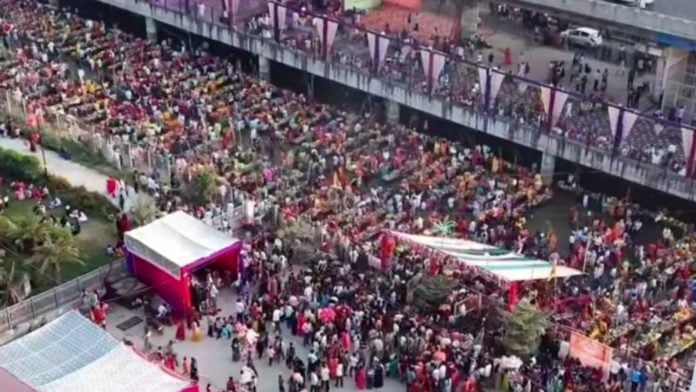
Ludhiana: For Asha Devi, celebrating Chhath Puja in Ludhiana was a different experience from observing the festival in her village in Bihar. Instead of gathering at a traditional river ghat, she joined hundreds of other devotees around a makeshift pond in Jamalpur Chowk, one of the city’s biggest industrial areas, with baskets of offerings for the Sun God and Chhathi Maiya.
It was her first Chhath Puja in Ludhiana. But despite being far from home, the rituals remained familiar.
“In our village, devotees usually gather at ghats, whereas here at Focal Point, numerous artificial ponds have been created,” Asha Devi, who hails from Bihar’s Siwan district, told ThePrint.
For Asha and other devotees like Sita Devi and Pinki Devi, who could not travel back to Bihar for the festival, these temporary arrangements offered a way to stay connected to their traditions and recreate a sense of home.
Ludhiana has a large concentration of migrants from Bihar and Uttar Pradesh, followed by Jalandhar and Amritsar. While many return to their native places for Chhath Puja, not everyone can make the journey. For those who stay back, local communities and residents come together to organise the celebrations.
Chhath Puja is a four-day festival dedicated to the Sun God and Chhathi Maiya. It is celebrated every year on the sixth day of the bright fortnight of Kartik and is observed mainly in Bihar, eastern Uttar Pradesh and Jharkhand. Even when living away from their native places, devotees follow the same rituals, although the arrangements may differ.
Makeshift ghats, artificial ponds
With makeshift ponds, temporary ghats and prayer platforms, several parts of Ludhiana were transformed as thousands of families from Bihar gathered for the celebrations.
The Sutlej River, Sidhwan Canal, Neelon Canal and Lohara Canal witnessed large gatherings. Water levels were regulated, while wooden planks were laid out to create walkways for devotees.
In areas without access to natural water bodies, including Focal Point and Ramnagar, temporary ghats and ponds were specially prepared. These ponds were built by digging the ground and lining the sides with cement. Just before the Sandhya Arghya rituals, they were filled with water.
Devotees stood in the shallow water, holding baskets filled with fruits and other offerings, while family members stood beside them with sugarcane sticks and joined in the prayers to the setting Sun.
At Jamalpur, the Yuva Chhath Puja Samiti organised the celebrations. More than 5,000 devotees were expected to participate in the Sandhya Arghya rituals, according to committee member Chandan Sharma.
“We work under proper government guidelines and permissions, and the area is secured to manage the crowd of devotees,” he said.
For some families, these community celebrations have become an annual tradition.
“Our families and we have been celebrating Chhath in Ludhiana for years. We cannot return to our native places for Chhath Puja, but we have kept our tradition alive,” Sita Devi and Pinki Devi said.
Ram Singh, an industrial worker from Siwan district who lives in Focal Point, said the arrangements in Ludhiana were different from those in his village. Back home, the government and members of the local community, including influential residents, contributed towards organising the celebrations.
In Ludhiana, however, residents in some areas, including Focal Point, have to make their own arrangements, from constructing artificial ghats and ponds to organising the festivities.
Balancing work and worship
While the celebrations bring communities together, observing the festival can be particularly challenging for women working in factories and other industries.
Both men and women can observe the Chhath fast, although it is traditionally observed by women. The rituals involve a 36-hour fast without water. For women employed in factories, managing work alongside the demanding religious observance can be difficult, particularly when employers do not grant leave for the festival.
Ram Singh said some companies do not grant women leave during Chhath Puja. In such situations, women either leave work or request time off.
Arrangements across the city
The Ludhiana administration made arrangements at several locations to manage the large gatherings expected during the festival.
Deputy Commissioner Himanshu Aggarwal told ThePrint that the two major congregation points were the Sidhwan Canal and the Sutlej River.
“First, we appointed Area In-Charges, one along the canal bank and one along the river bank. Then we divided these areas into smaller points where congregations and crowds were expected to be mobilised. Each point was further managed by a Magistrate, along with officials from every possible department — from the tehsildars to the Police Department and Municipal Corporation — and they were put on duty under the supervision of the Point In-Charge,” he said.
There were around 50 Point In-Charges across the city, Aggarwal said. Helpline numbers were also provided for assistance, while police personnel were deployed to manage crowds. Arrangements were made for lighting, traffic management and crowd control.
Professional divers were deployed at some locations to respond to emergencies.
“Under each Point In-Charge, five to six officials were working under them who looked after various aspects of the Puja, like cleanliness; for crowd control we had police, and for the canal we had river management and control, plus one person from revenue. We expected 3 to 4 lakh people to participate in the puja. There were also points where large crowds did not gather, but those points were still under scrutiny,” he added.
The four days of Chhath Puja
Nahay-Khay: On the first day, devotees take a holy bath in rivers, ponds or other water bodies. They then clean their homes and prepare a satvik meal, traditionally known as Kaddu-Bhaat.
Kharna: On the second day, devotees observe a fast throughout the day and break it after sunset with kheer, bananas and fruits.
Sandhya Arghya: On the third day, devotees and their families gather at rivers, ghats, ponds and other water bodies at sunset to offer arghya to the setting Sun.
Usha Arghya: On the fourth day, devotees offer prayers to the rising Sun and break their 36-hour waterless fast.
Jagruti Suri is an intern with ThePrint.
(Edited by Anupama yadav)
Also Read: Chhath is the beating heart of Bihari identity