



I was nine when I saw Kabhi Khushi Kabhie Gham for the first time. I had been sucking on an elaichi-flavoured lollipop, my mother sitting next to me, when the famous Karwa Chauth scene came on. Puzzled, I asked her about it. “It’s a Punjabi festival,” she told me. It left me, little as I was, with a yearning to see Chhath Puja on the square-box TV with these big actors and big actresses. For the next few years of my childhood, I watched mainstream shows and films with a detective’s eye, always on the lookout for a depiction of my Bihari festival.
I was always disappointed. As I grew older, I watched Karwa Chauth gradually expand beyond its Punjabi roots into the cultural imagination of Hindus across India, propelled by its repeated, positive depictions in popular media.
I began to realise the strange stranglehold Bollywood held over the common man’s imagination. I also realised that Bihar was unlikely to receive a similarly positive depiction, at least in the foreseeable future. It would, at best, be the convenient setting for a half-assed movie lazily designed to earn from the representation-starved masses, and, at worst, be the butt of jokes, the filthy land of the unruly mafia, or much worse.
Biharis everywhere, but never quite seen
Biharis, much to the bemoaning of people in several states, are apparently everywhere, like green moss on plump wet wood in the monsoon. Though some of the problems that led to Bihar’s decline predated his tenure, the Lalu Yadav government, which ruled the state from 1990 to 2005, saw an unprecedented mass out-migration.
The rate of interstate out-migration from Bihar increased by over 132 per cent between 1991 and 2001, according to Veena Jha’s India Emerging: The Reality Checks. The World Bank’s 2005 assessment of the state makes for grim reading: Bihar experienced virtually no economic growth in the first half of the 1990s, and its economy grew at an average annual rate of just 3.8 per cent from 1994-95 onwards, compared with the national average of 6.1 per cent. Its per capita income grew by approximately one per cent annually.
The economic disparities, in my eyes, make this less a story of migration by choice and more one of forced exodus. It was not driven by famines or genocides, but by criminal negligence on the part of the central government and a criminal streak within the state government.
Reality, nevertheless, corroborates the imagination. Yes, Biharis are everywhere. But we remain on the margins, with little class power in a capitalist, casteist society that has labelled us “labourers”, and little linguistic power in the face of a Bhojpuri music industry that has constructed a vulgar, sexually charged caricature of Biharis.
A significant chunk of well-off Biharis spend their lives performing the clown show of demonstrating how “better and more cultured” they are than the average Bihari. The more self-hating among them denounce every part of Bihari culture and identity, without exception. There is, however, one singular anomaly: Chhath Puja.
Four days of belonging
In this complex web of survival and guilt, Chhath Puja survives largely unscathed. It becomes the singular lighthouse around which half-built and half-broken Bihari identities dock and shore. For the past few years, I have spent considerable time trying to decode this mystifying paradox.
Amid all the confusion, the festival has distilled within itself the markers of Bihari identity. It has gone beyond being merely one part of that identity to enveloping the identity itself. It is a feeling of belonging compressed into four days of joy and celebration. It is a portal to one’s homeland that can be carried anywhere, as long as there is sun and water.
There is the disciplined sequence of four days, each with its distinct Bihari name and its own distinctive flick of the tongue against the roof of your mouth. The words remain untouched by the vulgarity of commercial Bhojpuri music. And then there is the food, with thekua reigning supreme: unmistakably Bihari in taste and texture.
I wonder whether this has something to do with the festival’s singularly unique attributes. Despite demanding strict observance, much like an ancient Hindu yajna, Chhath has no priest. There are no Sanskrit mantras and no idol. The arghya is a direct connection between the devotee and the deva, devoid of any conniving middleman. It is the women, the vratis, who perform the role of the priests.
Karna, the deeply troubled anti-hero of the Mahabharata, was looked down upon despite being the equal of those who scorned him. He found peace on riverbanks at sunrise and sunset, basking in the sunlight. The modern Bihari, too, returns to the river and relives his pain every year.
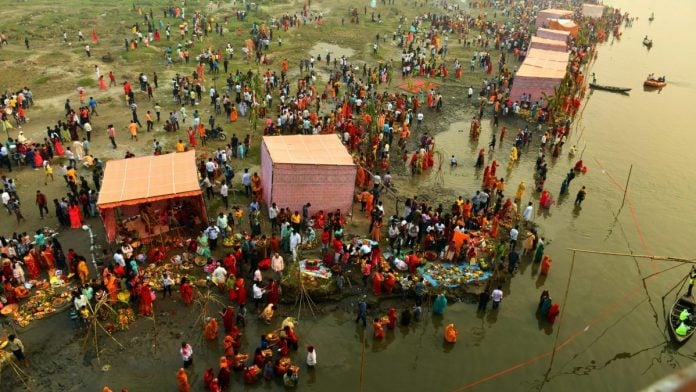
Ghats are filled with people of all castes and classes, performing rituals neck to neck; untouchability is impractical by the very logistics. (Cases of caste discrimination do still emerge from time to time.) Chhath, in its ideal form, breaks down barriers of caste, class and gender. Its universality and the equality embedded in its rituals are, I believe, what make it so resilient across distances.
It has also escaped the commercialisation that has transformed festivals such as Garba and Navratri, where the fundamentals are destroyed from within, for sheer spectacle – an unintended gift of being, strictly, the festival of the subaltern migrants and labourers.
An electric sense of community engulfs the festival. It draws back migrant labourers who have been forced to leave their families and homeland to make a living in other people’s cities. For four days, it offers some respite from the pain and humiliation of that displacement.
From Bihar to the world
A century ago, Bihari indentured labourers, practically slaves in all but name, were taken from Bihar to far-flung Caribbean islands and beyond. Today, the multinational nomination of Chhath Mahaparva to UNESCO’s Intangible Cultural Heritage list includes Mauritius, Fiji and Suriname alongside India. The festival has a visible presence in these countries, too.
Back then, crossing the seas was associated with the loss of religion. Yet, it was meticulously preserved, alongside other religious and cultural traditions despite the enormous toll it must have taken on them in a fundamentally hostile environment.
The indentured labourers came from different castes, linguistic backgrounds, and social circumstances. Many of the old boundaries gave way among the jahaji bhais (ship-brothers), much like the ghati bhais who gather at Chhath ghats today.
Today, the festival is flourishing again. The festival of Biharis, so deeply connected with the river and landscape of Bihar, finds itself on the shores of seas and oceans, still as sacred, still as essential.
Also read: Chhath Puja is becoming Bollywood’s new Karwa Chauth
The danger of being seen
That is not to say everything is cheerful. Watching The Vvaan, a Bollywood film released in 2026 that features Chhath, did fulfil my childhood wish. But it also brought new questions and deep concerns to the fore. The festival now has the visibility, and potentially the financial value, to be appropriated by elite classes. While I do want Chhath Puja to become visible, it must not be at the cost of emotional displacement of the communities who sustained it in the very first place.
With the Bihari population growing across other states, the politicisation of the festival may also be around the corner. At the same time, Chhath is losing some of its community spirit and collective character as private ghats appear on rooftops, in backyards and on verandahs, sometimes built with low cement walls or even inflatable children’s pools. Class is creeping into the festival, and the political elite in Patna seem to be encouraging this shift.
Instead of rectifying the situation of the ghats, improving the security for women and looking into the river pollution, the power class finds their peace in “private ghats” of their own, while the lower classes are left to suffer, with little administrative focus, in ghats alone.
These are questions we must ask. Sharda Sinha’s melodious voice, drawing migrants back to Bihar like moss to plump, wet wood during the monsoon, sings of the sun rising on a banana leaf: “Kelva ke paat par ugelan Surujdev.” Her voice, carried through loudspeakers, must not be allowed to drown out these questions.
Chhath Puja must remain what it is, because it gives Biharis something the world so often denies them: peace and belonging.
Shrijit Shaswat is an IIT Delhi graduate and writer interested in politics, society, literature, and culture.
(Edited by Maryam Hassan)